• About

Kathy Stoddard Torrey

~ Leadership Coach and Trainer

Kathy Stoddard Torrey

Tag Archives: #LeadershipRules #LeadYourselfFirst #Ka#sthySays

Compartmentalization

23 Tuesday Apr 2019

Posted by Kathy Stoddard Torrey in Emotional Intelligence, Leadership

≈ Leave a comment

Tags

#compartmentalize, #LeadershipRules #LeadYourselfFirst #Ka#sthySays

In a leadership workshop, we had a conversation about whether compartmentalization is a good or bad thing. We discussed some interesting perspectives.

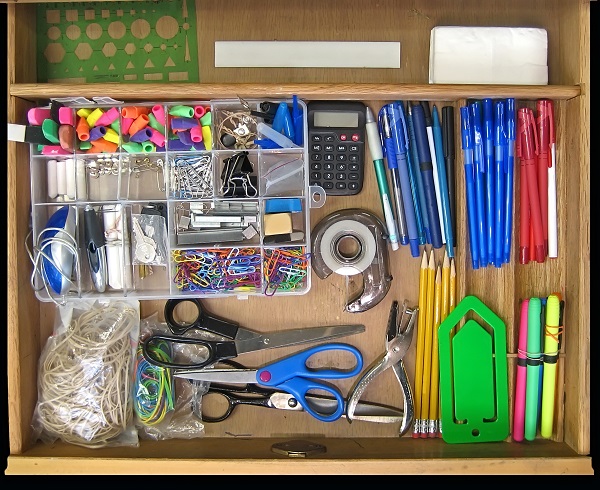
To start, let’s define what we mean by compartmentalization. When we compartmentalize, we separate objects, feelings, thoughts, or information into isolated compartments or categories. For example, I love going to The Container Store because it offers me all sorts of ways to organize the items in my life. I can separate the jumbled items in my bathroom drawer so that they are all easy to find. I am a fan of compartmentalization for items.

Information can be organized and compartmentalized for ease of retrieval and use. Databases and an organized computer desktop, for example, can make our lives much easier.

I think compartmentalization that happens outside of ourselves is good for the most part. By separating items and information into categories, we find them more easily. We require less hunting and brain power. It lowers our use of emotional pennies, which is always a good thing.

What about the internal compartmentalization that we do? It can be a healthy practice to keep our work separate from our home life. I remember reading about a man who stopped at a tree in his front yard each day when he arrived home from work. He pantomimed taking a large necklace off himself and placing it on the branch of a tree. He was mentally taking the worries and responsibilities of the day from himself and leaving them outside so they didn’t affect his time with his family. That’s a great practice!

How about the other way around? Can we leave all our home life at the door when we go to work? The answer is “not entirely.” When we refuse to share anything about our lives and our interests, we inhibit our ability to create positive relationships with people at work. We make it more difficult to create trust with our coworkers. We don’t have to share everything from home at work, but we do need to share a bit of ourselves with others.

Actually, we don’t want to share everything! We want to stay appropriate and professional. When I was in the throes of my divorce, I was in a lot of emotional turmoil. I didn’t need to share the depth of my despair or details of my personal life with participants in my workshops. It wouldn’t help them learn; it would, in fact, have been a distraction. I did tell them what was going on at the highest level that I could manage because I share stories about myself in workshops. I did not, however, share details of the situation or my emotions.

As a leader, it can be difficult to know how much to compartmentalize. Neither extreme is good for building positive work relationships. We can’t keep our lives completely to ourselves, and we don’t want to share every detail. We must find the place on the spectrum that is appropriate for us and the culture of our workplace.

Now let’s talk about when it isn’t appropriate to compartmentalize. This discussion requires us to go back to the concept of the 3rd Entity. Two or more people make us a system. This system or relationship is called the 3rd Entity in systems coaching. As a member of the system, everything that I think and feel is a part of the system. If I hold back, I am keeping something relevant to the 3rd Entity to myself.

Let’s look at an example. Let’s say that I am a member of a customer service team. I feel that we are not using the correct criteria to provide our customer service. Our conversations are timed, and we have little authority to make things right for a customer. I feel that we would be more effective if we weren’t in a rush and had some leeway on what we could offer customers. However, I keep my thoughts to myself. I am angry about the limitations, and my teammates can see my anger but don’t know what it is about.

I am compartmentalizing my anger – stuffing it down into a compartment of sorts and not talking about it. However, the anger is still present, and the system can’t do anything about it because it doesn’t know what is wrong. If the feeling, thought, idea, or information is relevant to the system, the system should know about it. If I share my thoughts and feelings, the system, my team, can then react. They may not make all the changes that I want, but by listening and sharing in a professional way, we increase the positivity of our relationship. Transparency rather than compartmentalization is usually the most effective way to keep a system (a.k.a. organization) performing at its best.

Leadership is an art, not a science. As leaders we are constantly making decisions that affect the individuals in our organization and the organization itself. How much to compartmentalize is one of those difficult decisions. Asking whether or not a potential action will benefit only us or also help the 3rd Entity in question is always a good place to start.


For a little bit of fun leadership development, join 53 Leadership Challenges at KathyStoddardTorrey.com.

Want to go further with your professional development? Check out the courses offered at PositiveEffectLeadership.com.

If you are interested in taking your career to the next level quickly, contact me for a sample coaching session at KSTorrey@tapferconsulting.com.

Slowing Your Roles

02 Tuesday Apr 2019

Posted by Kathy Stoddard Torrey in Emotional Intelligence, Leadership

≈ Leave a comment

Tags

#LeadershipRules #LeadYourselfFirst #Ka#sthySays, #roles, #systemscoaching

By email, I get daily meditations from Richard Rohr, who is a Franciscan friar ordained to the priesthood of the Roman Catholic Church. I am not Catholic, but I like his ideas and perspectives. Some I agree with, and all of them make me think. I like anyone who inspires me to stop and think about big ideas.

In one daily meditation, he talked about the roles that we take on in life. Across our lives, we can be a parent, student, spouse, friend, and worker. We talk about roles in systems coaching. In a system, which is a group of people, we all have roles.

One type of role is a positional role. I could be the boss or the accountant in an organization, perhaps both. In my family, I am the mother, grandmother, and mother-in-law. Other people within our system, and without, recognize the positional role that we embody.

Moving from one role to another can be difficult, even if it’s a change that we welcome. When my children left home, I went from full-time mother to long-distance mother. Still a mom, but an enormous shift of the heart and different use of time. When I divorced, I went from wife to divorcee. Honestly, the first time someone called me a divorcee, I felt like I’d been sucker-punched. There was a huge life shift in that change.

However, neither of those role changes are as difficult as the one that soldiers coming home from war face. Rohr wrote about what the Japanese did for their returning soldiers at the close of World War II. These men had been “loyal soldiers” for most of their lives; it was their identity. Now they needed a different role to embody.

The Japanese communities created a ceremony in which soldiers were publicly thanked and praised for their service to the people. After being honored, an elder would announce, “The war is now over! The community needs you to let go of what has served you and us well up to now. We now need you to return as a parent, a partner, a friend, a mentor – something beyond a soldier.” Rohr calls this process “discharging your loyal soldier.”

In systems coaching, we recognize the importance of honoring a person for who they are now. We call it “stroking the primary.” I know, weird term. It makes me think of stroking a puppy while telling her what a good dog she is. In truth, that is a good metaphor. We are recognizing and honoring the person for the role that they currently play or one they are grieving the loss of.

For example, retiring can be a huge challenge for people whose identity comes primarily from work. Imagine an executive whose opinions are valued highly, who has power and influence over others, and who is respected as a success in his or her field. Slipping off into retirement to become a “common” person without power and influence sounds like a terrible thing.

A first step is what we usually do for people retiring. We give them a party. We honor them and remember the contributions that they have made to our organization. Like the loyal soldiers, they are thanked profusely for their dedication.

Not every role change comes with a party. When my boys went off into the world on their own, no one threw me a Great Mom party. The kids didn’t stand around telling me how much they appreciated all that I did for them. I wasn’t remembered by teachers that I had helped or other children for my contributions to them through my volunteer activities, such as Cub Scouts and Boy Scouts. I was left to quietly struggle to shed the old role on my own.

We should celebrate moving from one role to another! We can throw our own party or create our own ceremony. I have divorced friends who struggle to switch to the role of divorcee. I could throw them a party or help them create a goodbye ceremony. It would be like the ceremony of discharging the loyal soldier. We would honor them for all their accomplishments as a spouse, recognize their sacrifices, and celebrate who they were.

For soldiers, executives, moms, and spouses, the next part is difficult. After shedding the old role, we get to decide who we are going to be now. Rohr says that the first part of our lives is doing. We do things to fulfill the roles that we take on. Later in life, we get to focus more on being. The question is not “What do I do now?” The question is “Who do I want to be now?”

Without that question, we can unintentionally become a victim. We can feel lost. There is always a grieving process when we lose something. Losing who we are is particularly painful and unsettling, especially if the change is beyond our control. Organizations make us retire, spouses don’t want to be with us anymore, children grow up – all beyond our control. Yet, we can control who we become next.

The trick, I think, is to intentionally decide who we are going to be. After my children left, I decided that I was going to focus on my career completely and find things that I enjoyed doing. I was going to be engaged in life and interested in learning.

There were some to-do’s in my list, but remembering the kind of person that I wanted to be kept me on track. I wanted to be positive. I wanted to contribute to the world in a positive way with every interaction. I wanted to be whole and happy.

When snakes shed an old skin, underneath they are the same. They have the same patterns and colors that they did before. We aren’t like that. We have the luxury to decide what we are going to look like after we shed an old role. The important thing is to consciously decide what the new us will look like – who the new us will be.


For a little bit of fun leadership development, join 53 Leadership Challenges at KathyStoddardTorrey.com.

Want to go further with your professional development? Check out the courses offered at PositiveEffectLeadership.com.

If you are interested in taking your career to the next level quickly, contact me for a sample coaching session at KSTorrey@tapferconsulting.com.

Follow Blog via Email

Enter your email address to follow this blog and receive notifications of new posts by email.

Join 214 other subscribers
  • RSS - Posts

Categories

Archives

  • December 2020
  • November 2020
  • October 2020
  • September 2020
  • August 2020
  • July 2020
  • June 2020
  • May 2020
  • April 2020
  • March 2020
  • February 2020
  • January 2020
  • December 2019
  • November 2019
  • October 2019
  • September 2019
  • August 2019
  • July 2019
  • June 2019
  • May 2019
  • April 2019
  • March 2019
  • February 2019
  • January 2019
  • December 2018
  • November 2018
  • October 2018
  • September 2018
  • August 2018
  • July 2018
  • June 2018
  • May 2018
  • April 2018
  • March 2018
  • February 2018
  • January 2018
  • December 2017
  • November 2017
  • October 2017
  • September 2017
  • August 2017
  • July 2017
  • June 2017
  • May 2017
  • April 2017
  • March 2017
  • February 2017
  • January 2017
  • December 2016
  • November 2016
  • October 2016
  • May 2015
  • April 2015
  • March 2015
  • February 2015
  • January 2015
  • February 2014
  • January 2014

Powered by WordPress.com.