• About

Kathy Stoddard Torrey

~ Leadership Coach and Trainer

Kathy Stoddard Torrey

Category Archives: #Communication

Let’s Talk: Conversation Outline

15 Tuesday Aug 2017

Posted by Kathy Stoddard Torrey in #Communication, Uncategorized

≈ 3 Comments

Tags

#Communication, #conversationoutline, #positiveoutcome

Conversation outline 4

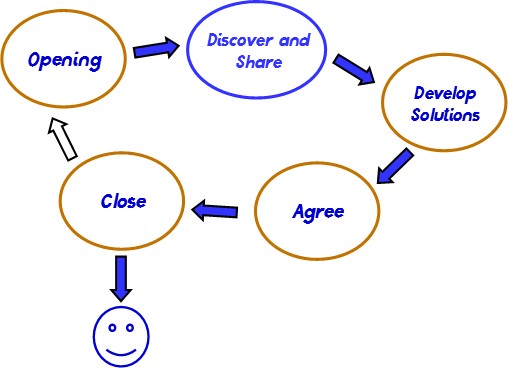
It took me a while to appreciate the power and beauty of this conversation outline. At first I thought that having a structure for a discussion was unnecessary. Boy, was I wrong! This guide keeps the conversation on track, ensures everyone has input, creates more options, and fosters positive relationships. Impressive!

Open. We open a conversation simply by stating what we are going to talk about. It helps the conversation stay on track.

Discover and Share. This is the most important step in a conversation. We often skip this step and move straight to positional arguing about the best thing to do.

In Discover and Share, we take time to listen fully by being completely present and listening for understanding. We pay attention to the words being said, tone of voice, facial expressions, and body language. We are curious about everything and ask a lot of questions.

Giving focused attention to someone is a gift. We don’t often feel like we are in the spotlight of someone’s attention, even though we like being seen and heard.

Finding out how the other person or people view the situation creates more possible solutions and helps to maintain positive relationships. We also share our perspectives and feelings during this step.

Develop Solutions. Once we have all the facts and feelings on the table, brainstorming begins. I see it as a funnel that begins with a wide variety of options and slowly narrows down to the best choice. During this phase, it’s important to continually ask what is best for the people involved in the decision – whether that is a couple, a team, a family, or an organization.

Agree. If we’ve done a good job during Discover and Share, it’s easier to come to an agreement.

Close. We check to make sure everyone is on board and explicitly state the agreement. It’s also a good time to check in one last time on how everyone is feeling about the agreement.

When having a conversation, focus on the Discover and Share step of the conversation. The other steps happen naturally and don’t need as much emphasis. The information needed to resolve conflicts never comes to light if we jump straight to developing solutions without fully listening and understanding each person’s perspective and feelings. It’s totally worth the time that it takes to be sure each person feels listened to, understood, and respected.


For a little bit of fun leadership development, join 53 Leadership Challenges at KathyStoddardTorrey.com.

Want to go further with your professional development? Check out the courses offered at PositiveEffectLeadership.com.

If you are interested in taking your career to the next level quickly, contact me for a sample coaching session at KSTorrey@tapferconsulting.com.

Let’s Talk: Facts and Feelings

08 Tuesday Aug 2017

Posted by Kathy Stoddard Torrey in #Communication, Uncategorized

≈ Leave a comment

Tags

#Communication, #factandfeeling, #LetsTalk, #listenfully

celebrate

Here is an important and life-altering piece of information: Every message and every situation have both a fact part and a feeling part. To communicate effectively, we must acknowledge both parts. I learned this lesson late in life, and it would have saved me some time and trouble if I’d known about it sooner.

For 20 years, I led volunteers as an Army spouse. In one group that met monthly, there was one young woman who always sat at my right hand and objected to everything that the group proposed. She objected on a factual level – logistics, budget, convenience, etc. She slowed us down every single month.

If I’d been savvier, I would have figured out that it wasn’t the facts that she objected to. I had a vague notion that she was unhappy or resentful, but I had no idea why. She was experiencing some feeling that I wasn’t dealing with at that time. If I’d asked and listened, I could have saved us a lot of time arguing over facts for no good reason.

In my leadership workshops, I have people work in pairs to practice recognizing the feeling part of a message. One person talks about something that arouses strong feelings for him or her. The other person listens and then comments on the facts and feelings that he or she hears. For example, the listening partner might say, “It sounds like [fact part] really frustrates you” or “Wow, [fact part] really makes you happy.”

The reactions of the speaking partners are revelatory. They say that they feel heard and understood. As humans, our personal needs are to be listened to, understood, and respected. Telling someone the emotions you sense that they are feeling powerfully meets those needs.

Don’t worry about getting the emotion wrong. I’ve never seen anyone get upset. The usual response is a pensive “No, I feel more …” The process helps them to become more aware of their emotions.

You can also just ask! Is your pre-teen refusing to wash dishes? If so, then ask how he or she feels about washing the dishes. If a coworker consistently objects to following a procedure, find out why. Don’t accept factual responses. What feelings does he or she have about the procedure?

The answers are usually surprising – something that you wouldn’t have guessed. The only way to move forward in any situation is to reveal and deal with both the fact and feeling parts.


For a little bit of fun leadership development, join 53 Leadership Challenges at KathyStoddardTorrey.com.

Want to go further with your professional development? Check out the courses offered at PositiveEffectLeadership.com.

If you are interested in taking your career to the next level quickly, contact me for a sample coaching session at KSTorrey@tapferconsulting.com.

Let’s Talk: Different Types of Communication

01 Tuesday Aug 2017

Posted by Kathy Stoddard Torrey in #Communication, Uncategorized

≈ Leave a comment

Tags

#clearcommunication, #nonverbalcommunication, #positiverelationships, #symboliccommunication, PositiveEffectLeadership

Symbolic Communication 550 px

Good communication with ourselves and others is a fundamental piece of a successful life. In coaching and in leadership workshops, communication is the most challenging topic; it’s also one that’s easy to work on. We can get better at getting our point across.

Back in 1972, Professor Albert Mehrabian said that our message is 7% words, 38% voice, and 54% body language. The only important thing to remember here is that our nonverbal communication has a huge influence on our message.

Nonverbal communication includes facial expression, tone of voice, and body language. If I say “I am so glad to be here” in a sarcastic tone while rolling my eyes and looking at my watch, you won’t believe my words. That’s so interesting! If the nonverbal and verbal messages are not aligned, then we go with the nonverbal message! Our words have no meaning when the nonverbal message contradicts them!

We want to be careful with the words that we use; however, we also need to pay close attention to our nonverbal messages. Crossed arms and stern looks can make us appear unapproachable or judgmental. If we deliver bad news while smiling, we send a very confusing message. It’s important that we intentionally align our verbal and nonverbal messages.

There is a third way that we communicate other than verbally and nonverbally; it is symbolic. We do a whole lot of communicating symbolically with our clothes, jewelry, shoes, hairstyles, backpacks, water bottles, fingernails, cars, and even our homes. We are telling the world something about ourselves with every symbolic choice that we make.

It’s important that our symbolic messages are intentional and appropriate. We cannot ignore the fact that we tell people about our commitment to a job with our clothes. If I show up to work in wrinkled clothes with my shirt untucked and hair that looks like I just tumbled out of bed, then I am sending the message that I’m not professional and don’t take my job seriously. That message might not be entirely true, but it’s still the message that I’m sending.

It’s also a good idea to pay attention to how your things (e.g., clothes, jewelry, bags) make you feel. You even send symbolic messages to yourself.

Speaking of talking to yourself, we all have a little voice in our head. How that voice talks to us can make a huge impact on our confidence and self-esteem. Negative self-talk can be a very destructive force. There are some things that we can do to improve the way we talk to ourselves.

Begin by asking yourself if you would talk that way to a friend. Would you say, “You are stupid and incompetent!” to someone you care about? Of course not! If you wouldn’t say it to your best friend, then don’t say it to yourself.

Studies have shown that talking to yourself using “you” or your name as if talking to a friend increases confidence, performance, and anxiety. For example, instead of “I can do this!”, I say, “Kathy, you can do this!” It’s an easy shift to make. No one knows exactly why this works, but it does, so let’s run with it.

Talking to ourselves as we would to a friend and using “you” and our names help to put us in an observer role, which is another way to battle negative self-talk. In one study, psychologists had people stand in the mirror and comment on themselves. If a person said, “I am a fat blob with a jiggly belly,” the researchers would ask them to state factual information as an observer. The participant could say, “I have a round abdomen.” Observing factually leads to action more often than negative self-talk does.

Lastly, we can name our inner voice. In coaching, we call it a Gremlin, and it seems intent on sabotaging our efforts. Many times, our Gremlins are trying to keep us safe. My Gremlin might say, “Don’t put in a proposal for that job. You won’t get it, anyway.” It’s trying to save me the pain and disappointment that I would experience if I didn’t get it. I can tell my Gremlin, “Thanks! I know you are trying to save me some emotional pain and disappointment, but I’ve got this! If I don’t get it, it will be OK.”

The first step in communicating is becoming aware of the different ways that we send messages to ourselves and others. The second step is to be intentional in the message and the way that we deliver it. This perspective gives “Watch your language!” a whole new meaning.


For a little bit of fun leadership development, join 53 Leadership Challenges at KathyStoddardTorrey.com.

Want to go further with your professional development? Check out the courses offered at PositiveEffectLeadership.com.

If you are interested in taking your career to the next level quickly, contact me for a sample coaching session at KSTorrey@tapferconsulting.com.

Newer posts →

Follow Blog via Email

Enter your email address to follow this blog and receive notifications of new posts by email.

Join 214 other subscribers
  • RSS - Posts

Categories

Archives

  • December 2020
  • November 2020
  • October 2020
  • September 2020
  • August 2020
  • July 2020
  • June 2020
  • May 2020
  • April 2020
  • March 2020
  • February 2020
  • January 2020
  • December 2019
  • November 2019
  • October 2019
  • September 2019
  • August 2019
  • July 2019
  • June 2019
  • May 2019
  • April 2019
  • March 2019
  • February 2019
  • January 2019
  • December 2018
  • November 2018
  • October 2018
  • September 2018
  • August 2018
  • July 2018
  • June 2018
  • May 2018
  • April 2018
  • March 2018
  • February 2018
  • January 2018
  • December 2017
  • November 2017
  • October 2017
  • September 2017
  • August 2017
  • July 2017
  • June 2017
  • May 2017
  • April 2017
  • March 2017
  • February 2017
  • January 2017
  • December 2016
  • November 2016
  • October 2016
  • May 2015
  • April 2015
  • March 2015
  • February 2015
  • January 2015
  • February 2014
  • January 2014

Powered by WordPress.com.