
• About

Kathy Stoddard Torrey

~ Leadership Coach and Trainer

Kathy Stoddard Torrey

Category Archives: Emotional Intelligence

Stress and Polyvagal Theory (Part 1)

12 Tuesday May 2020

Posted by Kathy Stoddard Torrey in Emotional Intelligence, Leadership, Uncategorized

≈ 1 Comment

Tags

#LeadershipRules #LeadYourselfFirst #KathySays, #learning, #polyvagaltheory, #stress

angry old woman 1K px

I was recently talking to a friend who is also a coach. I said to her, “I think I just need to accept the fact that I am an angry old woman. I am angry all the time!”

Her response was, “Me, too!”

I know enough to be leery of my own self-assessments, but I also know that my friend is not normally an angry person. I started listening to how other people were feeling. Many friends and acquaintances talked about not sleeping well and being short-tempered. Others felt panicky or depressed. It wasn’t just me!

Of course, the obvious answer is that we are all under a lot of stress during a pandemic. Duh! The bigger question is “what can we do about it”? Before we can come up with an action plan, we need a useful way to look at stress and its effects on our bodies.

As is often the case, I found the answer on my bookshelf. It’s not unusual for me to order books on a topic and have them sit on the shelf for a while. Then, suddenly I will want the information in them. Sitting on my shelf this time were two books on polyvagal theory.

Don’t run off! When I say “polyvagal theory,” people’s eyes glaze over, and they check out on me. Please don’t. The topic sounds dry and boring, but it gives us handles that we can use to move around and examine our pandemic stress.

I am going to un-science polyvagal theory a bit. If you are familiar with it, don’t mess with me for simplifying it. It’s important to me to make it useful. Here goes.

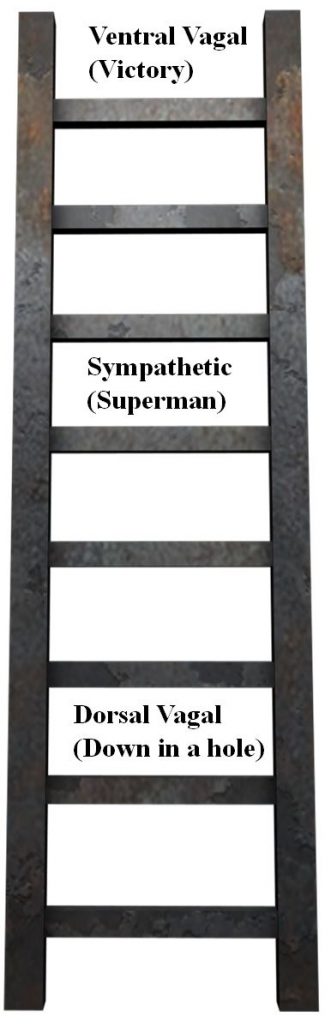
Part of our nervous system works on its own to regulate our basic bodily functions, like heartbeat, breath, and digestion. It’s called our autonomic nervous system. Our autonomic nervous system operates in three basic states.

When we are depressed, hopeless, or without energy, we are in the dorsal vagal state. Think of it as down in a hole. The world looks bleak, and we disassociate from other people when we are down in the hole.

When we are frightened or angry, our sympathetic nervous system has taken over. Most of us know it as the “fight or flight” state. We are on high alert, anxious, and expending a lot of energy. We are also angry a lot of the time about almost anything. I think of it as Superman on High Alert, looking for danger and bad guys.

Of course, neither of those is the state that we want to be in. We want to be peaceful and feel empathy. We want to be engaged and passionate while acting with compassion towards ourselves and others. That highest state is the ventral vagal state. Think “V” for victory. When we are in the ventral vagal state, we are more creative and open-minded.

autonomic state ladder

In one book that I read called The Polyvagal Theory in Therapy, author Deb Dana uses a ladder to visualize the three states. I like her metaphor and highly recommend her book if you want to learn more about polyvagal theory.

So here is a ladder with the three states. We move up and down the ladder one rung at a time. It’s not unusual to move through the three states many times during a day. However, we want to make the ventral vagal state at the top our home base.

Staying in the ventral vagal state can be a challenge right now because of COVID-19, which has moved us all down a rung or two from where we usually hang out. Even if I am usually in a ventral vagal state, our new normal is scary and unnerving. Moving down to the sympathetic nervous or dorsal vagal state is completely understandable.

So, what can we do to move up a rung or two when we feel anxious or depressed? Dana has some great suggestions in her book, and I have already used several to help myself become less angry and more at peace. I also have a few ideas of my own. Tune in next week for a list of suggestions!

In the meantime, practice noticing what state you are in at any given moment. Awareness is the first step!


For a little bit of fun leadership development, join 53 Leadership Challenges at KathyStoddardTorrey.com.

Want to go further with your professional development? Check out the courses offered at PositiveEffectLeadership.com.

If you are interested in taking your career to the next level quickly, contact me for a sample coaching session at KSTorrey@tapferconsulting.com.

Lower the Bar

05 Tuesday May 2020

Posted by Kathy Stoddard Torrey in Emotional Intelligence, Leadership, Uncategorized

≈ Leave a comment

Tags

#LeadershipRules #LeadYourselfFirst #KathySays, #lowerthebar, #reasonableexpectations

lower the bar dog 1K px

It’s unusual for a leadership coach and trainer to advocate lowering one’s standards, but these are unusual times. I talk about situational leadership in workshops all the time. As leaders, we must change our style to fit the experience of the people who we are leading and the importance of the task being done. Now I’m promoting situational standards.

I am not talking about changing our moral code. The standards that we hold for ourselves involving integrity, honesty, and transparency must not waver. I am talking about goals and expectations that we set for ourselves around achievement.

At the beginning of self-isolation, I created an ambitious list of things to accomplish both professionally and around my condo. I had categories and priorities. It was actually quite impressive! And I ignored it for the most part. I did what needed to be done, but not much more.

I beat myself up about my lack of motivation and achievement and then realized that I was truly doing the best that I could under the circumstances. I also realized that self-shaming was not helping. So, I lowered the bar on how I spent my time and how I felt.

First, I allowed myself to slow down quite a bit. Instead of maintaining a frenetic sense of achievement where I was always accomplishing something, I sat for short periods of time watching television or playing my beloved Plants vs. Zombies. I even added Sudoku to my repertoire. I still did what was necessary, but at a slower pace with more breaks. My productivity increased because I was more relaxed.

I also began with ambitious fitness goals that included using my stretchy resistance bands. I realized pretty quickly that those goals weren’t going to happen. The bands are still unstretched. So, I lowered the bar. When I stood up from working at the computer, I did five squats. When I passed through a doorway, I did 10 push-ups against the frame.

It doesn’t sound like much exercise, but even a little movement is an excellent antidote to malaise. When you start, you feel better. Then you can take on bigger goals. Now I’m incorporating yoga into my daily routine.

I am also talking about giving ourselves a break in maintaining our professional, calm demeanor. Of course, we never want to lose our cool, but these are some stressful times that challenge us physiologically (which we will discuss next week). When we feel that we are about to say or do something that could damage a relationship, it’s okay to call for a break or take a walk. We leaders are humans, with limits that are lower in stressful times.

If we do say or do something that we regret, it’s important to acknowledge it, apologize, and revisit the discussion in a calmer way. It’s best to apologize immediately and ask for a break, but if that’s not possible for you, those steps can be taken after stepping away and calming down.

Of course, all of this applies at home, as well. Right now, we are spending an inordinate amount of time with family. It’s natural to get on one another’s nerves. Add on the stressful feelings we all have about the pandemic, and we have created a volatile emotional cocktail. I can only imagine the added stress of homeschooling. I did homeschool my boys for a few years and know the work it involves under normal circumstances. I feel great empathy for parents. You can do this!

Our world is already different, and great leaders change as needed. We will come out on the other side as transformed as our society. None of us knows exactly what that will look like, but it’s important to give ourselves a break during the transition.


For a little bit of fun leadership development, join 53 Leadership Challenges at KathyStoddardTorrey.com.

Want to go further with your professional development? Check out the courses offered at PositiveEffectLeadership.com.

If you are interested in taking your career to the next level quickly, contact me for a sample coaching session at KSTorrey@tapferconsulting.com.

60th Birthday Reflections

31 Tuesday Mar 2020

Posted by Kathy Stoddard Torrey in Emotional Intelligence, Leadership, Uncategorized

≈ Leave a comment

Tags

#60thbirthday, #LeadershipRules #LeadYourselfFirst #KathySays, LifeLessons

60 bday 1K

Today is my 60th birthday. Birthdays that end in “0” make us want to reflect on our lives and our accomplishments. I am no exception – and I have more time than usual for some introspection. Here is my list of life lessons learned:

1. Let kindness and honesty be your guides. These two considerations must be taken together. Brutal honesty all the time is not kind, and not necessary. On the flipside, we can believe that leaving someone in the dark is kind, but honesty is usually much better. There is a balance to consider.

I keep way more things to myself than I did in my younger years. No one wants or needs to hear my opinions on every little thing. However, sometimes I feel a need to speak up. The questions I ask myself are: “Will knowing this help the other person in the long run?” and “Am I saying it for them or for my own ego?”

Everyone has to make their own decisions on how much honesty is kind. I tend to lean toward truth and appreciate it when others do the same with me. In my experience, people figure stuff out eventually. When they discover that you’ve known all along, there is a breach of trust that can never be fully repaired. Trust is the commodity of relationships.

2. Exercise self-control. Exercise is the appropriate word here because the more we use our self-control, the stronger it gets. Without self-control, we can’t honor #1 on the list because we are always blurting and giving in to our ego’s needs.

The big regrets that I have in life are when I lost my temper and lashed out at someone. It doesn’t happen often anymore, but I still feel bad about a few times when I lost control and yelled at my children when they were young.

3. Self-care is crucial. We cannot exercise self-control and make intentional choices around kindness and honesty if we don’t take care of ourselves. My biggest losses of self-control happened when several things in life were not going well. Stress puts us on edge and robs us of our ability to see the big picture and choose our words and actions wisely.

The antidote for stress is self-care, which will look different for each of us. For some people, self-care includes running or walking. For others, it means writing or drawing. We all need to have more than one self-care technique in our lives that allows us to center and regroup. Meditation is one great self-care technique that has tons of research proving its benefits.

4. Spend your emotional pennies wisely. I try not to spend emotional pennies on things that I cannot influence or control. If I can control it, I can change it. If I can influence it, I must decide if changing the thing is worth the emotional pennies that it will cost.

The most helpful phrase for me when conserving emotional pennies is “the chair is a chair.” You can read my blog on the quote from Triggers by Marshall Goldsmith. Basically, it means that certain people and situations are not going to change, and it’s best for me if I accept that.

5. Connect with others. I learned this one late in life. We humans crave connection with each other. I have always accepted the value of rugged individualism and was determined in my youth to make it on my own. Sixty years have shown me that it is impossible to make it on your own. Success happens with the support of a community.

Happiness also happens with the support of a community. The micro-moments of positivity we share with others are one type of building block we need to build a positive outlook on life.

6. Prepare for the worst, but expect the best. I am a firm believer in being prepared if everything goes to hell in a handbasket. However, I don’t believe in dwelling on the possibility. It’s important to assess, prepare, and then focus on a positive outcome that we want.

I ordered gloves and masks well before there was a shortage and then went on not thinking about it. I bought an extra six-pack of toilet paper at the grocery store while plenty was on the shelf but didn’t stress about it.

On a grander scale, when I was a stay-at-home mom, I put the utilities in my name to build credit. I went back to school and got my MBA. My goal was to be able to jump to self-sufficiency if anything happened to my then-husband. He would get irritated with me and insist I expected the worst of him. I pointed out that he could be hit by a bus on any given day. The fact that he was in the Army made his demise more likely than many others.

However, I never dwelt on the possibilities of my ex’s death or infidelity. I just prepared for the worst and went on living life and expecting everything to go well. The worst did eventually happen. I am grateful for a life of not expecting it – and for being prepared so I could move to self-sufficiency with relative ease.

7. Work to be vulnerable and loving despite the cruel blows that you will suffer. First, everyone suffers cruel blows in life. Cruel blows are a part of life. I’ve learned that it’s best to expect them and to not take them as personal affronts. Suffering disappointment, humiliation, and failure makes us human and more empathetic to the plight of others. Suffering is also an opportunity for growth.

And if you just scoffed or huffed at me, I totally get it. It sounds like a superficial platitude to me, as well, but that doesn’t make it any less true. I chose the word “work” for a reason. As far as I am concerned, putting my heart out on the line, knowing it will be crushed again, is work. It’s not easy at all and it’s a constant challenge.

Brenė Brown’s research on vulnerability helps me. She talks about the courage required to put yourself out there as a possible target for ridicule and deception. Maintaining that courage is work, but it’s worthwhile work. We cannot live a life full of joy and accomplishment if we live safely protecting our hearts. She talks a lot about this quote from Theodore Roosevelt:

“It is not the critic who counts; not the man who points out how the strong man stumbles, or where the doer of deeds could have done them better. The credit belongs to the man who is actually in the arena, whose face is marred by dust and sweat and blood; who strives valiantly; who errs, who comes short again and again, because there is no effort without error and shortcoming; but who does actually strive to do the deeds; who knows great enthusiasms, the great devotions; who spends himself in a worthy cause; who at the best knows, in the end, the triumph of high achievement, and who at the worst, if he fails, at least fails while daring greatly, so that his place shall never be with those cold and timid souls who neither know victory nor defeat.”

As I look back over the last 60 years, I haven’t been timid very often, but I have become bitter at times. Since I’m reviewing things that greatly influenced how I live, I feel I must include these charts from Richard Rohr, a Franciscan friar ordained to the priesthood of the Roman Catholic Church.
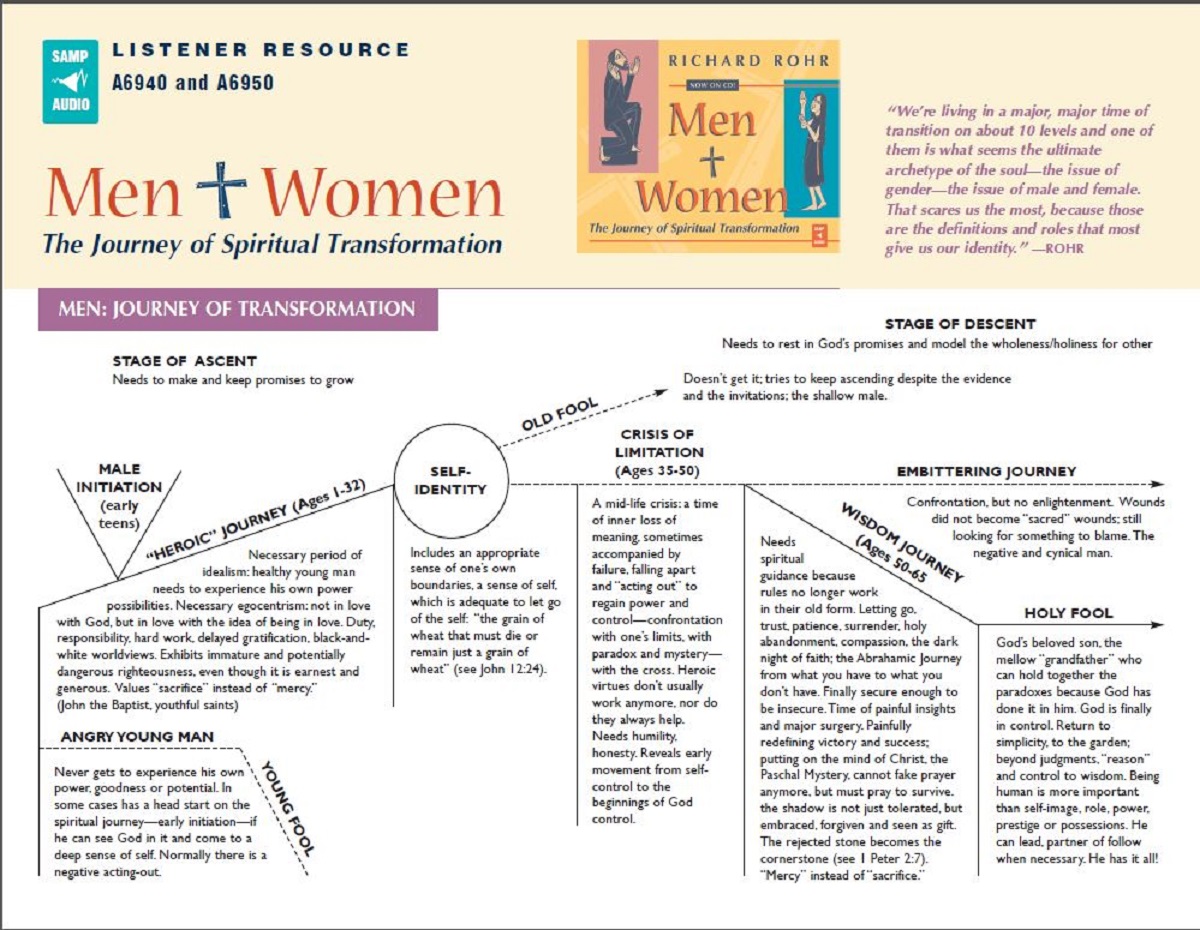
Men's Journey (Rohr)

Women's Journey (Rohr)

Side note: These graphs depict different paths for men and women. I believe that this is because of how we are socialized, not because of major, inherent differences. I also hope that younger women find that their path is not so different as the one Rohr describes for men. I can’t speak to their experiences, but the graph resonates with me and my experience in many ways.

I discovered these graphs in my oldest son’s coat pocket when I was in my late 40s. (I was about to wash his coat per his request – not snooping!) They changed the trajectory of my life. I could see clearly that if I did not change, I was headed for the Embittering Journey, and I didn’t want to end my life bitter and resentful. I worked to embrace joy and acceptance.

Now at 60, I find myself in danger of becoming the “Witch on Her Broom” who is filled with rage. The last bit – “going nowhere – except to blame others and protect herself” – is a particular danger for me right now. That’s why Brown’s writings about vulnerability resonate with me.

My life lessons list, which is as much a list of goals for living my life as anything else, is a result of wanting to become a Holy Fool. I want to “live with paradox and mystery, with compassion and forgiveness.”

I know all of those things are mine if I make some intentional choices. I love the Magic Wand of Destiny!


For a little bit of fun leadership development, join 53 Leadership Challenges at KathyStoddardTorrey.com.

Want to go further with your professional development? Check out the courses offered at PositiveEffectLeadership.com.

If you are interested in taking your career to the next level quickly, contact me for a sample coaching session at KSTorrey@tapferconsulting.com.


The PERSONAL Integrity Test of COVID-19

24 Tuesday Mar 2020

Posted by Kathy Stoddard Torrey in Emotional Intelligence, Leadership, Uncategorized

≈ Leave a comment

Tags

#COVID-19, #LeadershipRules #LeadYourselfFirst #KathySays, #outrage, #responsibility, integrity

COVID-19 2 1K px

Last week I talked about the importance of businesses maintaining customers’ trust during the current pandemic. Now, I want to get a little more personal. Let’s talk about our actions as leaders. So far, many of the examples during this crisis are not good.

The most heinous and trust-busting actions have come from our elected officials. There is a group of senators who knew of the coming pandemic. Did they take actions to prepare the United States of America? Did they consider the health of their own constituents? Nope. They sold stocks. They knew the market would crash, and they took care of themselves and a few wealthy donors.

In case you aren’t clear, this is horrendous leadership behavior. It is actually outrageous. Our response to this sort of action by our leaders should be outrage! Leaders have power, and with great power comes great responsibility. I cannot think of a punishment great enough for people who put personal monetary gain over the health of people depending on them. Seriously. This is an epic leadership fail for the ages.

The examples go down in the seriousness of their consequences, but not the display of bad judgment. Jeff Bezos owns Amazon, which owns Whole Foods, and he makes $8,961,187 an hour. He sent out a memo to Whole Foods employees, urging them to share paid time off with employees who become ill. Hmmm. This is a double-whammy of bad judgment.

First, grocery store employees are part of our frontline. We all need food and depend on grocery stores to provide it. Bezos can easily afford to cover paid sick leave for anyone who falls ill during the pandemic. In this instance, he is not taking care of the people who create his wealth or earning their loyalty or trust.

As a Whole Foods customer, I feel he isn’t doing much for me, either. He is encouraging people to work while they are sick, because no one wants to go without pay if they can avoid it. As a result, he is putting my health at risk by not ensuring that only very healthy people are handling my food. He has lost my trust as a customer, as well. He doesn’t seem to think that I or his employees matter very much.

I get a lot of emails from what I call the “Woowoo Community.” Some of the people in it have made a lot of money helping people feel better about themselves and even feeling better through alternative health options. I’m seeing a lot of “We’re in this together, so I am offering my deal at half off.” Hmmm. How generous. These are people who claim to care about my well-being but are really looking at the pandemic as a marketing opportunity. Shame on you! Offer your deal for free if you really want to help. Otherwise, keep it the same price and stop pretending that you care about my well-being.

I could go on and on with truly outrageous examples of poor leadership during this time of vulnerability. I think that it is high time that we got outraged about a lot of it! Leaders acting without integrity is one of the things that pushes my buttons and invites me to throw a lot of emotional pennies in a very forceful way. I’m working on using my emotional pennies in ways that will move us all forward to a good outcome. Sometimes it’s about using emotional pennies wisely for a good cause, not trying to avoid spending any at all.

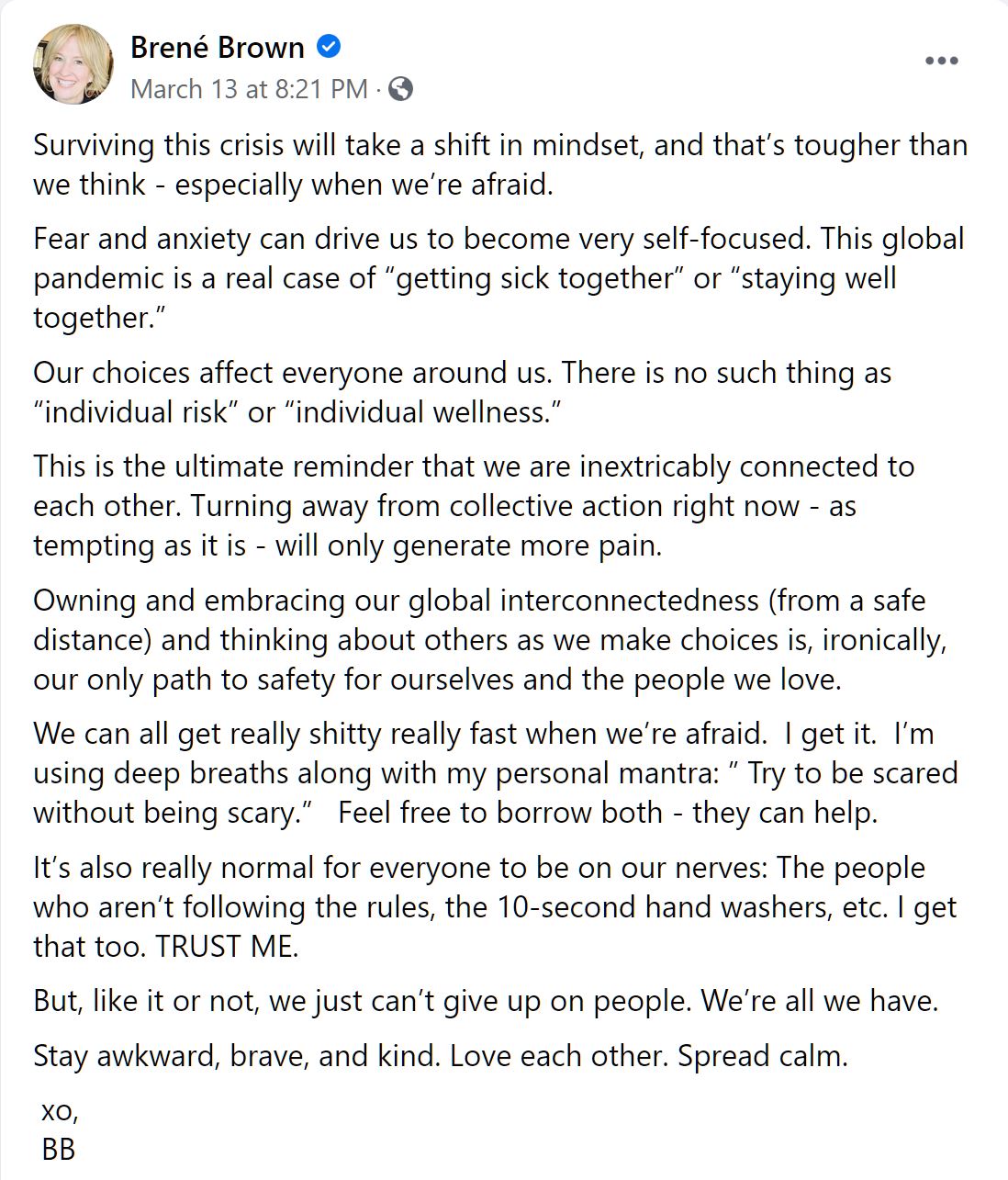
However, there are some bright spots out there. One is Brené Brown. A recent Facebook post from her is below. I agree with her assessment and advice 100%.

brene brown FB

Down on the frontlines, there are examples of humans being humane. These are true leaders. All of our healthcare workers and their families are making great sacrifices for the greater good. One of our local mayors is working tirelessly, and with a little ferocity, to make sure people don’t go hungry. Someone in my condo association put up a message offering to deliver food or run errands for anyone unable to go out. Even those who stay home are showing integrity and care for others. Sometimes it takes a lot of courage to face ourselves without any distractions.

Here is the bottom line:

  • Leaders with great power have a huge responsibility to use that power for the good of all – not just personal gain. I don’t mind people making money, but it should never be at someone else’s expense. And no one should ever receive personal gain through the abuse of power given to them as an elected official.
  • Those of us without great power can make a difference by holding leaders responsible for their actions. It’s important that we call out outrageous and unacceptable behavior.
  • Lastly, we can help. We are all leaders, and as Brené Brown says: “Our choices affect everyone around us. There is no such thing as ‘individual risk’ or ‘individual wellness.’”

Our best choices are kindness, compassion, and a dogged determination to ensure our leaders – with power and information that we do not have – act appropriately for the good of us all.


For a little bit of fun leadership development, join 53 Leadership Challenges at KathyStoddardTorrey.com.

Want to go further with your professional development? Check out the courses offered at PositiveEffectLeadership.com.

If you are interested in taking your career to the next level quickly, contact me for a sample coaching session at KSTorrey@tapferconsulting.com.
Integrity and Your Golden Ruler

10 Tuesday Mar 2020

Posted by Kathy Stoddard Torrey in Emotional Intelligence, Leadership

≈ Leave a comment

Tags

GoldenRuler, integrity, rationalization, success, values

Integrity meme

NOTE: This is a blog that I wrote back in 2015, but the topic has come up a lot lately.

We are happier, more confident, and more successful when we live in alignment with our values. Imagine a ruler that shows the values that are most important to you. I call mine my Golden Ruler.

Ideally, we want to hold each action that we are considering against our Golden Ruler and see if the action is in alignment with our values. For example, kindness is one of my main values. I want to be kind and be known as a kind person. However, I have a tendency to be a little snarky and sarcastic sometimes. I’m hilarious when I’m snarky, but the laugh is short-lived and I don’t feel good about the action because it’s not in alignment with my values. If I stop and ask myself, “Am I about to say something unkind?” I am measuring my possible action against my Golden Ruler. I feel better about myself and my life when my actions are in alignment with the values of my Golden Ruler.

In my leadership seminars, we talk about our values quite a bit. It’s important to know what your Golden Ruler looks like! We talk about how we want to be remembered when we are gone and what qualities we want to define us. We talk about specific examples of how we live those values. Then I ask them to tell a partner about one time when they didn’t live their values.

Without fail, everyone has to tell the story around the action. They explain why they “had” to do what they did that one time. They RATIONALIZE the behavior. That’s the red flag. If you hear yourself rationalizing a behavior, you are convincing yourself to go against your own values. You aren’t rationalizing behavior that goes against my values or your neighbor’s values, you are rationalizing to yourself in order to make it OK to violate your own values. This was a major revelation for me.

The concept really hit home for me when I was working with a particularly difficult group. This group was always late. Management did not support the training. People drifted in and out and no one really paid attention. It was the worst group I ever encountered in a decade of training in industry. When I was getting ready for one of our sessions I thought, “Why am I bothering to prepare? They are never on time. They don’t really care. There is no good reason for me to spend time prepping for them.” Wow. Then it hit me. Being prepared and professional is important to me; it’s who I am! I was letting other people’s actions and attitudes influence my actions. I was letting them influence who I was and how I showed up in the world. Scary!

The phrase I use in leadership workshops is “Rationalization is bad judgment’s best friend.” We use bad judgment when we violate our own code of conduct and make it OK by rationalizing it. Rationalizing a behavior helps us sidestep that fact that we are using bad judgment.

Acting in alignment with the values on our Golden Ruler is acting with integrity. We are doing what we feel is right no matter what the circumstances are. Integrity is a solid, constant thing that lives within us. We are happier, more fulfilled, and more successful when we remember that we have the power to choose our actions no matter what the rest of the world is doing.


For a little bit of fun leadership development, join 53 Leadership Challenges at KathyStoddardTorrey.com.

Want to go further with your professional development? Check out the courses offered at PositiveEffectLeadership.com.

If you are interested in taking your career to the next level quickly, contact me for a sample coaching session at KSTorrey@tapferconsulting.com.

Better to Be Warm or Competent?

03 Tuesday Mar 2020

Posted by Kathy Stoddard Torrey in Emotional Intelligence, Leadership, Motivation, Uncategorized

≈ Leave a comment

Tags

#LeadershipRules #LeadYourselfFirst #KathySays, #strengthvswarmth, #trust

businesswoman leader welcomes you with a handshake in her group

Research shows that we determine how we feel about leaders based on two factors: how lovable they are, and how fearsome they are. These two dimensions account for 90% of the impression that a leader makes on us.

Lovability includes things like warmth, communion, and trustworthiness. Fearsomeness includes strength, agency, competence, and confidence. According to a Harvard Business Review article by Amy Cuddy, Matthew Kohut, and John Neffinger (titled “Connect, Then Lead”), we care about these two qualities because they answer two important questions:

  1. What are this person’s intentions toward me?
  2. Is he or she capable of acting on those intentions?

I know many leaders who actively work to project strength and competence. I don’t see as many who worry about how warm they seem. According to the research, they are missing the boat.

Leaders who are competent but lack warmth can elicit envy in others. Envy creates both respect and resentment. We will follow that type of leader but judge any missteps harshly. In addition, we don’t trust leaders who don’t seem to care about us. We are more likely to fear them, and fear makes us less creative and less resilient. A leader who inhibits people’s problem-solving abilities can’t be classified as extraordinary.

The research shows that it is better to start with warmth in order to create a positive and lasting influence. Our personal needs are to be listened to, understood, and respected. When leaders meet those personal needs, they help to create trust and the positive relationships upon which great leadership depends.

I found one study by organizational psychologists Andrea Abele and Bogdan Wojciszke particularly telling. When leaders were asked what type of training they would like for themselves, they chose training based on competency and skills. When asked what training others should take, they picked soft-skills training.

In another experiment, they asked leaders to describe an event that shaped their self-image. They listed achievements that highlighted their competency and knowledge – things like earning an advanced degree or a pilot’s license. When asked to describe a similar event for someone else, they chose something that focused on the person’s warmth and generosity – things like volunteer activities and helping others.

I’m not sure why we don’t value compassion and generosity in ourselves. Maybe we believe that we have it already. From working with scores of leaders, and quite a bit of work on myself, I know that we rarely have an accurate self-image.

Here is a quote from “Connect, Then Lead” that helps to explain the power of warmth:

“But putting competence first undermines leadership: Without a foundation of trust, people in the organization may comply outwardly with a leader’s wishes, but they’re much less likely to conform privately – to adopt the values, culture, and mission of the organization in a sincere, lasting way. Workplaces lacking in trust often have a culture of ‘every employee for himself,’ in which people feel that they must be vigilant about protecting their interests.”

The authors are describing psychological safety! One of my favorite soapbox topics! Without psychological safety, teams, groups, and organizations cannot excel. The authors tell us that one way to promote psychological safety is to lead with warmth and show people that we care about them.

They describe the ideal as a “Happy Warrior” who starts by showing warmth and then demonstrates their competence and strength. Cuddy, Kohut, and Neffinger write, “Happy warriors reassure us that whatever changes we may face, things will work out in the end.” Not many people love change, but we face it with more ease when we believe that our leader has our back.

The bottom line is that we willingly follow leaders whom we trust to have our best interests at heart and who also have the strength and competence to be effective.


For a little bit of fun leadership development, join 53 Leadership Challenges at KathyStoddardTorrey.com.

Want to go further with your professional development? Check out the courses offered at PositiveEffectLeadership.com.

If you are interested in taking your career to the next level quickly, contact me for a sample coaching session at KSTorrey@tapferconsulting.com.

Don’t Yuck My Yum

25 Tuesday Feb 2020

Posted by Kathy Stoddard Torrey in Emotional Intelligence, Leadership, Uncategorized

≈ Leave a comment

Tags

#DontYuckNyYum, #LeadershipRules #LeadYourselfFirst #KathySays

Yuck my yum 1K px

I recently came across the phrase “don’t yuck my yum” in a third grade classroom. I had to ask what it meant. The explanation that I got went something like this: If you tell me that you like Pokémon cards and I say that Pokémon cards are stupid, I am yucking your yum.

At first glance, it seems pretty straightforward. I might translate it to “Don’t rain on my parade.” Whether it’s a yum or a parade, we don’t like people belittling us for liking something. I found a great video about the effects of childhood yucking-someone’s-yum here.  We are shaming and shoulding on others when we yuck their yum. Not cool.

However, I am a curious and cantankerous person by nature, and I began thinking about all the angles of yucking a yum. Does that mean that I cannot express an opinion about something that you like if I don’t share your enthusiasm? Must I pretend to like what you like so I don’t hurt your feelings?

I’m afraid that I am guilty of yucking a lot of yums if stating that I don’t like something fits the criteria. To me, I am stating a fact. You like it, I don’t. No big deal. A friend and fellow coach confirmed my feeling on the issue. She said, “Sometimes I tell you about a recipe that I like, and you say that it has too many steps and ingredients for you to do it. I know that you don’t like to cook, and I don’t feel like you are inferring that my recipe is bad or that you disapprove of my liking to cook.”

However, not everyone is a fellow coach who doesn’t take things personally. I can see how a sensitive person or a person who doesn’t know me well could feel that I’m yucking their yum when I state that I don’t like something. I am going to be a little more aware of how I share my opinions in the future, but I do believe that we are all entitled to our feelings and opinions!

The difference is whether we are sharing how we feel about something or dissing the something in question. I can say that I don’t enjoy playing Pokémon, and that’s fine. I can say that Pokémon cards are stupid, not fun, and only babies play the game; that is not fine.

Another thing to consider is: Do we have to share our opinions all the time? Must I tell you what I like and don’t like? We can build positive relationships by being curious about a topic, even if we don’t like it ourselves. I could ask, “What is your favorite Pokémon card?” or “What is the best part of playing the game?” I might find I could like it more than I initially thought. I don’t have to tell the person that I don’t care for it right off the bat.

So let’s go to the other extreme: I really like you, and I’m trying to build a relationship with you, so I never yuck your yum or tell you that I don’t like stuff that you like. I am not being authentic. In fact, I could be misleading you quite a bit about who I am. If you like to hike and I just go along with you in order to be with you, there may eventually come a time when I’m tired of pretending and tell you that I don’t like to hike. You would probably be surprised and a little hurt that I had, not lied exactly, but not been totally honest.

From a leadership and relationship perspective, yucking someone’s yum is like most leadership and relationship concepts – it requires awareness of the situation, emotional intelligence, and some good judgment. Most of the time if someone is telling us about something that they like, we can just get curious and ask questions. If they ask us to join them, then we can state that, although it’s wonderful that they like it so much, we would not be interested. Not yucking someone’s yum is a worthy goal – and it doesn’t mean that we must be inauthentic or not set boundaries.


For a little bit of fun leadership development, join 53 Leadership Challenges at KathyStoddardTorrey.com.

Want to go further with your professional development? Check out the courses offered at PositiveEffectLeadership.com.

If you are interested in taking your career to the next level quickly, contact me for a sample coaching session at KSTorrey@tapferconsulting.com.
How do I seem to you?

18 Tuesday Feb 2020

Posted by Kathy Stoddard Torrey in Emotional Intelligence, Leadership, Uncategorized

≈ Leave a comment

Tags

#impressionmanagement, #LeadershipRules #LeadYourselfFirst #KathySays, #self-awareness

apple pear mirror cropped

We’ve talked about impression management as one of the pieces of our decision rulers. We have a vision of how we want to be perceived by others, and most everything we do and say is calculated to ensure that others see us in that way. However, how we want to be seen and how we are really seen by others can be vastly different.

One of the challenges to becoming an extraordinary leader is getting an accurate picture of how we are perceived by others. We believe that we project a certain image, but people’s perceptions of us can be quite different.

For example, I might believe that I am a confident and knowledgeable person. However, most people may perceive me as being an arrogant know-it-all. The difference between my intent and others’ perceptions might not be as drastic as this example, but they are rarely the same.

We can discover how we are seen by others, but it takes some courage and an open mind. We must pay attention to the reactions that we get from other people and the things that they say about us.

One time, a friend sent me a video of an artist demonstrating how to make decorative Christmas trees. She said that the artist reminded her of me. I watched the video and only saw a mild similarity, so I started to dismiss the whole thing from my mind. Then, I decided to get curious. What did she see in the video that I was not seeing?

I wrote back that the artist did seem to talk in the same rambling and chatty way that I do sometimes. My friend came back and said, “Yes, and she’s tall like you.” I am almost six feet tall, and I forget that my height is a huge part of who I am to the rest of the world.

What I do with the information that I glean from others is up to me. I can play up my height and wear heels to seem more powerful, soften my communication style to compensate, or just be aware that I can seem a little intimidating at first just because of my height.

As leaders, we want to know how others see us. We can do this by watching out for clues from other people. People tell me all the time in a very sarcastic tone, “Why don’t you tell us what you really think?” That lets me know that I’m seen as a person with definite opinions who shares them freely. Is that good or bad? I get to decide!

The information that we gather about ourselves is just more information about us that leads to greater self-awareness. We totally get to decide whether we want to do anything differently or just be more aware. I do not plan to stop sharing my definite opinions and great ideas any time soon! (Although I do try to maintain a little grace and a lot of respect while I do it. 😉)


For a little bit of fun leadership development, join 53 Leadership Challenges at KathyStoddardTorrey.com.

Want to go further with your professional development? Check out the courses offered at PositiveEffectLeadership.com.

If you are interested in taking your career to the next level quickly, contact me for a sample coaching session at KSTorrey@tapferconsulting.com.

Positive Emotional Attractor State

11 Tuesday Feb 2020

Posted by Kathy Stoddard Torrey in Emotional Intelligence, Leadership, Uncategorized

≈ Leave a comment

Tags

#LeadershipRules #LeadYourselfFirst #KathySays, #NEA, #PEA, #PositiveEmotionalAttractorState, #positiverelationships, Positivity

PEA 600 px

Positive Emotional Attractor State

Positive Emotional Attractor (PEA) state happens when we are feeling positive and hopeful. When we are in a PEA state, the parasympathetic nervous system is activated, so we are more relaxed, we breathe deeply, and we are more creative. We are also more open to new information.

When we are in a Negative Emotional Attractor (NEA) state, the sympathetic nervous system is activated, and we feel stressed and fearful. We are not creative or open to new information. As a result, we are not going to make our best decisions in an NEA state. (PEA and NEA were researched and defined by Dr. Richard Boyatzis, and he discusses them in the book Resonant Leadership.)

For leaders, this information means that we want to start meetings and conversations with what has gone right, rather than jumping in on what has gone wrong. We want to firmly establish everyone in a PEA state in order to ensure that they are open to new information and are at their creative best. Of course, we must deal with difficult issues, but it’s easier to do that if we establish some positivity and rapport first.

We also want to create as many PEA state moments as possible to maintain positive relationships. We’ve talked about our tendency to notice and comment on the negative. This is just a reminder of the power of positivity and creating positive relationships. Remember, in order to maintain positive relationships, we must maintain a positivity ratio of at least 5:1 for our interactions with others.

It’s best if we intentionally start conversations with something positive whenever possible. When we push someone into an NEA state immediately, they’ve already stopped listening and absorbing information. It’s not hard to create an NEA state. We can do it just by intimidating someone a little bit or making them feel uncomfortable. Great leaders create positive, non-threatening environments.


For a little bit of fun leadership development, join 53 Leadership Challenges at KathyStoddardTorrey.com.

Want to go further with your professional development? Check out the courses offered at PositiveEffectLeadership.com.

If you are interested in taking your career to the next level quickly, contact me for a sample coaching session at KSTorrey@tapferconsulting.com.

Decision Ruler

04 Tuesday Feb 2020

Posted by Kathy Stoddard Torrey in Emotional Intelligence, Leadership, Uncategorized

≈ Leave a comment

Tags

#authenticity, #decisionruler, #LeadershipRules #LeadYourselfFirst #KathySays

decision ruler 1K px

Every time that we make a decision, we are comparing our various options against our internal decision ruler. Our rulers are composed of several different parts.

The first part is our values. Our values tell us who we want to be. They include adjectives like reliable, family-oriented, respectful, respected, honest, professional, goal-oriented, and successful. In workshops, I ask people to consider what they want to be remembered for and how they live those qualities in their lives.

The second part of decision rulers is how we want to be seen. It’s called impression management. We all manage how others see us in order to ensure they notice the qualities that we want to be known for. We all have different goals for how we are perceived. Some examples are intelligent, needy, victimized, badass, nurturing, and intimidating. We aren’t always conscious of this part of our decision-making process, but it’s one of the most influential parts of our decision ruler.

The third part is our priorities. Our priorities change over time and reflect what is important to us at this particular moment in time. Making money is one of my priorities at the moment, so I consider the impact of each possible course of action on my ability to make money.

Ideally, we want the three parts of our ruler to complement each other, but they don’t always. Often people who are dishonest want to be seen as honest. They manage our impression of them with deceptions. This sort of behavior is not the hallmark of exceptional leadership.

Pretending to have the qualities of a great leader is a disaster waiting to happen on several fronts. First, it’s hard to manage an impression if there is no basis of fact for it. For example, I might want to appear knowledgeable about leadership. However, if I don’t put in the work and do the research, I am just going to sound like an idiot spouting platitudes. Dishonest impression management eventually comes to light, and the people who have been misled are usually hopping mad.

Second, we use a lot of emotional pennies when we try to be what we are not. It’s a stressful way to live and an inauthentic way to live a life. We are our best selves when we are true to ourselves, our values, and our priorities.


For a little bit of fun leadership development, join 53 Leadership Challenges at KathyStoddardTorrey.com.

Want to go further with your professional development? Check out the courses offered at PositiveEffectLeadership.com.

If you are interested in taking your career to the next level quickly, contact me for a sample coaching session at KSTorrey@tapferconsulting.com.

← Older posts
Newer posts →

Follow Blog via Email

Enter your email address to follow this blog and receive notifications of new posts by email.

Join 214 other subscribers
  • RSS - Posts

Categories

Archives

  • December 2020
  • November 2020
  • October 2020
  • September 2020
  • August 2020
  • July 2020
  • June 2020
  • May 2020
  • April 2020
  • March 2020
  • February 2020
  • January 2020
  • December 2019
  • November 2019
  • October 2019
  • September 2019
  • August 2019
  • July 2019
  • June 2019
  • May 2019
  • April 2019
  • March 2019
  • February 2019
  • January 2019
  • December 2018
  • November 2018
  • October 2018
  • September 2018
  • August 2018
  • July 2018
  • June 2018
  • May 2018
  • April 2018
  • March 2018
  • February 2018
  • January 2018
  • December 2017
  • November 2017
  • October 2017
  • September 2017
  • August 2017
  • July 2017
  • June 2017
  • May 2017
  • April 2017
  • March 2017
  • February 2017
  • January 2017
  • December 2016
  • November 2016
  • October 2016
  • May 2015
  • April 2015
  • March 2015
  • February 2015
  • January 2015
  • February 2014
  • January 2014

Powered by WordPress.com.