
• About

Kathy Stoddard Torrey

~ Leadership Coach and Trainer

Kathy Stoddard Torrey

Category Archives: Leadership

Effective Conflict: Pick Your Style

26 Tuesday Sep 2017

Posted by Kathy Stoddard Torrey in Effective Conflict, Leadership, Uncategorized

≈ Leave a comment

Tags

#conflictstyle, #effectiveconflict #conflictresolution #positive disagreements, #TKImodel

conflict style 550 px

We can use various styles to handle conflict. We can do it quickly with little regard for the relationships that we harm. We can make consensus the goal and take the time needed to ensure that each and every person’s voice is heard and that their needs are met. We usually have a preferred style of conflict resolution, but we need to be able to use the style that is most likely to get us the outcome that we want.

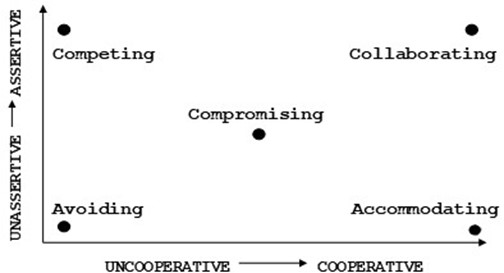
Below is model that displays various ways to deal with conflict. It’s the Thomas-Kilmann Instrument (TKI) Model. You can take an assessment to figure out your preferred conflict style. Our individual preferences are nice to know, but it’s more important to understand that each of these approaches to conflict is appropriate in different situations.
TKI model

 (Thomas-Kilmann Instrument (TKI) Model)

First, let’s look at the model. Assertiveness is the vertical axis on the left side of the graph. The higher up a conflict style is on the graph, the more assertive it is.

The axis at the bottom indicates how cooperative a person is being when using a particular approach to conflict. The conflict approaches farther to the right use more cooperation than the ones on the left.

In workshops, I use the example of a mom and her children deciding where to go to dinner to illustrate the different approaches to conflict.

COMPETING. If you look at the graphic, you can see that when we use a Competing approach to conflict, we are being very assertive and very uncooperative. In the Competing style, we adopt an “I win and you lose” perspective. We are going to use everything we’ve got to get our own way. Relationships don’t matter to us.

In our dining example, the mom really wants Mexican food, and she tells the kids to get in the car because they are going to a Mexican restaurant. There is no discussion, and the children have no input.

We can only use the Competing style if we have the power to make everyone do what we want. For example, the five year old of the family would not be able to force the family to go for pizza because she can’t drive or pay.

There are times when the Competing approach is appropriate. The first situation is when safety is an immediate issue. I am going to yell at you to stop if you are about to walk into the street where a bus will inevitably hit you. If I am facilitating a class and the fire alarm goes off, I’m not going to ask the group how they want to leave the room and which exit they want to use. I’m going to tell them exactly what to do.

The military uses a Competing style in critical situations. No military leader in his or her right mind is going to take a vote on how to react to an ambush or how to move forward in an attack.

In the everyday world, we use lack of time as our reason for using a Competing approach. Most of us feel very busy, and we don’t think that we have time to ask for input and have a discussion about a situation or decision. It’s important to note that the input and discussion are worth the time and should be included whenever possible. People feel part of a decision when they have input. They also feel valued. The Competing style does not enhance the positivity of relationships and should only be used when absolutely necessary.

ACCOMMODATING. In an Accommodating style of conflict resolution, the outcome doesn’t matter to us. In our dinner example, the mom doesn’t really care where the family goes to dinner. Pizza may not be her favorite, but if that is what everyone else wants, she is willing to drive them there and eat some pizza.

As leaders, we want to use the Accommodating style whenever possible. We want to give others as much autonomy as we can. It’s motivating to have some power over how we do things or what we are achieving. Some leaders have trouble letting people do things their own way. Make an effort to let others lead and decide whenever you can.

It’s fine to leave the decisions to others when we truly don’t care about the outcome. It is not okay to say we don’t care when we really do – that’s passive-aggressive behavior. If I say that I don’t care where we go to dinner, I need to truly not care where we go to dinner.

AVOIDING.  When we use an Avoiding conflict resolution style, we don’t take part in the conflict at all. We would be the teenager of the family who doesn’t want to be seen out in public with our lame family under any circumstance, so dinner is irrelevant. We aren’t assertive, but we also aren’t cooperative. We don’t care about what anyone else wants, and we don’t want to deal with them or the situation.

It is appropriate to use the Avoiding style when the situation has nothing to do with us. We often get worked up about decisions and how something “should” be done when we are not truly affected. For example, it may offend our moral sensibilities when someone is not working the way we believe that he or she should. However, performance issues are usually between a person and his or her supervisor. It’s best if we do our work to the best of our abilities and let them work it out. Our participation is not needed or helpful.

COMPROMISING. The Compromising approach is the one that is used most often and is appropriate much of the time. When using it, we ensure that everyone’s ideas are heard and then meet as many needs of as many people as possible in a reasonable amount of time.

Remember, our personal needs are to be listened to, understood, and respected. We can do all of those things when using a Compromising style and develop and maintain positive relationships.

When deciding where to go to dinner, we might take suggestions and then ask for a vote. Telling one child that she can choose where we go for dessert next time because she doesn’t want to go eat ice cream like everyone else is a Compromising style.

COLLABORATING. The Collaborating style is both very cooperative and very assertive. The goal is to satisfy the needs of everyone. This style requires a lot of time, energy, and commitment.

In our dinner example, we are going to make sure that everyone is happy with our restaurant choice and everyone is committed to making the best darn decision that we can. We are going to make a list of possible restaurants, ask for input from everyone, and consider how far each is from the house. We might create a list of average costs for a meal for each place that we are considering. We would also consider when each person ate last at the places being considered. We are going to spend a spend a good chunk of time on this and should probably be considering where to eat next week and not tonight.

The Collaborating style is appropriate for big, expensive decisions. If we are deciding where to build a new facility or whether or not to buy a house, we want to be sure that we have researched all the pertinent facts and unearthed as many advantages and disadvantages as possible. Using a Collaborative style helps to ensure that we aren’t missing any vital information needed to make a good decision.

We each have our own preferred style of conflict resolution. That style can change when we are stressed. It’s good to be aware of our preferences, but it’s also important not to be a one-hit wonder and only use that style. Great leaders use the style appropriate for the situation – no matter what their preferences are.


For a little bit of fun leadership development, join 53 Leadership Challenges at KathyStoddardTorrey.com.

Want to go further with your professional development? Check out the courses offered at PositiveEffectLeadership.com.

If you are interested in taking your career to the next level quickly, contact me for a sample coaching session at KSTorrey@tapferconsulting.com.

Effective Conflict: Listening Creates Solutions

19 Tuesday Sep 2017

Posted by Kathy Stoddard Torrey in Effective Conflict, Uncategorized

≈ Leave a comment

Tags

#effectiveconflict #conflictresolution #positive disagreements, #listenfully, relationships

listening fully 550 px

Sometimes I help groups that are stuck in disagreement find solutions. When we meet, every person who walks in the door has the problem in one pocket and the solution in the other pocket. They are all completely certain that their view of the situation are clear and correct. They also believe that they have determined the correct solution using the best criteria.

What’s fascinating is that each person has his or her own definition of the problem that is rarely the same as anyone else’s. The solutions they bring are different, and the standards used to judge those solutions’ correctness often vary wildly.

Of course, they don’t know all that when they walk in. They’ve been arguing but not listening. They may know each other’s solutions, but they rarely have figured out why each person believes that their solution is best. They have been arguing positions without asking questions or truly listening.

The best illustration of what is missing from the discussion is the Conversation Outline that I’ve talked about before (https://kathystoddardtorrey.wordpress.com/2017/08/15/lets-talk-conversation-outline).

Conversation outline 4

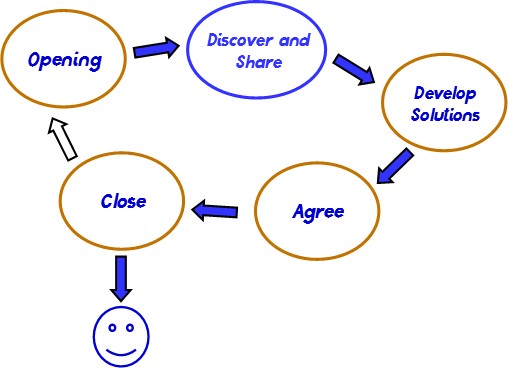
When in conflict, we usually jump from Opening to Develop Solutions. It amounts to saying, “Let’s talk about the new procedure” and then each person insisting that his or her way is the right way. This chain of events damages relationships and doesn’t increase the chances of the group agreeing to anything other than the fact that they don’t like each other.

The Listen and Share stage is often skipped, and it is where the biggest picture of the problem is discovered. Let’s say that a team must decide on a vendor to use for a new project. One person believes that the most reliable vendor is the one to choose. Another thinks that the lowest-cost vendor is the best choice. Another person might say that they should stick with the one that they have now with whom they’ve built a relationship. One team member thinks they should give a brand new and promising vendor an opportunity.

Each person is using reasonable criteria for his or her decision. In the Listen and Share stage, the group stops to figure out what those criteria are – they listen for understanding. In the process, they acquire a complete view of the situation. In essence, they pull the problems and solutions out of their pockets and lay them all out on the table. Then they examine them one by one without trying to convince each other of anything. The discussion is truly sharing and listening – not arguing or convincing.

During the Listen and Share stage, it’s important that everyone stays curious. They would ask questions like, “Why do you think reliability is more important that cost?” and “What advantages do you think the new vendor would bring?”

Here is an important side note: authentic curiosity is imperative! You can ask the questions above with a sarcastic or snide tone and ruin the relationship and the discussion. It can be difficult to put our egos aside and listen to other people’s ideas, but listening and curiosity are the keys to great solutions. If you are having a hard time, remember that maintaining a positive relationship with others is key in getting to your desired outcome. No one likes to “give in” to someone who is mean to them.

After I have guided a group through the discussion process, they come up with a better solution than any one person brought through the door. It’s a better solution because it’s been created by many different brains and perspectives. We take the collective knowledge of the group and then use their collective brain power to decide on the best course of action for the group or organization. It is a fabulous process to watch.

There may be a person or two who won’t let go of a solution because it helps them the most or just because they’ve let their egos get the best of them. Those people who put their own needs above the needs of others and the organization benefit from coaching conversations with their leaders.

Once a person has taken a strong position, it can be difficult to change because it feels like defeat. It’s important for the group to accept a person’s change in position gracefully and never do the “I told you so” dance or say, “I knew you’d come around to the right way of thinking.” Not cool.

For the most part, after a facilitated discussion, there is more understanding and less animosity – and the decision is a good one that the group feels confident about. You can achieve those same results by focusing on the Listen and Share stage of the conversation outline. Ensuring that every person’s perspective is heard and understood makes finding a solution much, much easier.


For a little bit of fun leadership development, join 53 Leadership Challenges at KathyStoddardTorrey.com.

Want to go further with your professional development? Check out the courses offered at PositiveEffectLeadership.com.

If you are interested in taking your career to the next level quickly, contact me for a sample coaching session at KSTorrey@tapferconsulting.com.

Effective Conflict: Hold Tightly to Your Outcome

12 Tuesday Sep 2017

Posted by Kathy Stoddard Torrey in Effective Conflict, Uncategorized

≈ 1 Comment

Tags

#desiredoutcome, #effectiveconflict #conflictresolution #positive disagreements

outcome 550px

Keeping the outcome that you want to happen in the forefront of your mind during a conflict is a powerful tool. I learned the value of this technique back when I was a Cub Scout leader, well before I had any training in communication and conflict resolution. The event was a tiny blip on the grand scheme of life, but the lesson that I learned has served me well for about two decades.

The leaders of the Cub Scout pack that we belonged to included a few petty, mean-spirited people. For the most part, I led my Webelos Den and had as little to do with them as possible. However, we were about to have a meeting to discuss our year-end banquet, where the boys in my den would graduate from Cub Scouts and move on to Boy Scouts.

I don’t remember all the details, but when I got to the meeting I discovered that the other leaders had met in secret before the official meeting and made some infuriating decisions that were going to affect my Webelos. I was furious. I was angry at the manipulation and deception, and outraged at the other leaders’ behavior, which was decidedly un-Scout like. I am a woman with a temper, and my first impulse was to storm out of the room.

As I sat there fuming, a couple of things occurred to me. First, they were counting on me leaving so that they could have free rein to do whatever they pleased. They could legitimately say that I had left and they had carried on as best they could if I left the meeting in a huff. They were a particularly sneaky lot.

Second, I realized that if I left, my den would have had no representation. My obligation and responsibility was to the boys I had worked with for the last two years. I knew them well and was very fond of them. I decided that I needed to swallow my anger and pride and continue to represent them and work for their best interests.

It became a mantra in my mind during the discussion – “you represent the boys.” I vividly remember one woman who was really taking delight in trying to bait me. I stayed calm, looked her in the eye, and argued logically and reasonably. I never lost my temper despite the fact that I was roiling inside. The outcome I wanted was for my Webelos to have the recognition and banquet that they deserved as they left Cub Scouts for Boy Scouts. I kept that outcome in mind and held onto it tightly.

In the end, I was satisfied with the plans for the banquet. Because I stayed calm and reasonable, I gained back a lot of the ground lost in the others’ secret meeting. I felt cheated of a good temper-tantrum yelling match but proud of myself for staying calm and representing those boys who were not able to represent themselves.

I remember walking out into the cool night air after the meeting and being startled by what I had accomplished. I was in awe of the power of self-discipline – controlling my temper. For me, it was an enormous revelation to see that I could get the outcome that I wanted if I could keep the coolest head. Amazing. Life changing.

Later I learned about Emotional Intelligence. In its simplest form, there are four categories of Emotional Intelligence: self-awareness, self-discipline, relationship awareness, and relationship management. There is real power in using self-discipline to achieve your desired outcome in a conflict.

Self-discipline means controlling our impulses; we pause to think before we act. Our first impulse might be to yell at someone who has done a poor job or insulted us. However, yelling doesn’t create a positive work environment, foster positive relationships, or get us closer to what we want to achieve in a disagreement.

Think of self-discipline as a muscle. The more you exercise it, the stronger it gets! Each time that you exercise self-control, you make it easier the next time. Make a practice of pausing and taking a breath whenever you feel an undesirable impulse coming on. Think of the consequences, and make a decision that is in alignment with your values and goals.

I must admit that there is immediate gratification in yelling and belittling others when someone makes us angry during an argument. However, there are consequences to our actions. We damage the relationship and our own reliability and trustworthiness. People won’t trust or respect us, and we hurt our chances of getting desired outcomes in the future.

It’s easier to control our impulses if we hold tightly to the outcome that we want. When tempted to yell or make personal jabs, remember that those actions will lessen your chances of getting the outcome that you want. Hold tightly to your desired outcome, and use self-discipline to act in ways that will help you achieve it.


For a little bit of fun leadership development, join 53 Leadership Challenges at KathyStoddardTorrey.com.

Want to go further with your professional development? Check out the courses offered at PositiveEffectLeadership.com.

If you are interested in taking your career to the next level quickly, contact me for a sample coaching session at KSTorrey@tapferconsulting.com.

Effective Conflict: Types of Conflict

05 Tuesday Sep 2017

Posted by Kathy Stoddard Torrey in Effective Conflict, Uncategorized

≈ Leave a comment

Tags

#effectiveconflict #conflictresolution #positive disagreements, #typesofconflict

family discussion 550 px

There are four different types of conflict. Knowing the kind of conflict that you are facing can help you manage your expectations and decide on an effective strategy for dealing with the conflict.

The easiest type of conflict to resolve is a disagreement about facts. In workshops, I will say, “I believe that I am the tallest person in the room.” Then I will ask the group if they agree or disagree. At 6 feet tall, I am sometimes the tallest person. However, the group will usually suggest different participants who are close to my height or taller. The group will sometimes argue a bit about who appears to be tallest.

Fortunately, it’s an easy conflict to resolve. I ask the person whom the group believes to be the tallest to come to the front of the room. We stand back to back, and viola! – we have an answer. One of us is clearly taller than the other, or the group declares a tie. Either the way, we know for sure.

We argue all the time about things that can easily be proven or disproven with a little research! It’s amazing. When my youngest son was living at home, I had the new registration for his car. He insisted that he had an updated registration in his glove box and that he didn’t need the one in my hand. I started to argue with him and then said, “Let’s go check.” We walked out to the car together, and he pulled out the registration. It was about to expire, so he took the one from my hand without further argument.

Here is an important side note: We want to maintain positive relationships at work and at home – especially during disagreements. A relationship can strengthen when conflict is handled effectively. It’s essential never to do the “I told you so” dance. It can be especially tempting when proving a sullen and argumentative teenager wrong, but it’s well worth the effort to restrain yourself. We want to use every opportunity to create positive moments. The appropriate response is something like, “I’m glad that we figured that out.” Do the “I told you so” dance in your head if you must.

The second type or level of conflict is one based on procedures. In this case, everyone agrees on the outcome, but not how to achieve it. I use my trusty water bottle to demonstrate this type of conflict in workshops. I put the water bottle on one side of the room and tell the group that we must decide together how to get it to the other side. For fun, I tell them that efficiency is not a consideration. We don’t have to find the fastest way to get the water bottle from one side to the other.

I begin by picking up the water bottle and carrying it to the other side of the room with a series of side steps, spins, claps, and a bit of moon walking. Then I ask them if they would all be willing to use the same method. Sometimes a few people agree, but for the most part, the group refuses. I ask them for their suggestions. They usually say we should hand it person to person or toss it. In the end, we find a way we would all be willing to use to transport the bottle, and it doesn’t take a huge amount of time to come to an agreement.

After we agree, I tell the group to pretend that I am the only one who will be transporting the bottle. Then, I ask them if my original suggestion is an acceptable way to get the bottle across the room, keeping in mind that efficiency is not a consideration. It’s interesting that most groups have trouble admitting that my inefficient, yet entertaining, way is acceptable.

Here is another important side note: Let people achieve the agreed-upon outcome in whatever way they want as long as it meets efficiency, safety, and organization standards and policies. There is usually more than one way to get a job done, and we build positivity in our relationships if we let others do it their own way as much as possible. Sometimes our egos get in the way, and we want everyone to do things the “right” way, which is our way. Ask yourself, “Does it really matter if it’s done the way the other person or group wants to do it?” People feel empowered and motivated when they get some autonomy.

The third level of conflict involves deciding an outcome. We aren’t just deciding how to get the water bottle from one place to another; we don’t agree on where the water bottle needs to go. Disagreements about an outcome can be much more time-consuming to resolve and require some discussion about standards, values, emotions, and expectations. I would need to understand why you think and feel that the water bottle needs to go to the back of the room or another room – and you would need to be able to explain your rationale. Once again, we want to keep our egos out of the discussion and resist any temptation to use the words “because I said so.”

My husband and I were having a difficult time deciding where to ultimately retire. I put a big map of the US up on the wall. He didn’t want to live in states that taxed his military retirement, so I put a piece of blue tape over all those states. I feel that water is going to become a scarce resource, so I put blue tape on states with low rainfall. We both agreed to stay at or below the Mason Dixon line for warmth. It’s a decision that remains unresolved, but what’s important is to capture the things that are important to everyone involved.

It’s also important to use what’s best for the bigger organism as the guideline for deciding the best outcome. At work, a discussion on a desired outcome should include the needs and goals of the organization. A goal or outcome that would be fantastic for the sales or marketing department might not be in alignment with the organization’s goals for growth or income. An outcome may not be the best thing for one individual or team, but might be best for the family or organization.

The final type of conflict is around values. In many cases, it’s best to agree to disagree on values. For example, you and I could argue ourselves silly about our spiritual beliefs and not change each other’s minds. Values are usually closely held to the heart and not easily changed.

Although we may not agree, that does not mean that we can’t build positivity with the discussion. Our personal needs are to be listened to, understood, and respected. “Agreed with” is not on the list. We can learn about a person’s beliefs and perspectives by listening in a respectful way. Listening does not obligate you to agree!

Think family dinners at holidays. It is a rare family whose members all agree about religion, politics, and worldviews. It’s perfectly acceptable to ask questions and understand a person’s perspectives and beliefs without agreeing with them. Effective conflict doesn’t have to include resolution. It can just be achieving mutual understanding.

For a little bit of fun leadership development, join 53 Leadership Challenges at KathyStoddardTorrey.com.

Want to go further with your professional development? Check out the courses offered at PositiveEffectLeadership.com.

If you are interested in taking your career to the next level quickly, contact me for a sample coaching session at KSTorrey@tapferconsulting.com.

Effective Conflict: How do you feel about conflict?

29 Tuesday Aug 2017

Posted by Kathy Stoddard Torrey in Effective Conflict, Uncategorized

≈ Leave a comment

Tags

#Communication, #effectiveconflict #conflictresolution #positive disagreements

fingernail on chalk board 550 px

When I do Effective Conflict workshops, I start by having everyone determine how they personally feel about conflict. I put my water bottle in the middle of the floor and tell the group that the bottle represents conflict. Then, I ask them to stand close to the bottle if they are comfortable with conflict and far away if they do not like any form of conflict. People will move to various places around the room in relation to conflict (i.e., the water bottle). It’s important to start by knowing our own feelings about conflict.

Something interesting happened the first couple of times that I did this exercise. After I gave the instructions and people were milling around to determine where they wanted to stand, someone asked, “Do you mean conflict at work or at home?” I wasn’t expecting that question; I had assumed that people felt a certain way about conflict all the time. That was an incorrect assumption!

As it turns out, most people in my workshops have very different feelings about conflict at work than they do about conflict at home. There doesn’t seem to be an overarching pattern to the difference. For example, one person may be more comfortable with conflict at home, and someone else more comfortable with conflict at work. It varies by personality and situation, but there is usually a difference.

Whether at work or home, the first piece of dealing with conflict effectively is knowing how we feel about conflict in general. Our feelings set the tone for the discussion. If we really don’t like conflict, we might avoid it or try to get it over with in a hurry. Neither of these is particularly useful when dealing with differences of opinion.

The other important piece of dealing with conflict effectively is knowing that conflict is not a bad thing! When I ask workshop participants what color conflict is, they usually answer “red” or “black.” When I ask what conflict sounds like, people say things like “nails on a chalkboard” or “a freight train coming at you.” Wow! Those are horrible, stressful sounds!

It’s useful to think of conflict as just discussing a difference of opinion or perspective. Granted, we can get pretty wrapped up and emotional about our views, but we want to step back and look at conflict as an opportunity to learn something new about ourselves, other people, and a particular situation. If handled well, conflict can result in more positivity in a relationship, not less.

The fundamental pieces of effective conflict are knowing our own feelings about conflict and adjusting our perspective to a more positive view of disagreements. After all, deciding where we want to go to lunch is resolving a conflict. We will talk about specific tools, techniques, and the various levels of conflict as we continue this topic, but let’s begin by checking in with our feelings and perspectives when faced with a conflict – big, small, at home, or at work.


For a little bit of fun leadership development, join 53 Leadership Challenges at KathyStoddardTorrey.com.

Want to go further with your professional development? Check out the courses offered at PositiveEffectLeadership.com.

If you are interested in taking your career to the next level quickly, contact me for a sample coaching session at KSTorrey@tapferconsulting.com.

Let’s Talk: Choosing Your Mindset

22 Tuesday Aug 2017

Posted by Kathy Stoddard Torrey in #Communication, Uncategorized

≈ Leave a comment

Tags

#Communication, #conversation, #mindset, #perspective

romantic mindset 550 px

One of the biggest influences on the success of a conversation is the mindset that you bring into it. People can immediately tell what attitude that we bring into the room with us. In systems coaching, we call it creating the Emotional Field. When you are talking to someone, there is always an atmosphere or container that surrounds the conversation. Our greatest success will come with intentionally creating an Emotional Field that supports the topic and people involved.

The Emotional Field is created by the feelings and intentions that you bring into the conversation. For example, when I am facilitating a workshop in-person, I intentionally bring in some fun and curiosity. Light-hearted learning is easier and more enjoyable. Also, I want to make sure that I am willing to learn from the participants. If I’m not willing to learn from them, then they will likely not be willing to learn from me.

I also intentionally bring in the intention to be flexible and spontaneous.  If the group begins to talk about something a bit off-topic that interests them, then I will follow that discussion. I’m willing to follow the group’s lead for a while.

A different facilitator might come in with seriousness and an intention to cover the material strictly as outlined. Participants’ experiences with that facilitator are going to be completely different than their experiences with me — even if we both use the exact same outline. We influence the experience and the outcome with the Emotional Field that we create.

I really can’t overstate the power of intentionally creating an atmosphere for a conversation. Let’s say that I’m going into a coaching situation in a workplace. I know that the person I’m going to talk with really does not receive feedback well. I am going to take their resistance to feedback into account and make sure that I bring some patience and understanding into the discussion. I want to create an Emotional Field that will help the employee hear the feedback and not feel threatened. If I come in with an adversarial attitude or a “let’s get this over with” mentality, I am not supporting a positive outcome for that conversation.

In most conversations, it’s useful to be willing to hear and consider different views and perspectives — bringing open-mindedness into the Emotional Field. Being defensive or combative rarely leads to a positive outcome. It’s important to remember that listening for understanding does not require us to then agree.

Likewise, different situations generally call for different mindsets. If you want romance, go with soft music, lighting, and tone of voice. If you want to party, play loud music and have high energy. Your chance of getting the outcome that you want is greatly increased if you bring in the appropriate qualities that fit the message and the outcome that you’re trying to get.

For a little bit of fun leadership development, join 53 Leadership Challenges at KathyStoddardTorrey.com.

Want to go further with your professional development? Check out the courses offered at PositiveEffectLeadership.com.

If you are interested in taking your career to the next level quickly, contact me for a sample coaching session at KSTorrey@tapferconsulting.com.


Let’s Talk: Conversation Outline

15 Tuesday Aug 2017

Posted by Kathy Stoddard Torrey in #Communication, Uncategorized

≈ 3 Comments

Tags

#Communication, #conversationoutline, #positiveoutcome

Conversation outline 4

It took me a while to appreciate the power and beauty of this conversation outline. At first I thought that having a structure for a discussion was unnecessary. Boy, was I wrong! This guide keeps the conversation on track, ensures everyone has input, creates more options, and fosters positive relationships. Impressive!

Open. We open a conversation simply by stating what we are going to talk about. It helps the conversation stay on track.

Discover and Share. This is the most important step in a conversation. We often skip this step and move straight to positional arguing about the best thing to do.

In Discover and Share, we take time to listen fully by being completely present and listening for understanding. We pay attention to the words being said, tone of voice, facial expressions, and body language. We are curious about everything and ask a lot of questions.

Giving focused attention to someone is a gift. We don’t often feel like we are in the spotlight of someone’s attention, even though we like being seen and heard.

Finding out how the other person or people view the situation creates more possible solutions and helps to maintain positive relationships. We also share our perspectives and feelings during this step.

Develop Solutions. Once we have all the facts and feelings on the table, brainstorming begins. I see it as a funnel that begins with a wide variety of options and slowly narrows down to the best choice. During this phase, it’s important to continually ask what is best for the people involved in the decision – whether that is a couple, a team, a family, or an organization.

Agree. If we’ve done a good job during Discover and Share, it’s easier to come to an agreement.

Close. We check to make sure everyone is on board and explicitly state the agreement. It’s also a good time to check in one last time on how everyone is feeling about the agreement.

When having a conversation, focus on the Discover and Share step of the conversation. The other steps happen naturally and don’t need as much emphasis. The information needed to resolve conflicts never comes to light if we jump straight to developing solutions without fully listening and understanding each person’s perspective and feelings. It’s totally worth the time that it takes to be sure each person feels listened to, understood, and respected.


For a little bit of fun leadership development, join 53 Leadership Challenges at KathyStoddardTorrey.com.

Want to go further with your professional development? Check out the courses offered at PositiveEffectLeadership.com.

If you are interested in taking your career to the next level quickly, contact me for a sample coaching session at KSTorrey@tapferconsulting.com.

Let’s Talk: Facts and Feelings

08 Tuesday Aug 2017

Posted by Kathy Stoddard Torrey in #Communication, Uncategorized

≈ Leave a comment

Tags

#Communication, #factandfeeling, #LetsTalk, #listenfully

celebrate

Here is an important and life-altering piece of information: Every message and every situation have both a fact part and a feeling part. To communicate effectively, we must acknowledge both parts. I learned this lesson late in life, and it would have saved me some time and trouble if I’d known about it sooner.

For 20 years, I led volunteers as an Army spouse. In one group that met monthly, there was one young woman who always sat at my right hand and objected to everything that the group proposed. She objected on a factual level – logistics, budget, convenience, etc. She slowed us down every single month.

If I’d been savvier, I would have figured out that it wasn’t the facts that she objected to. I had a vague notion that she was unhappy or resentful, but I had no idea why. She was experiencing some feeling that I wasn’t dealing with at that time. If I’d asked and listened, I could have saved us a lot of time arguing over facts for no good reason.

In my leadership workshops, I have people work in pairs to practice recognizing the feeling part of a message. One person talks about something that arouses strong feelings for him or her. The other person listens and then comments on the facts and feelings that he or she hears. For example, the listening partner might say, “It sounds like [fact part] really frustrates you” or “Wow, [fact part] really makes you happy.”

The reactions of the speaking partners are revelatory. They say that they feel heard and understood. As humans, our personal needs are to be listened to, understood, and respected. Telling someone the emotions you sense that they are feeling powerfully meets those needs.

Don’t worry about getting the emotion wrong. I’ve never seen anyone get upset. The usual response is a pensive “No, I feel more …” The process helps them to become more aware of their emotions.

You can also just ask! Is your pre-teen refusing to wash dishes? If so, then ask how he or she feels about washing the dishes. If a coworker consistently objects to following a procedure, find out why. Don’t accept factual responses. What feelings does he or she have about the procedure?

The answers are usually surprising – something that you wouldn’t have guessed. The only way to move forward in any situation is to reveal and deal with both the fact and feeling parts.


For a little bit of fun leadership development, join 53 Leadership Challenges at KathyStoddardTorrey.com.

Want to go further with your professional development? Check out the courses offered at PositiveEffectLeadership.com.

If you are interested in taking your career to the next level quickly, contact me for a sample coaching session at KSTorrey@tapferconsulting.com.

Let’s Talk: Different Types of Communication

01 Tuesday Aug 2017

Posted by Kathy Stoddard Torrey in #Communication, Uncategorized

≈ Leave a comment

Tags

#clearcommunication, #nonverbalcommunication, #positiverelationships, #symboliccommunication, PositiveEffectLeadership

Symbolic Communication 550 px

Good communication with ourselves and others is a fundamental piece of a successful life. In coaching and in leadership workshops, communication is the most challenging topic; it’s also one that’s easy to work on. We can get better at getting our point across.

Back in 1972, Professor Albert Mehrabian said that our message is 7% words, 38% voice, and 54% body language. The only important thing to remember here is that our nonverbal communication has a huge influence on our message.

Nonverbal communication includes facial expression, tone of voice, and body language. If I say “I am so glad to be here” in a sarcastic tone while rolling my eyes and looking at my watch, you won’t believe my words. That’s so interesting! If the nonverbal and verbal messages are not aligned, then we go with the nonverbal message! Our words have no meaning when the nonverbal message contradicts them!

We want to be careful with the words that we use; however, we also need to pay close attention to our nonverbal messages. Crossed arms and stern looks can make us appear unapproachable or judgmental. If we deliver bad news while smiling, we send a very confusing message. It’s important that we intentionally align our verbal and nonverbal messages.

There is a third way that we communicate other than verbally and nonverbally; it is symbolic. We do a whole lot of communicating symbolically with our clothes, jewelry, shoes, hairstyles, backpacks, water bottles, fingernails, cars, and even our homes. We are telling the world something about ourselves with every symbolic choice that we make.

It’s important that our symbolic messages are intentional and appropriate. We cannot ignore the fact that we tell people about our commitment to a job with our clothes. If I show up to work in wrinkled clothes with my shirt untucked and hair that looks like I just tumbled out of bed, then I am sending the message that I’m not professional and don’t take my job seriously. That message might not be entirely true, but it’s still the message that I’m sending.

It’s also a good idea to pay attention to how your things (e.g., clothes, jewelry, bags) make you feel. You even send symbolic messages to yourself.

Speaking of talking to yourself, we all have a little voice in our head. How that voice talks to us can make a huge impact on our confidence and self-esteem. Negative self-talk can be a very destructive force. There are some things that we can do to improve the way we talk to ourselves.

Begin by asking yourself if you would talk that way to a friend. Would you say, “You are stupid and incompetent!” to someone you care about? Of course not! If you wouldn’t say it to your best friend, then don’t say it to yourself.

Studies have shown that talking to yourself using “you” or your name as if talking to a friend increases confidence, performance, and anxiety. For example, instead of “I can do this!”, I say, “Kathy, you can do this!” It’s an easy shift to make. No one knows exactly why this works, but it does, so let’s run with it.

Talking to ourselves as we would to a friend and using “you” and our names help to put us in an observer role, which is another way to battle negative self-talk. In one study, psychologists had people stand in the mirror and comment on themselves. If a person said, “I am a fat blob with a jiggly belly,” the researchers would ask them to state factual information as an observer. The participant could say, “I have a round abdomen.” Observing factually leads to action more often than negative self-talk does.

Lastly, we can name our inner voice. In coaching, we call it a Gremlin, and it seems intent on sabotaging our efforts. Many times, our Gremlins are trying to keep us safe. My Gremlin might say, “Don’t put in a proposal for that job. You won’t get it, anyway.” It’s trying to save me the pain and disappointment that I would experience if I didn’t get it. I can tell my Gremlin, “Thanks! I know you are trying to save me some emotional pain and disappointment, but I’ve got this! If I don’t get it, it will be OK.”

The first step in communicating is becoming aware of the different ways that we send messages to ourselves and others. The second step is to be intentional in the message and the way that we deliver it. This perspective gives “Watch your language!” a whole new meaning.


For a little bit of fun leadership development, join 53 Leadership Challenges at KathyStoddardTorrey.com.

Want to go further with your professional development? Check out the courses offered at PositiveEffectLeadership.com.

If you are interested in taking your career to the next level quickly, contact me for a sample coaching session at KSTorrey@tapferconsulting.com.

Kathy’s Bloom and Flourish Model: Pulling It All Together

27 Tuesday Jun 2017

Posted by Kathy Stoddard Torrey in Bloom and Flourish, Leadership, Uncategorized

≈ Leave a comment

Tags

#BloomandFlourish, #KathySays, #plants

plants 550 px

Kathy’s Bloom and Flourish Model

  1. Peaceful Base
  2. Physical Health
  3. Positivity Spiral
  4. Flow/Accomplishment/Meaning
  5. Positive Relationships
  6. Spiritual Connectedness
  7. Financial Stability
  8. Your Choice

 Yay! We’ve talked about all seven pillars of Kathy’s Bloom and Flourish Model. In the beginning, we discussed the fact that fewer than 20% of Americans are satisfied with life and functioning well. Many of us are getting by, but we aren’t truly flourishing. When we look at the model, it’s easy to see why – many of the pillars are challenging. I myself would say that I am not doing great in several areas.

The first step in moving forward is to figure out where we are now. We can use Kathy’s Bloom and Flourish Model Wheel to get a snapshot of our lives in relation to the pillars. You can download a blank copy of the Wheel from my website; it’s under the “Free Stuff” tab.

First, we want to rate each pillar on the Wheel on a scale of 0 to 10.

10—You couldn’t be more satisfied with where you are at this point in your life. You are right on track.

5—It’s OK, but there are some changes that you could make here and feel more satisfied.

0—There is no fulfillment in this area. You would be much happier if everything about this category was different.

Then we mark our ratings on the Wheel.  If we write down a 10 for a category, we make a line along the outer edge of the circle. If we write down a 5 in a category, we make a line across the piece about halfway between the outer edge of the circle and the center. If we have a 0 in a category, we draw a small line right by the center point where all the pieces meet.

Kathy Bloom and Flourish Wheel filled in

Here is my current Wheel. I feel pretty good about the Peaceful Base pillar. There are always things to simplify and organize, but I’m happy with my Peaceful Base, so I ranked it a 9. My Physical Health isn’t great compared to people who haven’t had brain surgery, but I feel I’m as healthy as I can be, so that pillar also gets a 9. I very much like what I do and create, so Flow/Accomplishment/Meaning also gets a 9.

I have not been consistent in my meditation lately, and I’m feeling a bit negative, so the Positivity Spiral gets a rank of 6. I discussed my failings around creating a local community, so Positive Relationships gets a 5, but I’m already working on that one! I am not as conversant with God as I would like, so I will rate my Spiritual Connectedness at 8. I feel that I do not earn what I could and don’t manage my money as wisely as I could, so I rate the Financial Stability pillar a 7.

I’m sure that you noticed that there are eight pieces on the Wheel and only seven pillars. That last blank piece is one that you fill in. Is there something that you need to bloom and flourish that isn’t covered under the other pillars? Cheryl Richardson, a nationally-known life coach, often writes about her requirement for beauty and nature in her life. Do you need to be surrounded by beautiful things? Then you could label the last pillar “Beauty.” Do you crave being in nature? If so, you make your final pillar “Nature.” If you need both, your final pillar could be “Beauty and Nature.” It’s totally up to you!

I thought for a while about whether or not I needed something else that would be my final pillar. I realized that it is “Plants.” When the weather permits, I love to be outside doing things in the yard. I also like lots of plants in the house. Looking at green plants and colorful flowers has a relaxing effect on me. When I am not surrounded by plants, I am not in the same peaceful state that I’m in when I can see live, growing greenery and flowers. I’ve got quite a few plants inside and out that I love, so I rate my own Plant pillar an 8.

You get to decide whether or not you want an additional pillar. Most hobbies and creations fit in the Flow/Accomplishment/Meaning pillar, but it’s your Wheel, and you can put whatever you want on it. If you feel you must paint, draw, or sculpt and believe those need separate recognition, go for it!

In the beginning of this series, I said that, like all worthwhile achievements, creating a life of meaning and satisfaction would require work. It does! If we just let ourselves be blown around by life’s events, we are like a leaf in the wind; we don’t have control over where we go, and we can get pretty beat up.

We want to be a sailboat that uses the winds in our lives to move in the direction we want to go. There is a goals and commitments page included with the Wheel that you can download. There you can write out specific things that you want to accomplish for each pillar. Using Kathy’s Bloom and Flourish Model helps you to create the foundation that you need to launch out into the world and stay on course to create a life that you love living.


For a little bit of fun leadership development, join 53 Leadership Challenges at KathyStoddardTorrey.com.

Want to go further with your professional development? Check out the courses offered at PositiveEffectLeadership.com.

If you are interested in taking your career to the next level quickly, contact me for a sample coaching session at KSTorrey@tapferconsulting.com. You can go further faster with a great coach!

← Older posts
Newer posts →

Follow Blog via Email

Enter your email address to follow this blog and receive notifications of new posts by email.

Join 214 other subscribers
  • RSS - Posts

Categories

Archives

  • December 2020
  • November 2020
  • October 2020
  • September 2020
  • August 2020
  • July 2020
  • June 2020
  • May 2020
  • April 2020
  • March 2020
  • February 2020
  • January 2020
  • December 2019
  • November 2019
  • October 2019
  • September 2019
  • August 2019
  • July 2019
  • June 2019
  • May 2019
  • April 2019
  • March 2019
  • February 2019
  • January 2019
  • December 2018
  • November 2018
  • October 2018
  • September 2018
  • August 2018
  • July 2018
  • June 2018
  • May 2018
  • April 2018
  • March 2018
  • February 2018
  • January 2018
  • December 2017
  • November 2017
  • October 2017
  • September 2017
  • August 2017
  • July 2017
  • June 2017
  • May 2017
  • April 2017
  • March 2017
  • February 2017
  • January 2017
  • December 2016
  • November 2016
  • October 2016
  • May 2015
  • April 2015
  • March 2015
  • February 2015
  • January 2015
  • February 2014
  • January 2014

Powered by WordPress.com.