• About

Kathy Stoddard Torrey

~ Leadership Coach and Trainer

Kathy Stoddard Torrey

Category Archives: Leadership

Conversation Container

21 Tuesday May 2019

Posted by Kathy Stoddard Torrey in #Communication, Emotional Intelligence, Leadership, Uncategorized

≈ Leave a comment

Tags

#conversationcontainer, #effectivecommunication, #LeadershipRules #LeadYourselfFirst #KathySays, #metaskills

PEA 600 px

The topic of how to create the best conditions for a conversation has popped up a lot lately. It’s not something that I see in leadership and conversation literature, but it is absolutely crucial to a successful conversation.

So what makes a conversation successful? There are at least a couple of things. From a leadership perspective, we want to develop or enhance a positive relationship. Leadership is all about creating positive relationships. I promise that this does not mean we are going to be pushovers.

Second, we want to have a clear outcome in mind. If an employee has a grievance, our goal is to find a resolution. We do not want to decide ahead of time what the resolution will look like; that’s what the conversation is for. You can read more about holding onto your outcome here.

We know that the beginning of a conversation is important. Couples relationship expert John Gottman found in his research that conversations that start harshly will end harshly more than 90% of the time. Those percentages are a good incentive to pay attention to how we open a conversation.

The way to ensure that we begin well is to pay attention to our mindset before we go into a conversation. Intentionally or not, we bring certain qualities or perspectives with us when we start talking with someone. If I’m angry, I might bring an adversarial attitude. If it’s important to me to look smart, I could bring in a know-it-all mindset. In systems coaching, we call those metaskills, and neither of those examples is going to help create a positive relationship or achieve the desired outcome.

Deciding what metaskills to bring into a conversation is harder than it sounds. In workshops, I ask groups to come up with the qualities and mindset that would create the most helpful container for conversations with a blamer, a screamer, a cryer, a know-it-all, and a person with an excuse for everything. When I walk around the room at the beginning of their discussions, I hear things like, “They need to understand…” and “We have to make it clear…” They are not talking about metaskills; they are talking about how to get to the outcome before they’ve even started this imaginary conversation.

I stop the discussions and redirect them. I ask, “Who do you need to be in order to have a reasonable and productive conversation with these people?” In other words, what type of person do you need to be? Do you need to be a patient person? A calm person? An angry person? An impatient person?

They go back to their group discussions and come up with great lists of qualities. Each group has a different type of person, but their lists contain similar metaskills. They decide they would want to be kind, patient, calm, firm, open-minded, respectful, empathetic, and professional. Being a person with those qualities will help them to have a reasonable conversation because they are creating a supportive container for the conversation. The qualities we embody are the metaskills that create the container.

Several clients have reported amazing outcomes from this practice. One told the story of facing a conversation with an employee who was angry about being passed over for a promotion. She took a minute and thought of how the employee must feel – angry, disappointed, and frustrated. He was entitled to feel that way. Although the decision was a fair one, it didn’t take away the sting of rejection.

My client’s normal style was to meet anger with anger. Instead, she met the employee’s anger with empathy and said things like, “Yes, I can understand why you are upset.” It was not the response the employee was expecting! He was expecting a good row! Instead, his anger dissipated, and the conversation turned to things that he could do to improve his chances next time around. By changing the container for the conversation, my client changed the entire tenor and outcome.

It’s important to note that kindness and firmness are not mutually exclusive. We can hold people accountable in a firm way and also be kind. It’s easy if we truly have the other person’s best interests at heart. Exceptional leaders know that their success is dependent on the success of everyone around them, which means they hold high standards and help people meet them. The best leaders know that figuring out how to meet goals and standards is a dialogue that happens best in a conversation container of respect and a true desire for others’ success.

 

Creating Positive Relationships

14 Tuesday May 2019

Posted by Kathy Stoddard Torrey in #Communication, Emotional Intelligence, Leadership, Positivity, Uncategorized

≈ 1 Comment

Tags

#LeadershipRules #LeadYourselfFirst #KathySays, #noticethegood, #positiverelationships, Positivity

mom and son 600 px

One of the essential elements of extraordinary leadership is the ability to create and maintain positive relationships. In fact, we are happier and more successful as parents, spouses, friends, family members, and humans if we are amidst positive relationships. As leaders, we cannot cultivate the personal power that we need to motivate others unless we can create positive relationships. You can read more about the power of positivity and positive relationships here.

Research shows we need at least a five-to-one ratio of positive interactions to not-positive interactions in order to maintain a positive relationship. In one study, simply asking a student how homework was going was considered a negative interaction. Wow. That sets the bar for a positive interaction pretty high. The reality is that we don’t have a lot of positive interactions with others.

I first realized how few positive things that I was saying to others when my sons were in high school. I was in my coach training with the Coaches Training Institute. We had talked about the power of appreciation and acknowledgments. I realized that some days, I didn’t say even one nice thing to my children. I committed to saying at least one nice thing a day to each of them.

This tactic is a great way to start creating positive relationships. It’s not as easy as it sounds, but it is doable. It’s essential that the acknowledgment or appreciation be sincere. Bad nonverbal communication can kill a nice statement. Any hint of sarcasm will sabotage your efforts. Start by saying things that you truly believe.

The comments must never be about the appearance of a person; that is a compliment and not what we are going for. We want to say something meaningful about the person, which is an acknowledgment. Our other option is to show appreciation for an action. For me, appreciation is easier, so I started with that.

When I saw my sons doing something that I wanted to see them do again, I made a statement about it. I said things like, “Thank you for putting your dishes in the sink. I really appreciate it.” I meant it! I did appreciate them putting the dishes in the sink. I appreciated when they put away their laundry, drove safely, helped each other, and mowed the grass.

After telling them what I appreciated, I then told them why. The why is an important piece of the appreciation message. I was grateful when they mowed the lawn because it was an enormous effort for me that wiped me out for the rest of the day when I did it. I appreciated them putting the dishes in the sink because it made cleaning up after meals much faster – and I didn’t like that task any more than they did.

People are more likely to repeat the action when you comment on it in a positive way. They know you like it, and they like being appreciated. Maybe they never saw it as important before and now realize it’s a big deal to you. For whatever reason, people do things more often when they feel that those things are appreciated. Appreciation also builds the overall positivity of a relationship. It’s a win-win.

Acknowledgments are more difficult and more powerful. When we give someone an acknowledgment, we are commenting on positive qualities of that person – not their actions or their appearance – though an acknowledgment can begin by noticing an action. After all, we show our qualities through our actions.

I could say, “I saw you helping your brother with his physics homework. You are a kind person who takes time to help others.” Here is another example: “I was watching you work out in the driveway. You really are consistent in your exercising, and you are getting stronger. I admire your willpower and determination.”

It’s essential that the things we say are true. We can’t run around saying things we don’t mean. Trust me, people can tell if you are insincere. As I looked for positive things to say to my sons who were and are outstanding human beings, I wasn’t making things up. All their great qualities were there. Some I was aware of. Others I noticed for the first time as I began to really pay attention to who my sons were.

The sad part is that I had not told them much of the good I saw and felt for them. I’m not sure why. Part of the reason harkens back to the fact that we are hardwired to notice and hang on to the negative. Noticing the good around us is not something that comes naturally or that we are trained to do. I’m sure the fact that they were surly teenagers was also a contributing factor. Also, I just wasn’t very good at sharing feelings. Looking for positive actions and the good in others is a new habit that we must form. Forming new habits takes work.

I started by saying one positive thing a day. Weirdly enough, it was difficult, and I would forget my intention. However, over time giving appreciation and acknowledgments got easier. It felt more natural. I was in the habit of looking for good things and commenting on them. Believe me, that is huge! The ability to easily and naturally see the positive qualities and actions of others is crucial for great leadership.

My two sons were suspicious of my new behavior at first. I was talking to them in a different way suddenly. I’m sure that they wondered what I was up to. I told them after a bit. Transparency is usually the best way to go. I told them that I was working to notice and comment on the good things around me and that they were definitely some of the best things around me.

A delightful outcome that I didn’t see coming was that my high school-aged sons began saying nice things back. They told me when they appreciated things I was doing. They even pointed out some of my strengths. I cannot begin to express how touching that is. The dynamics of our relationships changed for the better.

Violá! We created positive relationships by increasing our number of positive interactions. When I say something positive about someone, it is positive for both of us, and vice versa. The boys and I enjoyed each other’s company more and increased our level of trust, which led to more meaningful conversations.

Saying one positive thing to someone every day is a simple way to begin to create a positive relationship. Man, there is no better way to decrease our expenditure of emotional pennies than to create positive relationships. The results are extraordinary, which is what we are looking for in extraordinary leadership.


For a little bit of fun leadership development, join 53 Leadership Challenges at KathyStoddardTorrey.com.

Want to go further with your professional development? Check out the courses offered at PositiveEffectLeadership.com.

If you are interested in taking your career to the next level quickly, contact me for a sample coaching session at KSTorrey@tapferconsulting.com.


 Going All In

07 Tuesday May 2019

Posted by Kathy Stoddard Torrey in Emotional Intelligence, Leadership, Motivation, Resilience, Uncategorized

≈ 4 Comments

Tags

#LeadershipRules #LeadYourselfFirst #KathySays, #mindset, #MovingForward

Plan B 600 px

I recently spoke to my Ex-Husband, Oldest Son, and Youngest Son all in one day. There was a time when I would have felt that it had been a wonderful day. However, times are not what they were, and all three conversations were distinctly unsatisfying.

The bottom line is that three people who were once closest to me and each other aren’t close at all anymore. The reason is a series of complicated stories that are not mine alone to tell. It feels like a Greek tragedy where everyone has done what they had to do to be true to themselves and no one is wrong, yet no one is exactly right, either.

The conversations unsettled me. I wallowed a bit in the fact that I have failed in one of my life’s major goals. I spent decades creating a loving family. At 22 years old, I decided to marry my Ex and make family the center of my life. I consciously decided to make family my first priority and career second. I gave up a job offer at a prominent PR firm to follow my new husband to Germany. It was a choice, and I made it on purpose.

My Ex and I had six years together before we had Oldest Son. They were very happy times. We were young, healthy, hopeful, and in love. My decision to put family first appeared to be a very good one.

Then we had Oldest and Youngest Sons within two years of each other. We were a young military family who stuck together as we moved. My mother moved in with us and made us a happy family of five. My decision to put family first appeared to be a very good one.

The kids grew, and we were all a team. We all supported my Ex in his military career. It felt good to have common goals and to work together at Cub Scouts, Boy Scouts, and military life. My mom’s presence made our lives easier and more fun. I enjoyed all the phases of being a mom and staying home with my two boys. My decision to put family first appeared to be a very good one.

We had rough years individually and together. The boys were teens who made some bad teenage decisions, but we got through. They became young men in college who made some more not-great decisions, but we got through. My Ex deployed twice, and I had brain surgery during the first deployment. Tough times, but we got through. I began to work and felt like I could jump in and progress quickly in a long-postponed career. My decision to put family first still felt like a good decision.

My decision to put family first was influenced by a story that my high school basketball coach told me. He was divorced and single at that time. He told me that he had spent Christmas day alone, driving through town looking at all the lights. He said it was nice, but the melancholy tone in his voice and the pained look in his eyes told a different story. At 15 years old I decided that I never wanted to find myself in that position. I wanted always to have family around me for holidays.

Fast forward to now. I live alone in a small condo. I share walls and ceiling with others. My beloved Honda Pilot whom I call Amber sits out front with no shelter. She is my view from my front windows. Other people’s vehicles are my view in the back. Not one relative lives in the state that I live in. Oldest son lives with my grandchildren in New Jersey. Youngest son and his new bride live in Texas near my sister and her family. I am now almost 60 years old. I’ve spent a lifetime creating a family that has disintegrated. Putting family first doesn’t feel like the best decision I’ve ever made. Maybe it was and I just failed. I failed at my life’s main work.

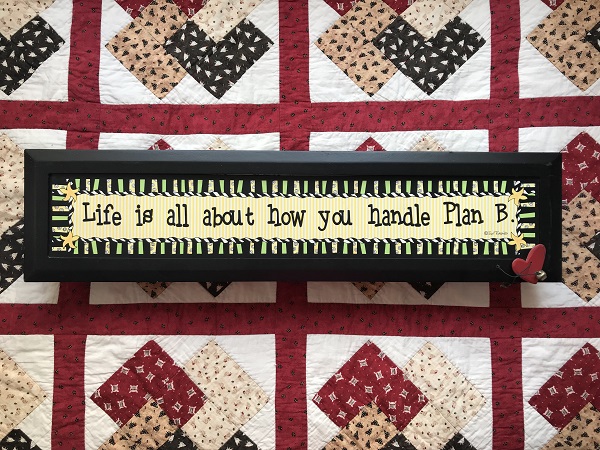
Now, I spend most of my time alone. I have good friends where I live. I enjoy them and depend on them. I am working to create a community here. I visit Oldest Son and Youngest Son individually. It is Plan B. Plan A failed, and I feel like a failure trying to make the best of a situation I do not want to be in.

After wallowing about the unplanned results of my life and my feeling of being a complete failure, I remembered the most valuable lesson that I learned when getting my MBA. It was taught in terms of financial investments, but it applies to all aspects of life. When deciding what to do when moving forward, do not consider the sunk costs – what’s already been invested. Forget the past, and look hard at the present. Given the current situation with no thought to the past, what is the best thing to do? I translate that to: We are where we are. What do we do from here? More accurately now: I am where I am. What do I do from here?

Not considering past expectations removes an enormous emotional burden. I use a hurricane metaphor to help me get past the recent changes in life. A huge hurricane came through that destroyed everything and caused me to start life again. It wasn’t my fault, and there was nothing I could have done to avoid it. That mindset helps me see the current situation more clearly because it clears all regrets. Whether it’s true or not doesn’t matter. I am where I am, and blame and failure are irrelevant. Nothing can change the present.

The future is another matter. It can be changed! Or not. I could continue to wallow and rewind the past in my head, which would lead to an icky future that is not much different than the present. Good thing I have a Magic Wand of Destiny and the Power of Choice. I’ve written a lot about goals, making intentional choices, finding your Big Why, and taking baby steps forward. Insert all of that information here. I am assessing my current situation objectively, finding my motivation, and making a plan.

However, there is another thing to consider that will help – mindset. I read a story in leadership workshops from the book Whistle While You Work by Richard Leider and David Shapiro. Leider tells about a time that he went on an East African adventure with Outward Bound. The group found themselves walking through tall grass, and one person saw a lion. The grass is called Lion Grass because it’s one of a lion’s favorite hunting grounds.

The gravity and danger of their situation suddenly hit home to the person who had seen the lion. He sat down and refused to go on. He wanted to turn back, but the truck that had dropped them off was en route to the meeting place ahead of them. There was nowhere to go back to. I can definitely relate to the situation and the feeling!

The leader talked with the shaken man and explained the situation. It didn’t help. The man refused to move. Then the leader offered an Outward Bound motto: “If you can’t get out of it, get into it!” In other words, if there is no way to remove yourself from an unwanted situation, the answer is to completely get into it so you can move yourself through it as quickly as possible.

I’ve actually reminded myself of this concept several times throughout my life. If I took on a task or job that I didn’t like but didn’t want to quit, I chose to completely get into it. The journey was less painful, I was successful, and the end seemed to arrive more quickly.

So, what does “getting into it” look like? It’s about being all in. A friend once told me that she liked watching me play basketball in high school because when I played, I was all in. To me, it means that no part of me is playing the observer; all of me is completely present in the experience.

That is how I want to be now as I create a life that is nowhere near the expectations I held for decades. I want to be all in. I want to really get into it. I want to be fully engaged with no part of me sitting on the sidelines complaining or being hesitant. I am drawing my line in the sand and stepping over it into a life I completely accept and intend to enjoy. I am where I am, and I’ve decided to like it.

P.S. This little girl is my current role model: https://www.youtube.com/watch?v=qR3rK0kZFkg


For a little bit of fun leadership development, join 53 Leadership Challenges at KathyStoddardTorrey.com.

Want to go further with your professional development? Check out the courses offered at PositiveEffectLeadership.com.

If you are interested in taking your career to the next level quickly, contact me for a sample coaching session at KSTorrey@tapferconsulting.com.

Compartmentalization

23 Tuesday Apr 2019

Posted by Kathy Stoddard Torrey in Emotional Intelligence, Leadership

≈ Leave a comment

Tags

#compartmentalize, #LeadershipRules #LeadYourselfFirst #Ka#sthySays

In a leadership workshop, we had a conversation about whether compartmentalization is a good or bad thing. We discussed some interesting perspectives.

To start, let’s define what we mean by compartmentalization. When we compartmentalize, we separate objects, feelings, thoughts, or information into isolated compartments or categories. For example, I love going to The Container Store because it offers me all sorts of ways to organize the items in my life. I can separate the jumbled items in my bathroom drawer so that they are all easy to find. I am a fan of compartmentalization for items.

Information can be organized and compartmentalized for ease of retrieval and use. Databases and an organized computer desktop, for example, can make our lives much easier.

I think compartmentalization that happens outside of ourselves is good for the most part. By separating items and information into categories, we find them more easily. We require less hunting and brain power. It lowers our use of emotional pennies, which is always a good thing.

What about the internal compartmentalization that we do? It can be a healthy practice to keep our work separate from our home life. I remember reading about a man who stopped at a tree in his front yard each day when he arrived home from work. He pantomimed taking a large necklace off himself and placing it on the branch of a tree. He was mentally taking the worries and responsibilities of the day from himself and leaving them outside so they didn’t affect his time with his family. That’s a great practice!

How about the other way around? Can we leave all our home life at the door when we go to work? The answer is “not entirely.” When we refuse to share anything about our lives and our interests, we inhibit our ability to create positive relationships with people at work. We make it more difficult to create trust with our coworkers. We don’t have to share everything from home at work, but we do need to share a bit of ourselves with others.

Actually, we don’t want to share everything! We want to stay appropriate and professional. When I was in the throes of my divorce, I was in a lot of emotional turmoil. I didn’t need to share the depth of my despair or details of my personal life with participants in my workshops. It wouldn’t help them learn; it would, in fact, have been a distraction. I did tell them what was going on at the highest level that I could manage because I share stories about myself in workshops. I did not, however, share details of the situation or my emotions.

As a leader, it can be difficult to know how much to compartmentalize. Neither extreme is good for building positive work relationships. We can’t keep our lives completely to ourselves, and we don’t want to share every detail. We must find the place on the spectrum that is appropriate for us and the culture of our workplace.

Now let’s talk about when it isn’t appropriate to compartmentalize. This discussion requires us to go back to the concept of the 3rd Entity. Two or more people make us a system. This system or relationship is called the 3rd Entity in systems coaching. As a member of the system, everything that I think and feel is a part of the system. If I hold back, I am keeping something relevant to the 3rd Entity to myself.

Let’s look at an example. Let’s say that I am a member of a customer service team. I feel that we are not using the correct criteria to provide our customer service. Our conversations are timed, and we have little authority to make things right for a customer. I feel that we would be more effective if we weren’t in a rush and had some leeway on what we could offer customers. However, I keep my thoughts to myself. I am angry about the limitations, and my teammates can see my anger but don’t know what it is about.

I am compartmentalizing my anger – stuffing it down into a compartment of sorts and not talking about it. However, the anger is still present, and the system can’t do anything about it because it doesn’t know what is wrong. If the feeling, thought, idea, or information is relevant to the system, the system should know about it. If I share my thoughts and feelings, the system, my team, can then react. They may not make all the changes that I want, but by listening and sharing in a professional way, we increase the positivity of our relationship. Transparency rather than compartmentalization is usually the most effective way to keep a system (a.k.a. organization) performing at its best.

Leadership is an art, not a science. As leaders we are constantly making decisions that affect the individuals in our organization and the organization itself. How much to compartmentalize is one of those difficult decisions. Asking whether or not a potential action will benefit only us or also help the 3rd Entity in question is always a good place to start.


For a little bit of fun leadership development, join 53 Leadership Challenges at KathyStoddardTorrey.com.

Want to go further with your professional development? Check out the courses offered at PositiveEffectLeadership.com.

If you are interested in taking your career to the next level quickly, contact me for a sample coaching session at KSTorrey@tapferconsulting.com.

Horton the Elephant: Leadership Role Model

09 Tuesday Apr 2019

Posted by Kathy Stoddard Torrey in #Communication, Emotional Intelligence, Leadership

≈ Leave a comment

Tags

#consistency, #HortonRules, #LeadershipRules #LeadYourselfFirst #KathySays, #StandUpTechnique

For the last week or so, I’ve helped take care of my grandchildren. I have a spirited granddaughter who is two years old. Her mother takes a parenting class, and after the last class, she wanted to set up a game plan. I’m usually game for a good game plan and I do try to stay consistent with their parenting standards.

She said that the goal of the week was to immediately follow up on any request made of my granddaughter that was ignored. We had all gotten into the habit of telling her something several times before standing up and ensuring that she did it.

It is a parenting technique that I believe in whole-heartedly. Her comments reminded me of my resolve when my children were little to make sure that there was no question about whether or not I meant something when I said it.

I went to playgroups and saw other moms who didn’t back up what they said. They sat in the same spot and said, “Honey, don’t do that” over and over while Honey continued to do as she pleased. Honey knew her mom wasn’t standing up, I knew it, everyone in the room knew it, people passing by knew it as did their dogs. There was no reason for Honey to stop because there were never going to be any consequences. Honey’s Mom was never going to stand up. I call getting up immediately when an instruction is ignored the Stand Up Technique.

The Stand Up Technique also applies to great leadership. As leaders, we must be ready to follow up on the tasks we assign. If it becomes apparent to everyone that we are going to ask people to do things and then never make sure those things are done, it becomes highly unlikely that the things will get done. Why should anyone bother when everyone knows that the leader is not going to Stand Up and make sure that there are consequences for tasks left undone?

It is time intensive in the beginning to ensure everyone knows that you mean business. I tell the following story in leadership workshops. Back when circuses kept elephants in chains, handlers put small elephants in big metal cuffs with thick chains attached to long spikes. The baby elephant would try and try to get free but gives up after a while. When the elephant was grown, its handlers could use a small cuff, chain, and spike. The elephant didn’t believe that there is a point in trying to get away. We want to give everyone around us that same impression.

If we begin by ensuring all tasks are done and then administering consequences when they are not, we let everyone know that there is no point in trying to get away with not doing things. They begin to feel confident that we will always check up on things and give consequences as appropriate. After a while, no one even considers not doing a task. What’s the point? Like the large elephant, they’ve decided that resistance is futile.

I feel a need to point out that “following up” and “giving appropriate consequences” does not mean yelling or shaming. We want everyone who works with us to be successful, and that is the mindset that we bring into every conversation. We also want to be respectful of others all the time!

Using the Stand Up Technique also gives us, as leaders, a good yardstick for our words. If I ask someone to do something, am I willing to follow through and do what needs to be done to ensure my request is completed? If not, I should keep my mouth shut. I ruin my credibility if don’t see things through to the end.

I am reminded of a statement by Horton the Elephant in Horton Hatches the Egg. He tells the terrible mother Mayzie that he will sit on her egg and protect it. Through a series of challenges that include hunters, Horton refuses to give up the egg. He says, “I meant what I said, and I said what I meant. An elephant’s faithful one hundred percent.” We all need to be elephants in that we are one hundred percent faithful to the words that we speak.

The first question we should ask is “Does it matter?” Does it matter if someone does it his or her own way? Does it matter if they fail? Does it matter if that task is done at all? If the answer is “Not really” or “Only to me,” let it go.

Marshall Goldsmith lists a couple of good questions to ask ourselves in Triggers: “Will my input improve this situation?” and “Am I truly helping or trying to prove how smart I am?” Asking ourselves these questions can get us to pause and be selective about the tasks that we assign and the things that we say.

The bottom line is that everyone, both children and adults, will take our requests to heart if we mean what we say and ensure that we said what we meant. Horton is a great role model.


For a little bit of fun leadership development, join 53 Leadership Challenges at KathyStoddardTorrey.com.

Want to go further with your professional development? Check out the courses offered at PositiveEffectLeadership.com.

If you are interested in taking your career to the next level quickly, contact me for a sample coaching session at KSTorrey@tapferconsulting.com.

Slowing Your Roles

02 Tuesday Apr 2019

Posted by Kathy Stoddard Torrey in Emotional Intelligence, Leadership

≈ Leave a comment

Tags

#LeadershipRules #LeadYourselfFirst #Ka#sthySays, #roles, #systemscoaching

By email, I get daily meditations from Richard Rohr, who is a Franciscan friar ordained to the priesthood of the Roman Catholic Church. I am not Catholic, but I like his ideas and perspectives. Some I agree with, and all of them make me think. I like anyone who inspires me to stop and think about big ideas.

In one daily meditation, he talked about the roles that we take on in life. Across our lives, we can be a parent, student, spouse, friend, and worker. We talk about roles in systems coaching. In a system, which is a group of people, we all have roles.

One type of role is a positional role. I could be the boss or the accountant in an organization, perhaps both. In my family, I am the mother, grandmother, and mother-in-law. Other people within our system, and without, recognize the positional role that we embody.

Moving from one role to another can be difficult, even if it’s a change that we welcome. When my children left home, I went from full-time mother to long-distance mother. Still a mom, but an enormous shift of the heart and different use of time. When I divorced, I went from wife to divorcee. Honestly, the first time someone called me a divorcee, I felt like I’d been sucker-punched. There was a huge life shift in that change.

However, neither of those role changes are as difficult as the one that soldiers coming home from war face. Rohr wrote about what the Japanese did for their returning soldiers at the close of World War II. These men had been “loyal soldiers” for most of their lives; it was their identity. Now they needed a different role to embody.

The Japanese communities created a ceremony in which soldiers were publicly thanked and praised for their service to the people. After being honored, an elder would announce, “The war is now over! The community needs you to let go of what has served you and us well up to now. We now need you to return as a parent, a partner, a friend, a mentor – something beyond a soldier.” Rohr calls this process “discharging your loyal soldier.”

In systems coaching, we recognize the importance of honoring a person for who they are now. We call it “stroking the primary.” I know, weird term. It makes me think of stroking a puppy while telling her what a good dog she is. In truth, that is a good metaphor. We are recognizing and honoring the person for the role that they currently play or one they are grieving the loss of.

For example, retiring can be a huge challenge for people whose identity comes primarily from work. Imagine an executive whose opinions are valued highly, who has power and influence over others, and who is respected as a success in his or her field. Slipping off into retirement to become a “common” person without power and influence sounds like a terrible thing.

A first step is what we usually do for people retiring. We give them a party. We honor them and remember the contributions that they have made to our organization. Like the loyal soldiers, they are thanked profusely for their dedication.

Not every role change comes with a party. When my boys went off into the world on their own, no one threw me a Great Mom party. The kids didn’t stand around telling me how much they appreciated all that I did for them. I wasn’t remembered by teachers that I had helped or other children for my contributions to them through my volunteer activities, such as Cub Scouts and Boy Scouts. I was left to quietly struggle to shed the old role on my own.

We should celebrate moving from one role to another! We can throw our own party or create our own ceremony. I have divorced friends who struggle to switch to the role of divorcee. I could throw them a party or help them create a goodbye ceremony. It would be like the ceremony of discharging the loyal soldier. We would honor them for all their accomplishments as a spouse, recognize their sacrifices, and celebrate who they were.

For soldiers, executives, moms, and spouses, the next part is difficult. After shedding the old role, we get to decide who we are going to be now. Rohr says that the first part of our lives is doing. We do things to fulfill the roles that we take on. Later in life, we get to focus more on being. The question is not “What do I do now?” The question is “Who do I want to be now?”

Without that question, we can unintentionally become a victim. We can feel lost. There is always a grieving process when we lose something. Losing who we are is particularly painful and unsettling, especially if the change is beyond our control. Organizations make us retire, spouses don’t want to be with us anymore, children grow up – all beyond our control. Yet, we can control who we become next.

The trick, I think, is to intentionally decide who we are going to be. After my children left, I decided that I was going to focus on my career completely and find things that I enjoyed doing. I was going to be engaged in life and interested in learning.

There were some to-do’s in my list, but remembering the kind of person that I wanted to be kept me on track. I wanted to be positive. I wanted to contribute to the world in a positive way with every interaction. I wanted to be whole and happy.

When snakes shed an old skin, underneath they are the same. They have the same patterns and colors that they did before. We aren’t like that. We have the luxury to decide what we are going to look like after we shed an old role. The important thing is to consciously decide what the new us will look like – who the new us will be.


For a little bit of fun leadership development, join 53 Leadership Challenges at KathyStoddardTorrey.com.

Want to go further with your professional development? Check out the courses offered at PositiveEffectLeadership.com.

If you are interested in taking your career to the next level quickly, contact me for a sample coaching session at KSTorrey@tapferconsulting.com.

Erasing the Past

26 Tuesday Mar 2019

Posted by Kathy Stoddard Torrey in Emotional Intelligence, Leadership

≈ Leave a comment

Tags

#erasingthepast, #LeadershipRules #LeadYourselfFirst #KathySays, #TheOrville

I recently watched an episode of The Orville. For you non-sci-fi people, it’s a TV show about people exploring space. It’s similar to Star Trek: The Next Generation, but with fewer leadership paradigms and more crass situational comedy. Sometimes, however, they have a gem of an episode.

In the one I just watched, a time capsule from 2015 has been discovered, and an iPhone is in it. They figure out how to get the phone up and running. It belonged to a young woman named Laura who left all of her texts, emails, photos, songs, etc., on the phone so that the future could get a glimpse of her life.

One of the characters, Gordon, finds her enchanting and gets the ship’s computer to create a simulation based on the information in the phone so that he can experience Laura’s world in the holodeck. (If you have no idea what a holodeck is, email me. We need to talk.) The doors to the holodeck open, and Gordon walks into a party at Laura’s house.

Gordon meets the recreated Laura and falls in love with her. Unfortunately, the simulation is based on information in the phone, and the real Laura got back together with her boyfriend in 2015. Gordon is heartsick and has the computer delete the boyfriend from the program. When he re-enters the simulation, Laura is a different person.

She doesn’t play angsty songs about love in a dive pub. She is more driven to move up at Macy’s, where she works. She is still charming but different. She turns out to be a different person when her boyfriend is completely deleted from her life. He was the one who encouraged her to sing and perform.

Of course, the show got me thinking about what I would be like if I had the ability to delete people from my life. Not just delete them now, which I can actually do to some extent, but to erase them so that I had never interacted with them.

The first person to come to mind was my father. We have a stormy history. Obviously, if I completely delete him, I delete myself. He is my father. So let’s just look at how I would be different if he had not had any part in my growing up.

It’s an interesting question because I get some of my best and worst qualities from him, I think. Of course, there is no way to know for sure. This is just an interesting game.

My father told me when I was young that I could do anything. I played softball in elementary school and pitched fastpitch in high school. On the ring finger of every glove that I owned he wrote, “This is a winner’s glove. I never miss a ball.” I think a lot of my confidence comes from him.

I believe that my silly bravery comes from him also. I am not afraid to make a fool of myself. As a result, I am not afraid to take risks. I have a clear memory of skipping with him through a parking lot on our way to see a movie. It was, in fact, the second movie of the day for us. We saw The Sting with Redford and Newman then drove across town to see another one of the duo’s films, Butch Cassidy and the Sundance Kid. I remember people snickering at us as we skipped and really not caring.

The other thing he told me over and over was “Make them come up to your level. Do not lower yourself to theirs.” As a tall, opinionated, and pretty young girl, I took a lot of mean hits from classmates. I started at a private school in 8th grade, where they were particularly vicious in the beginning. Even the teachers were mean to me. I have tried to live by that phrase for all of my life – even when dealing with my father, who is not always kind, truthful, or supportive.

I also get my temper from him, which I’ve worked most of my life to control. He passed on his contempt for others who are different than us or less fortunate. Man, that one is hard to spot and change because it feels like truth until you really bring it to a conscious level and examine it. I work to see everyone as a person of value with dreams and needs equal to my own. I slip sometimes, but it’s at a conscious level that I can now deal with.

I could go through the same “what if I delete them” exercise with my ex-husband. We were married for 36 years, and he influenced who I’ve become more than my father did.

When we were separated, I went through our pictures and belongings, deciding what to keep and what to leave behind. I remember sitting in a closet under the eaves of our home surrounded by albums and boxes that contained 35 years of photographs and memories. I felt a real urge to destroy everything that had to do with my ex. It was a tumultuous time, and my emotions were very raw. Then I realized that I would have to delete 35 years of my life to do that. However, it’s really, really hard to be mad at a person now and not take it out on every memory with that person.

Hurricane Irma had just devastated much of Florida. I thought of the people who had lost all of their belongings and pictures. Some had lost loved ones. They were going to have to rebuild their lives from scratch. In a way, I was experiencing a hurricane in my life.

I could see the disaster coming. I was divorcing and moving out of my home. I could prepare for it, but I couldn’t avoid it. The hurricane would come in and take away everything familiar. I would put some belongings in storage and load the rest up into a U-Haul trailer that I would drive away with. I planned to be homeless for a while. I would rely on the kindness of friends and family.

In my mind, I decided that the husband in this history of photos was lost in my metaphorical hurricane. I loved him, and I missed him. I still had to deal with this husband in the now that I wasn’t terribly fond of, but I wanted to find a way to keep hold of the good memories. I was made from all of those experiences. I am who I am today because I was married to a man who I loved for more than 30 years.

He helped me develop my corny sense of humor. I hear one of his favorite phrases, “Maybe, we’ll see,” in my head all of the time. It represents a less rigid approach to life that I learned from him. I cherish the sense of belonging and teamwork that I experienced in our marriage. It was a great feeling that I am now working to recreate with friends and clients. I am more relaxed, fun, and resilient as a result of our relationship.

It was freeing to look at the photographs without malice. This lovely guy was taken by the hurricane. I can remember and love him and the memories.

I wouldn’t delete my ex from my past any more than I would delete my father. I have little to no interaction with either now, but it’s important for me, my sanity, and my well-being to feel gratitude toward them both for helping me develop into the person that I am now. The good times and the bad helped me see the good in myself and build resilience, which comes in mighty handy in life.

In The Orville, Gordon decided the same thing. He put the boyfriend back into the program, went into the simulation, sang a song with Laura, and said goodbye to both her and her boyfriend.

Even the cruelest people in our pasts have helped us to develop into who we are now. We get to choose how we grow by how we react and what we take away from the experiences. We lose all the opportunities for growth and self-awareness if we negate the person and ignore the experiences.

In my mind, I give difficult people in my past a hug, thank them for the lessons, wish them well – then tell them not to let the screen door hit them in the butt on their way out the door. Boundaries in the present are essential, but that’s a topic for another time.


For a little bit of fun leadership development, join 53 Leadership Challenges at KathyStoddardTorrey.com.

Want to go further with your professional development? Check out the courses offered at PositiveEffectLeadership.com.

If you are interested in taking your career to the next level quickly, contact me for a sample coaching session at KSTorrey@tapferconsulting.com.

Life Is a Treasure Hunt

19 Tuesday Mar 2019

Posted by Kathy Stoddard Torrey in Emotional Intelligence, Leadership, Positivity

≈ Leave a comment

Tags

#, #LeadershipRules #LeadYourselfFirst #KathySays, #treasurehuntlife

When I was growing up, I read a lot of Sherlock Holmes. I still love following a mystery and considering each event and detail as a possible clue.  Of course, I never have the whole thing figured out when Mr. Holmes exclaims, “Elementary, my dear Watson!”, but I always have my suspicions.

Looking at each detail of the story for meaning is one of the things that I enjoy most in Sherlock Holmes’ adventures. I didn’t think of looking for meaning in the details of my own life until I read The Celestine Prophecy years ago. I don’t remember many details of the plot, but I did take away the thought that people and challenges might be put in my path for a reason.

I’ve always fought against the idea of “destiny.” What is the point of living life if you are just living out a script set in stone? However, I like the idea of looking for and following clues because I’m still in control in that case. I always have the ability to choose whether to follow the clue or not, but recognizing it as a possible turning point keeps me from blundering blindly through life without making a conscious choice.

Of course, that doesn’t mean that I have to jump on every opportunity that comes my way. If I did, I’d buy every single item advertised on TV and fall for every marketing gimmick. The ultimate choice is mine. I find that my stomach is my most reliable yardstick for making a decision that’s right for me.

I was offered a discount on a leadership school that is quite expensive. Two trainers who I respect from my life coach class recommended me. I felt a real obligation to live up to their expectations and to take advantage of the opportunity in front of me. In the end, I realized that the thought of taking on such a huge financial burden was making me crazy, and my stomach was in knots. When I let go of the opportunity, my whole body relaxed, and my stomach unclenched and gave a sigh of relief.

In her book The Unmistakable Touch of Grace, Cheryl Richardson writes about a guiding hand influencing our lives. She calls it “grace” and writes, “Every event we experience and every person we meet has been put in our path for a reason. When we awaken to this fundamental truth, we begin to understand that a benevolent force of energy is available to guide and direct our lives.”

Richardson advocates asking for that help from the Universe, or whatever name you use for your higher power. Asking a higher power for help isn’t all that odd an idea. Many people pray to God and ask for help and guidance. Here is the phrase that Richardson uses: “I am open and receptive to the power of grace in my life now. I ask to be shown clear examples of how this energy is operating in my life.”

My best example of grace stepping in to lend a hand came the morning that I was struggling to get the convoluted idea of grace that was in my brain untangled, down my arms, and into my hands to type. I was about to give up when my friend Rose called. She said, “I thought that you could use a smile this morning.” I told her that I always appreciated a smile, and she asked me what I was up to.

I started trying to explain the concept of grace and clues and choice. My explanation seemed lifeless and vague, but she sent me scrambling for a pen with her immediate comment, “Oh, the treasure hunt to fulfillment.” Wow! Thank you, Universe, for sending me Rose this morning!

“That is the way I live my life,” she continued. “I see myself surrounded by opportunities that I get to choose from.” It’s way beyond coincidence that she telephoned just as I was grappling with Cheryl Richardson’s call for grace.

Rose’s metaphor of life as a treasure hunt reminded me of a game that I used to play with my children. They were too young to read, so I sketched various places around our yard and used them as clues.  I handed them a picture of the slide. They would run to the slide, where a picture of the basketball goal waited for them. They ran to each place eager to find out where the next clue led.

There are a lot of similarities between the kids’ game and life. First, there’s no way to see the end from the beginning. Second, to get to the end and win the game, you have to follow all of the clues in a specific order. You focus all of your energy on the visual image of your immediate goal. Once you reach that goal, another one waits for you that will take you further along your adventure. The game of life is fun when it’s a puzzle and a journey into the unknown that requires brains, courage, and tenacity.

There are those who disagree with my perspective on life, and I wouldn’t argue with them. They have just as much a chance of being right as I do, but being “right” isn’t what is important. Whether or not it’s true, isn’t it a more fun way to look at life? We have two choices. One is to go through life feeling that we are buffeted by the winds of fortune and are forced to fly hither and yon like a feather with no say in where we go. On the other hand, we can see ourselves surrounded by clues and gifts that are ours for the taking. Each day is an opportunity to learn and grow. Each person is a potential guru with wisdom to share.

Now I will confess that I wrote this blog back in 2007. It represents a turning point in how I view life. I still work to see life as Rose does – a treasure hunt to fulfillment. I will admit that the treasure hunt has taken me to some dark and scary places in the past dozen years or so. However, the journey is an adventure if you expect tokens and clues that will lead you into sunlit happiness. An adventure is something that I can look forward to living.

Life is a grand adventure when each moment could uncover a clue that leads to the treasure of living our best lives! As my friend Sherlock Holmes would say, “Come, Watson, come! The game is afoot!”


For a little bit of fun leadership development, join 53 Leadership Challenges at KathyStoddardTorrey.com.

Want to go further with your professional development? Check out the courses offered at PositiveEffectLeadership.com.

If you are interested in taking your career to the next level quickly, contact me for a sample coaching session at KSTorrey@tapferconsulting.com.

Avoiding Silver-lining

12 Tuesday Mar 2019

Posted by Kathy Stoddard Torrey in #Communication, Emotional Intelligence, Leadership

≈ Leave a comment

Tags

#, #atleast, #clearcommunication, #LeadershipRules #LeadYourselfFirst #KathySays, #silver-lining

Brené Brown turned silver-lining into a verb in a video on sympathy vs. empathy. You can watch it here if you are interested. I love her discussion on silver-lining things.

When someone is upset about a situation, we want to make them feel better. It’s a natural reaction, but not always a helpful one. Sometimes we feel compelled to show them the bright side of a situation – also not really helpful. When we do that, we are silver-lining. A tip-off that we are silver-lining someone are the words “At least.”

For example, let’s say that I am expressing frustration about not getting a gig after spending a lot of time on writing a proposal. The people listening want to cheer me up and make me feel better. They might say, “Well, at least you still have your health” or “At least you still have that other job that you are working on.” Both true perhaps, but the statements are not going to improve the situation or make me feel better.

After I watched Brown’s video, I started noticing a lot of silver-lining going on. A friend and fellow coach with a soft and nurturing heart who doesn’t like to see people suffering was the first person I noticed. She called me when I was seven hours into an eight-and-a-half hour drive. She asked me how much further I had to go, and I told her. Her answer was, “At least you only have an hour and a half to go.”

I felt like smacking her upside of the head. I wouldn’t ever, but I felt like it. Her statement made me angry. The point was that I had an entire hour and a half of torture left! I was tired, and my back hurt. I was bored and felt like I couldn’t take another moment in the car. Her silver-lining had totally dismissed my feelings and situation. Her statement had the exact opposite effect of what she intended.

My friend was the first person who I thought of and noticed, but I should have seen myself first because I am also guilty of silver-lining! I am a champion at silver-lining, especially with my children. They complain or share a frustration, and I want to show them that things are not that bad. I will say something like, “At least you have friends you enjoy at work” or “At least you have a car that runs.” Ack! I’m working to never silver-lining them again.

I noticed silver-lining again in a leadership workshop. We were talking about communication toxins. Small groups were creating skits to show each toxin and an antidote for each. Communication toxins are criticism, defensiveness, contempt, and stonewalling, in case you are curious. They come from John Gottman’s research on couples.

I heard a lot of “At least” when they were creating their skits. We stopped and talked about better ways to deal with the toxins and, in general, situations when people were feeling some negative emotions.

The first step is to identify and acknowledge the feeling that the person is experiencing. Susan David, author of Emotional Agility: Get Unstuck, Embrace Change, and Thrive in Work and Life, advocates facing all of our feelings, even the uncomfortable ones. Before we can face them, though, we have to name them.

In coaching, after naming an emotion, we normalize it. It’s important for all of us to be reminded that it’s normal and acceptable to feel some of what are termed “negative” emotions. In truth, emotions are just emotions. They are not inherently good or bad, positive or negative. Our emotions are natural reactions to events.

Now, we can control our emotional reactions to some degree, but that’s a different conversation. Now we are just naming and normalizing. Remember that silver-lining does not help someone reframe a situation or feel better; it’s not the solution.

Let’s go back to my road trip example. I sigh and say I have an hour and a half to go of an eight-hour drive. One good response could be, “That is a really long drive. I bet you are tired.” I might respond with something like, “I am tired! My back is sore, and I am so bored that I can’t stand it.”

At this point, most of us want to send a solution like “Why don’t you listen to an audiobook?” or silver-lining the situation with “At least most of the drive is behind you.” Resist!

It’s time to normalize and help them name and accept the emotions that they are feeling. We might say, “Of course you are tired! You’ve been sitting and focusing on driving for hours!” Hearing that kind of response makes us relax because we feel seen and heard.

Naming and normalizing emotions can also open the door to furthering the conversation. Once I feel that someone is listening and empathizing, I might say, “Long drives are terrible – and my children live so far away.” I’ve shared something else that is troubling my mind as I drive hour after hour.

Once again we are presented with the temptation to do some silver-lining because we want to make people feel better. We don’t want to say, “At least you get to see them every few months.” Instead, we want to name and normalize again by saying something like “It is frustrating that they aren’t closer to you.” No solutions or silver-lining – only listening and empathizing.

When we silver-lining people, we create resistance and an adversarial conversation. They feel compelled to defend the emotions that they are feeling. They don’t feel listened to or understood. Remember my gut reaction when my friend said, “At least you only have an hour and a half left.” I was immediately angry.

When we acknowledge the feelings and listen, we let people know that their feelings are valid and normal. We also let them know that we value them enough to really listen to them in order to understand what they are feeling. Our personal needs are to be listened to, understood, and respected. When we meet those needs, we help others relax into their situations, gain some perspective, and maybe find a solution.

Or maybe they just feel better because they aren’t alone with their feelings. Empathy, rather than silver-lining, goes a long way towards creating positive relationships, which are the hallmark of great leadership and a happy life.


For a little bit of fun leadership development, join 53 Leadership Challenges at KathyStoddardTorrey.com.

Want to go further with your professional development? Check out the courses offered at PositiveEffectLeadership.com.

If you are interested in taking your career to the next level quickly, contact me for a sample coaching session at KSTorrey@tapferconsulting.com.

“Fixing” a Mistake

05 Tuesday Mar 2019

Posted by Kathy Stoddard Torrey in Leadership

≈ Leave a comment

Tags

#fixingamistake, #LeadershipRules #LeadYourselfFirst #KathySays, #oops

Being consistent is one of the great challenges of leadership. To be reliably calm means that we don’t lose our temper, yell, or blame. The goal is to maintain our composure and make good decisions as often as possible, but every now and then we’re going to mess up. When we make a mistake, we’ve broken trust. We want to avoid breaking trust because once it’s gone, trust is difficult to gain back. However, all is not lost if we lose someone’s trust. There are things that we can do to regain it as quickly as possible.

The first thing to do is to admit that we’ve done something disappointing. If we made a bad decision, forgot something, or lost our temper, we should admit it. The second thing to do is apologize. Some old-school thought states that leaders should never apologize. It’s based on the belief that leaders have to be perfect to be great leaders. The problem with that thinking is that none of us are perfect. We are human, and we make mistakes. We only make matters worse if we don’t admit our mistakes and apologize.

We also need to do whatever we can to fix the problem if that’s possible. An apology goes a long way, but we also want to do what we can to make things right. If we forgot to do something, how can we get it done and deal with the results of forgetting? If a plan doesn’t work, it’s time to regroup and try again. We help to rebuild trust when we do what we can to repair any damage that we’ve done.

After we have broken trust, we will have to continue to behave in a consistent, reliable manner until everyone feels comfortable again. It may take some time, so we need to be patient.

In summary, when we break trust, it’s important to acknowledge it, apologize, and do what we can to fix it. Then we continue to be trustworthy until whoever was affected decides that they can trust us again.


For a little bit of fun leadership development, join 53 Leadership Challenges at KathyStoddardTorrey.com.

Want to go further with your professional development? Check out the courses offered at PositiveEffectLeadership.com.

If you are interested in taking your career to the next level quickly, contact me for a sample coaching session at KSTorrey@tapferconsulting.com.


← Older posts
Newer posts →

Follow Blog via Email

Enter your email address to follow this blog and receive notifications of new posts by email.

Join 214 other subscribers
  • RSS - Posts

Categories

Archives

  • December 2020
  • November 2020
  • October 2020
  • September 2020
  • August 2020
  • July 2020
  • June 2020
  • May 2020
  • April 2020
  • March 2020
  • February 2020
  • January 2020
  • December 2019
  • November 2019
  • October 2019
  • September 2019
  • August 2019
  • July 2019
  • June 2019
  • May 2019
  • April 2019
  • March 2019
  • February 2019
  • January 2019
  • December 2018
  • November 2018
  • October 2018
  • September 2018
  • August 2018
  • July 2018
  • June 2018
  • May 2018
  • April 2018
  • March 2018
  • February 2018
  • January 2018
  • December 2017
  • November 2017
  • October 2017
  • September 2017
  • August 2017
  • July 2017
  • June 2017
  • May 2017
  • April 2017
  • March 2017
  • February 2017
  • January 2017
  • December 2016
  • November 2016
  • October 2016
  • May 2015
  • April 2015
  • March 2015
  • February 2015
  • January 2015
  • February 2014
  • January 2014

Powered by WordPress.com.