• About

Kathy Stoddard Torrey

~ Leadership Coach and Trainer

Kathy Stoddard Torrey

Category Archives: Leadership

Developing Empathy and Care

27 Tuesday Nov 2018

Posted by Kathy Stoddard Torrey in Emotional Intelligence, Leadership, Mindfulness, Uncategorized

≈ Leave a comment

Tags

#agreatleadercares, #LeadershipRules #LeadYourselfFirst #KathySays, #LovingKindness

PEA 600 px

Not everyone on the planet is lovable. A few aren’t all that likeable. Keep in mind that this is “lovable” and “likeable” from our own perspective. Individuals that we don’t care for at all usually have a few people who love them to pieces.

In our personal lives, it’s a good idea to eschew people who do not share our fundamental values or are mean-spirited. We come to be like the five people that we hang around the most. Choose wisely. It’s okay to create distance between ourselves and people who are negative and make us feel bad.

However, at work we don’t get to choose with whom we interact. Negative, callous coworkers and bosses are always a challenge. They are also pervasive; it doesn’t do a lot of good to leave one organization because another set of negative people will be waiting at the next place.

More challenging still is the fact that great leaders care about everyone in the organization. The adage “People don’t care what you know until they know that you care” is true. One of the ways that leaders create personal influence is by truly caring about the health and welfare of their peers, employees, and bosses.

In workshops, I get a lot of pushback on this topic. “How could I possibly care about this person?” they cry. There is a way to create empathy for everyone, but it requires some work and determination. I remind them that no one said that it was easy to become an exceptional leader.

One of the best ways to shift our attitudes and feelings about even the most unlovable people is the Loving Kindness Meditation. Its results are well-researched. Loving Kindness Meditation increases our empathy for others, as well as our feelings of friendliness and compassion.

The meditation is easy. There are no right or wrong ways to do it, but there are guidelines. You can search online and find all types of Loving Kindness Meditations. Many of my participants like the Christian versions. What’s important is that we create statements to use in the meditation that have the most power and meaning for us.

Basically, during the Loving Kindness Meditation, we say three or four phrases to ourselves first. The most important thing is to create and hold onto feelings of friendliness, joy, compassion, and expansiveness as you say the phrases. Here is an example:

  • May I be filled with loving kindness.
  • May I be well in body and mind.
  • May I be at ease and happy.

Then, we say the same phrases while thinking of someone with whom we feel close. We start by thinking, “May [name of loved one] be filled with loving kindness.” It’s important to hold onto the positive feeling while thinking each phrase about our loved ones. Then, we move on to someone that we feel neutral about, someone we don’t really care for, and finally everyone in the world. Use the same three to four phrases each time.

Research shows that this specific type of meditation also increases positivity – which is another important foundation for the lives of leaders. A positive attitude motivates others and increases workplace morale.

In case you need some more motivation to take on this daily practice, here are some more benefits that result from an increase in positivity: increased resiliency, increased satisfaction with life, less inflammation in your body, increased broad-mindedness, increased immunity to viruses, better ability to connect with others, less depression, and better focus. Wow! That’s quite a list! Who doesn’t want all that?

This practice can be a game changer in our lives. We will see results with 10 minutes of meditation five or six times a week. The challenge is to incorporate Loving Kindness Meditation into our lives for eight weeks. By then, we should see results that will have positive effects in both our personal and professional lives. Remember, the key is to hold on to positive and expansive feelings while thinking the phrases. The words alone won’t create any change.

Empathy and caring are skills that we can develop. The ability to see a person as a person and not a nuisance or a bother is crucial for leaders. We can’t influence or motivate someone until we have created a positive relationship with him or her. Ultimately, a leader’s job is to help everyone to be successful – that’s a lot easier on both sides if we genuinely care about the people we are helping.


For a little bit of fun leadership development, join 53 Leadership Challenges at KathyStoddardTorrey.com.

Want to go further with your professional development? Check out the courses offered at PositiveEffectLeadership.com.

If you are interested in taking your career to the next level quickly, contact me for a sample coaching session at KSTorrey@tapferconsulting.com.
 

Holiday Conversation Outline

20 Tuesday Nov 2018

Posted by Kathy Stoddard Torrey in #Communication, Effective Conflict, Emotional Intelligence, Uncategorized

≈ Leave a comment

Tags

#conflict, #holidayconversationoutline, #LeadershipRules #LeadYourselfFirst #KathySays, #noneedtoagree, #peacefulfamlydinner

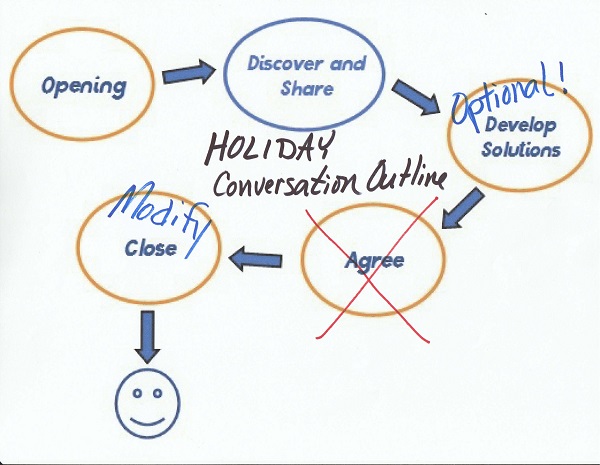
holiday conversation outline

I’ve talked about an effective outline for conversations in the past. Discussions at work usually require some sort of agreement. Many personal conversations do, as well. However, holiday discussions over a turkey rarely require agreement and an action plan to move forward. Keeping this in mind can help us create a peaceful and enjoyable holiday.

Let’s go through a holiday version of the Conversation Outline.

Open. The opening happens when one person brings up a topic. When acting in a leadership position, we want to make sure the topic is focused and clear. Holiday openings made by anyone at the table can be a messier affair.

We can help to start the conversation in a positive way by avoiding assumptions and getting curious. If Aunt Joan says, “People with tattoos shouldn’t be allowed to get food stamps,” she is opening a conversation. Instead of disagreeing immediately and assuming what she means by that comment, we could better serve the group by getting curious.

We could ask, “Aunt Joan, what connection is there between tattoos and receiving food stamps?” Now, our nonverbals our key here. If we ask with the slightest hint of sarcasm or disapproval, all is lost! Curiosity is our guiding light. Why does she think there is a link between tattoos and food stamps? Don’t make assumptions. Ask!

Once we have a clearer picture of her objection, we have our topic of conversation.

Discover and Share. This is the most important step in a conversation. We often skip this step and move straight to positional arguing about the best thing to do.

In Discover and Share, we take time to listen fully by being completely present and listening for understanding. We pay attention to the words being said, tone of voice, facial expressions, and body language. We are curious about everything and ask a lot of questions.

Giving focused attention to someone is a gift. We don’t often feel like we are in the spotlight of someone’s attention, even though we like being seen and heard.

It’s very important to be curious about both the fact and feeling parts of another person’s stance. We usually focus solely on the facts. We can get a lot further along in knowing another person if we ask about their feelings, as well. We could say to Aunt Joan, “This topic seems to make you angry. What about this makes you mad?” Many of our most closely held beliefs aren’t logical and can’t be swayed by logical arguments. Understanding a person’s feelings is the key to understanding the person.

During holiday gatherings, we can keep the sharing part to a minimum. It’s imperative that we keep in mind that we are not trying to change anyone’s mind about anything. We are listening to understand and creating positive relationships. If we manage to offer a perspective the other person hasn’t thought about, it’s a bonus – but not the goal.

The chances of changing Aunt Joan’s mind are minimal at this point. We are giving her the gift of our attention. The greatest gift that we can  give is our time and attention.

Develop Solutions. In business, we begin brainstorming once we have all the facts and feelings on the table. I see it as a funnel that begins with a wide variety of options and slowly narrows down to the best choice.

With family and friends, we can participate in this step if everyone else thinks it would be fun. Coming up with outlandish possibilities to challenges discussed can be enjoyable. It can also be a nightmare. If we start handing possible solutions to Aunt Joan, who is an argumentative person, she is likely to get defensive.

During this phase when acting as a leader, it’s important to continually ask what is best for the people involved in the decision – whether that is a couple, a team, a family, or an organization. Developing Solutions at a holiday gathering is COMPLETELY OPTIONAL.

Agree. Ignore this step entirely! Most holiday discussions at the dinner table do not require agreement. Accept that families can offer us some of the best opportunities for personal growth. We get to practice letting others be themselves without any effort on our part to change them. One conversation with us isn’t going to transform Aunt Joan into an open-minded, empathetic person. We get to practice listening to her fully and allowing her to be who she chooses to be.

Close. If we did need to agree on how to move forward, we would now check to make sure that everyone was on board, and we would explicitly state the agreement. Since we didn’t require agreement, we don’t have anything to clarify.

However, we can close by summarizing what we learned about the other person’s feelings and perspective.

The Discover and Share step of the conversation is the most important step. Holiday gatherings give us the chance to practice being curious without the pressure of coming to an agreement. Bonus: We create a more positive relationship with friends and family. Our holiday gift to the world can be to make each person we talk with feel listened to, understood, and respected.


For a little bit of fun leadership development, join 53 Leadership Challenges at KathyStoddardTorrey.com.

Want to go further with your professional development? Check out the courses offered at PositiveEffectLeadership.com.

If you are interested in taking your career to the next level quickly, contact me for a sample coaching session at KSTorrey@tapferconsulting.com.


The Overconfidence Effect

13 Tuesday Nov 2018

Posted by Kathy Stoddard Torrey in Emotional Intelligence, Leadership, Uncategorized

≈ 1 Comment

Tags

#LeadershipRules #LeadYourselfFirst #KathySays, #OverconfidenceEffect, #seethebigpicture

Rubin's Vase 600 px

The Overconfidence Effect sends a chill down my spine. It says that the more certain you are of something, the more likely it is that you are wrong.

Is that not one of the scariest things you have ever heard? It means that I, a person who makes swift and confident decisions, could often be wrong!

The Overconfidence Effect happens most often when we don’t see all the various perspectives of a situation. In other words, we are not seeing the big picture.

The Rubin’s vase above is an excellent example. If you said it is a picture of a vase, you would be right. It is a picture of a vase. However, I might say that it is a picture of two faces, and I would also be right. We could stand yelling at each other in defense of our facts, but both of us are correct.

However, neither one of us is seeing the entire picture. Rubin’s vase is both a picture of two faces and a picture of a vase. It’s a great metaphor for life. If we are very certain of something, we are probably missing the big picture.

So, the next time that you feel absolutely certain about something, pause and take a step back. Are you seeing the entire picture? Is there another way of looking at this situation that is equally valid? Keep in mind that anyone who disagrees with you also has a reason. It’s a good idea to find out what that reason is so that you can make a decision based on the complete picture.


For a little bit of fun (and free) leadership development, join 53 Leadership Challenges at KathyStoddardTorrey.com.

Want to go further with your professional development? Check out the courses offered at PositiveEffectLeadership.com.

If you are interested in taking your career to the next level quickly, contact me for a sample coaching session at KSTorrey@tapferconsulting.com. #PositiveEffectLeadership #LeadershipRules #KathySays

Noticing the Good

06 Tuesday Nov 2018

Posted by Kathy Stoddard Torrey in Leadership, Positivity, Uncategorized

≈ Leave a comment

Tags

#LeadershipRules #LeadYourselfFirst #KathySays, #noticingthegood, Positivity

noticing good 600 px

Human beings are hardwired to notice and remember the negative things that happen in life. However, we are not doomed to dwell on the less than desirable events of life. We can choose intentionally to change our focus.

As leaders, we want to develop positive relationships. In order to do that, we have to maintain a positivity ratio of at least 5:1. In other words, we must have about five positive interactions with a person for every negative interaction that we have.

In order to maintain a 5:1 ratio, we need to be noticing and commenting on what is going right all the time! It can be a challenge because leaders are trained to look for and comment on problems. However, research on motivation tells us that commenting positively and showing appreciation for a job well done is very effective.

When I first began my quest to create positive relationships, I noticed that I wasn’t regularly saying even one nice thing to my family members in a day. I began to intentionally make one positive comment daily about something that each family member was doing or a quality they had that I admired.

At first, they were suspicious. They wondered, “What is Mom up to?” I kept doing it, and after a while, they began saying positive things to me and each other. The entire family dynamic improved.

We begin to create positive relationships by noticing what is going right both at work and at home. If we see someone doing something that we would like to see them do again, we should comment on it positively. We want to show gratitude for effort and action. The results are astounding!


For a little bit of fun (and free) leadership development, join 53 Leadership Challenges at KathyStoddardTorrey.com.

Want to go further with your professional development? Check out the courses offered at PositiveEffectLeadership.com.

If you are interested in taking your career to the next level quickly, contact me for a sample coaching session at KSTorrey@tapferconsulting.com. #PositiveEffectLeadership #LeadershipRules #KathySays
Indecision

30 Tuesday Oct 2018

Posted by Kathy Stoddard Torrey in Emotional Intelligence, Leadership, Uncategorized

≈ Leave a comment

Tags

#ilovefacts, #indecision, #LeadershipRules #LeadYourselfFirst #KathySays, relationships

indecision 600 px

I don’t usually have trouble making decisions. I learn what I can, evaluate, and decide. I am particularly good at deciding on the outline for workshops. I can see what an organization needs and then come up with the proper structure to provide the needed information and engagement.

However, last week I found myself dithering. Dithering! I am not a ditherer. I disdain dithering. Yet, there I was. Unable to decide whether to put two workshops in a month every other month or one workshop a month for six months or one workshop one month and then a virtual meeting the next. Ack! My mind was running around in circles.

Then I remembered one of the most valuable lessons of my life. When I’m dithering, I don’t have enough information. We can’t make good decisions unless we have all the information that we need. I was guessing at what would be best for the organization that I was working with.

The solution was to set up a meeting and ask what would be best for them. So easy! Finding out how quickly they wanted the training done, how much they wanted to spend, and the logistical challenges of people not all in one place made it easy to create a curriculum and structure.

Sometimes we don’t know everything. Sometimes we can’t know everything. It is possible to get stuck in analysis paralysis. Even after my discussion with the organization, we weren’t 100% sure that all the options would work. However, we pledged to be flexible and communicate any problems or challenges as they arose. Sometimes you just move forward with the intention of adjusting as necessary.

Sometimes, we don’t have any way of knowing what we need to know for a good decision right now. If possible, we want to postpone the decision, especially if it’s a big one like buying a house. I just lived that example.

In January 2018, I left my home and had no idea where to plant roots. I put things that I didn’t need for daily life in a storage room and loaded everything else in a 6’ x 12’ U-Haul trailer.

I was definitely dithering and feeling very lost. Should I move to be with one of my sons? One lives in New Jersey, and the other is in Texas. My sister also lives in Texas, so I have two relatives there, but precious grandchildren in New Jersey.

I started in North Carolina, where I have facilitated a leadership series for 11 years. I lived with a dear friend and did work that I love. It was a great beginning.

When word got out that I was staying in the area between workshops instead of returning to Alabama, an amazing thing happened. Former graduates started reaching out to me. I’ve graduated about 24 people a year. I realized that I had a community that was ready to welcome me with open arms. Add a few very close friendships that I had maintained since leaving the area six years earlier, and I had place that felt familiar and comfortable.

After a small stint of living on my uncle’s ranch after the leadership series was over, I decided that NC was the place that I wanted to call home. In July, I bought a condo. I am not with any blood relatives but am stationed so that I can head either direction to see mine. The people here may not be blood relatives, but they are family here. I also have work! I feel known and respected here for my professional abilities. Anywhere else, I would be starting from scratch professionally.

In January, I had no idea where I would live or what I would do. I am blessed to have so many kind and generous family members and friends who took me in while I was figuring out the next phase of life.

By relieving myself the need to make an immediate decision about where to live, I gave myself time to gather the information that would help me make a decision with which I would feel comfortable. I am very confident that I’ve invested in the right place to call home.

Facts! I love facts! They are the antidote to dithering and the foundation for great decisions.


For a little bit of fun (and free) leadership development, join 53 Leadership Challenges at KathyStoddardTorrey.com.

Want to go further with your professional development? Check out the courses offered at PositiveEffectLeadership.com.

If you are interested in taking your career to the next level quickly, contact me for a sample coaching session at KSTorrey@tapferconsulting.com. #PositiveEffectLeadership #LeadershipRules #KathySays

Coaching a Bad Attitude (Part 5)

23 Tuesday Oct 2018

Posted by Kathy Stoddard Torrey in #Communication, coaching, Emotional Intelligence, Leadership, Uncategorized

≈ Leave a comment

Tags

#coachingabadattitude, #LeadershipRules #LeadYourselfFirst #KathySays, #morale, Motivation

coaching cycle

In part 1 of Coaching a Bad Attitude, we talked about the importance of having a job manual for every single employee. Often, employees with bad attitudes are also people who hold onto knowledge and power. A manual ensures that no one’s daily actions are a mystery, which means that everyone can be let go if necessary.

In part 2, we discussed the importance of the coach having a positive attitude. Leaders are responsible for helping their employees create success. If we get adversarial with employees, we are ensuring a battle during the coaching.

In part 3, we talked about limiting the conversation to observable behaviors. Proving a bad attitude can be a difficult thing.

In part 4, we outlined the best way to have a coaching session, by using the Coaching Dialogue Outline.

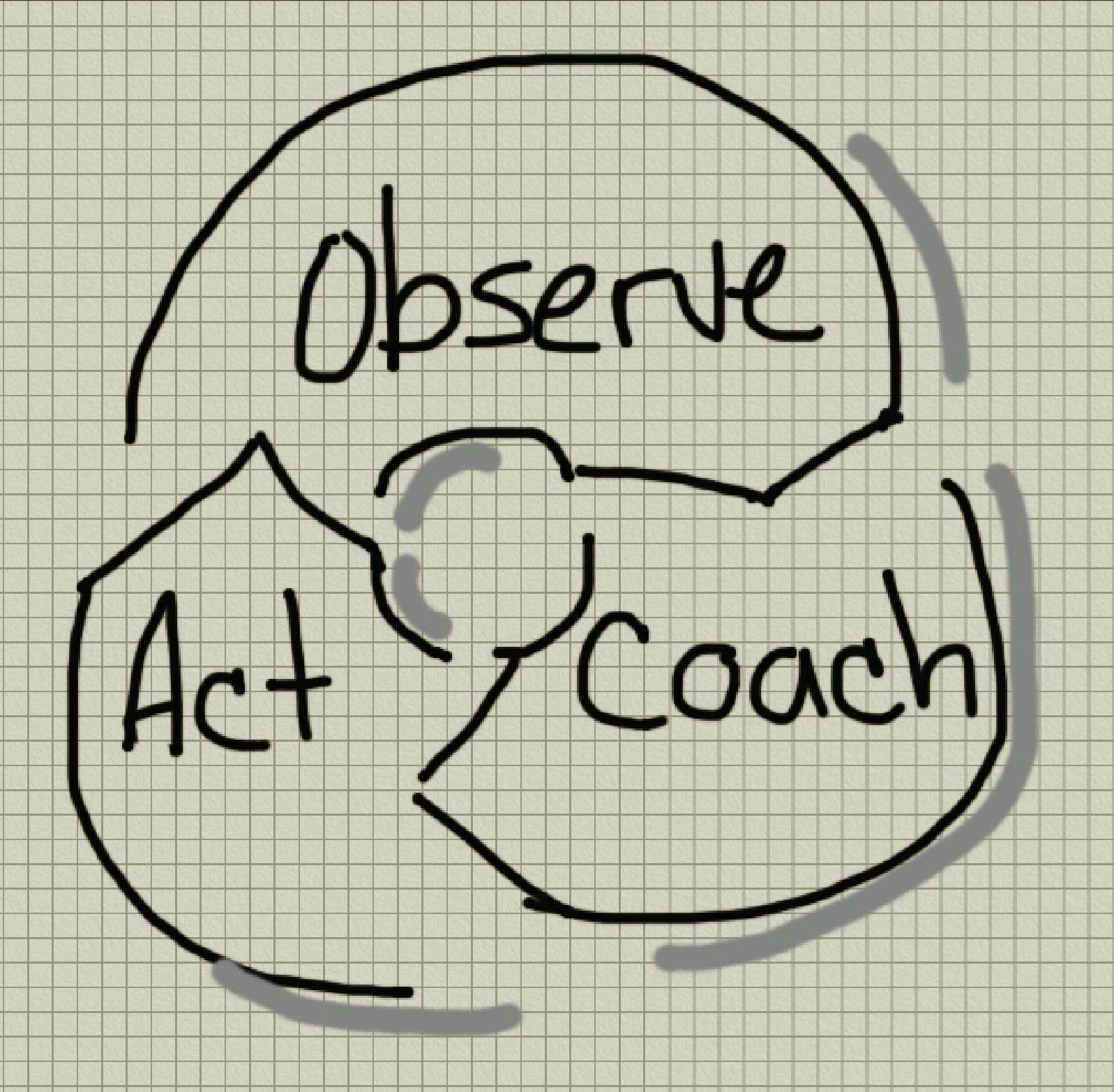
It’s important to note that coaching is not a one-and-done deal; coaching is an ongoing process. The cycle actually starts with observation. We watch our employees and notice what they are doing well and what they could improve on. We are great leaders, so we always comment specifically on the good things in a positive way. Areas of improvement are the topics of coaching.

It’s hard to miss a bad attitude, but it’s important to remember that we are looking for specific behaviors that lead us to believe an employee has a bad attitude. We must have specific, observable behaviors to discuss.

We set up a time to talk and follow the Coaching Dialogue Outline. You can download the outline here. At the end of the conversation, we agree. It’s really important for the next phase of coaching that the agreement be in writing. We can summarize our agreement and then email it to the employee.

We could start the email with: I want to make sure that we are both clear about what we agreed to in our coaching session. A summary is below. Please let me know if I’ve forgotten anything or if you feel that something is not right.

Then say something positive about the coaching session and optimistic for the future.

It is imperative that we pester the employee until we get a response. We must have written confirmation of the employee’s agreement to change his or her behavior. Resend the email if necessary, and ask for confirmation. If that doesn’t work, print the email, hand it to the employee, stand there while he or she reads it, and then get a signature.

People can be slippery and claim not to have understood or not to have agreed to what was discussed in the coaching session. People with bad attitudes are often adept at dodging accountability. Do not let that happen. All is lost if we don’t get written confirmation of our agreement.

The next stage of coaching is action. It’s imperative that we follow through on anything we committed to do. How can we expect employees to adhere to our agreements if we don’t? Now is also when the employee will change his or her behavior. We both put what we agreed to during the coaching session into action.

Now we are back to observing. This time we know exactly what we are looking for as far as acceptable behavior. If the employee makes a positive change, yay! We want to be sure to comment on each and every good thing that we see him or her do. Sometimes, that’s all it takes. However, it’s rarely a one-and-done with a bad attitude.

Usually, we’ve got to go through the coaching cycle again. We observe that the behavior hasn’t changed or that the employee is expressing the bad attitude in new ways. Then we start the cycle again. We coach using the Coaching Dialogue Outline, we get written confirmation of our agreement, and then everyone acts as agreed upon.

So, how long do we continue in the coaching cycle? In workshops, I have people guess how many times we should go around before giving up. The most popular answer that I get is three, but the answer is not a number. We go around the coaching cycle until we lose hope. When we feel certain that there is no point in going around one more time, it’s time to leave the coaching cycle and begin the organization’s official termination policy. It’s essential to get HR involved at this point and do exactly as we are told. HR will be grateful for your documentation of the coaching process.

Lots of leaders have trouble letting an employee go. It’s particularly troubling to terminate an employee who does a good job but has a bad attitude. Know that we are freeing the person to find a job that is better suited to his or her talents and abilities.

Also know that a bad attitude is toxic. One person can destroy the motivation and morale of a team. One person’s bad attitude can also create a lot of turnover, which is quite expensive. Studies show that it costs between 50-90% of an employee’s annual salary to find and train a replacement.

In the end, it’s up to the employees to change bad attitudes and negative behaviors. Some just can’t do it. They are too ingrained in their thought patterns and don’t want to see and do life differently. It is their choice – and our choice not to tolerate behavior that affects productivity, efficiency, positivity, morale, and turnover.


For a little bit of fun (and free) leadership development, join 53 Leadership Challenges at KathyStoddardTorrey.com.

Want to go further with your professional development? Check out the courses offered at PositiveEffectLeadership.com.

If you are interested in taking your career to the next level quickly, contact me for a sample coaching session at KSTorrey@tapferconsulting.com. #PositiveEffectLeadership #LeadershipRules #KathySays

Coaching a Bad Attitude (Part 4)

16 Tuesday Oct 2018

Posted by Kathy Stoddard Torrey in coaching, Leadership, Uncategorized

≈ 1 Comment

Tags

#coachingabadattitude, #conversationoutline, #discoverandshare, #LeadershipRules #LeadYourselfFirst #KathySays

Conversation outline for coaching

In part 1 of Coaching a Bad Attitude, we talked about the importance of having a job manual for every single employee. Often, employees with bad attitudes are also people who hold onto knowledge and power. A manual ensures that no one’s daily actions are a mystery, which means that everyone can be let go if necessary.

In part 2, we discussed the importance of the coach having a positive attitude. Leaders are responsible for helping their employees create success. If we get adversarial with employees, we are ensuring a battle during the coaching.

In part 3, we talked about limiting the conversation to observable behaviors. Proving a bad attitude can be a difficult thing.

Now we are going to outline the best way to have a coaching session by using the Coaching Dialogue Outline. Let’s go through it step-by-step.

1. Before the Discussion. We’ve already talked about this step. We want to bring in a positive attitude and be clear on the outcome that we want from the coaching. Before the coaching session, we also want to consider what the challenges might be for the employee. Generally, the obstacles are ability, resources, or attitude.

For employees with bad attitudes, the root cause may be that they don’t have the resources that they need to perform their jobs. If so, that’s something that we can fix as leaders. Perhaps they don’t have the needed skills and abilities for the job. If it’s a training issue, that one is also on us to fix.

It’s important to consider possible reasons for the bad attitude, but it’s imperative that we don’t make assumptions.

Here’s a summary:

  • Consider ability, resources, and attitude
  • Intentionally create a safe space for the coaching by having a positive and helpful attitude
  • Clearly define the desired outcome

 2. Opening. In this step, we are face-to-face with the employee, and we are telling them what we want to talk about. It’s important to let your positive attitude and intention to be helpful shine out during this step. We can use the CAR format to help us stick to observable behaviors and business-based results.

This is a good time to remind the employee and ourselves that this is a dialogue, not a diatribe. As leaders, we need to do more asking than telling. We are problem-solving together with the employee, not telling the employee what he or she needs to be doing.

Here’s a summary:

  • Use the CAR (circumstance, action, result) format as a good objective opening
  • Emphasize that this is a dialogue

3. Discover and Share. This is THE MOST IMPORTANT STEP! When we skip this step, we miss the information that we need to solve the problems and overcome the challenges.

We, as leaders, want to make no assumptions and put all our preconceived notions aside. During this phase, we pretend like we know nothing and get really curious about what is going on. Remember, we hold onto our positive attitude while asking thoughtful questions.

If we enter the discussion with an open mind, we are listening carefully and willing to change our minds about a situation. It is possible that the employee has a brilliant suggestion. We must put our egos aside and listen without trying to “win.” We all win when our employees are successful.

Lastly, the conversation must include both facts and feelings. One way to bring feelings into the conversation is to name the feelings that we see and watch the employee’s response. For example, I could say, “Henrietta, it seems like this topic annoys you.” It could also be that she is fearful, upset, feeling disrespected, etc. If we don’t get it right, they will let us know, but we are getting to the heart of an issue when we discuss the feeling part of it.

Here is a summary:

  • Set all assumptions and preconceptions aside, and listen without judging
  • Be open to influence
  • Share information clearly without trying to “win”
  • Include a discussion of both facts and feelings

Here are some possible questions to ask:

  • What obstacles are you facing?
  • What feelings are present?
  • Have you faced a challenge like this before? If so, how did you deal with it?
  • Do you see any patterns here?
  • If circumstances were perfect, what would the situation look like? Is there a way to create those circumstances?

4. Develop solutions. This is the brainstorming step. We start by creating as many crazy solutions as possible. In the beginning, we sideline any reality checks. It’s fun! We are asking our employee to get creative.

Then we start discussing the possible solutions that we’ve created, with an eye to what is realistic. Someone’s job might be a lot easier if we hired an assistant for him or her. However, that might not be the best solution for the organization. It can be helpful to discuss the difference between what is best for the employee and what is best for the team, group, or organization. They aren’t always the same.

Maybe we can’t hire an assistant. Are there other ways to remove some responsibilities from the employee if he or she is truly overwhelmed? Sometimes great solutions begin with outrageous ideas.

We want our employees to solve their own problems if possible. They will be more likely to follow through on their own ideas than ours. Also, they know more about their own situation and abilities. As much as possible, we want them to create the solutions.

Here is a summary:

  • Brainstorm as many solutions as possible, without limitation
  • Then discuss options in terms of what is best for the team, group, or organization
  • Allow the employee to come up with as much as possible

5. Agree. We’ve done all the hard parts now. This step is just ensuring that we and the employee are on the same page. We want to capture what we’ve decided in writing. The summary below captures the things to consider in this step.

Here’s a summary:

  • End the discussion with an action plan and summary
  • Ensure that the employee creates and/or supports the action plan as much as possible
  • Connect the action plan with the initial desired outcome
  • Consider ability, resources, and attitude
  • Make sure the action plan is SMART (specific, measurable, attainable, relevant and time-bound)

6. Close. And we are done! The last thing to do is to check in with the employee to see how he or she is feeling. Ideally, they are positive and excited about moving forward with the plan. That might be a bit much to hope for when coaching employees with a bad attitude, but we can express confidence in their ability to move forward and follow the plan. It’s a good time to remind them of the positive business outcomes that everyone will receive as a result in the change in behavior.

Here’s the summary:

  • Check the relationship
  • Express confidence in agreement and employee
  • Summarize the benefits of the behavior change

The conversation is complete, but the coaching is far from done. Next time we will discuss the bigger picture – the Coaching Cycle.


For a little bit of fun (and free) leadership development, join 53 Leadership Challenges at KathyStoddardTorrey.com.

Want to go further with your professional development? Check out the courses offered at PositiveEffectLeadership.com.

If you are interested in taking your career to the next level quickly, contact me for a sample coaching session at KSTorrey@tapferconsulting.com. #PositiveEffectLeadership #LeadershipRules #KathySays

Coaching a Bad Attitude (part 3)

09 Tuesday Oct 2018

Posted by Kathy Stoddard Torrey in coaching, Emotional Intelligence, Leadership, Uncategorized

≈ 2 Comments

Tags

#CAR, #coachingabadattitude, #LeadershipRules #LeadYourselfFirst #KathySays

CAR STP feedback 550 px

In part 1 of Coaching a Bad Attitude, we talked about the importance of having a job manual for every single employee. Often, employees with bad attitudes are also people who hold onto knowledge and power. A manual ensures that no one’s daily actions are a mystery, which means that everyone can be let go if necessary.

In part 2, we discussed the importance of the coach having a positive attitude. Leaders are responsible for helping their employees create success. If we get adversarial with employees, we are ensuring a battle during the coaching.

So now the job manual is done, and we have the proper attitude. The next thing to consider when planning to coach an employee with a bad attitude is, “What is the outcome that I am looking for?”

Most people immediately answer, “I want him or her to have a good attitude!” However, discussing the attitude itself is usually counterproductive. If you sit down to coach me and say, “You need to change your attitude,” my response would be, “What attitude? I don’t have an attitude. You have an attitude!” And we are off and running in a conversation that runs in circles.

We want to discuss the specific behaviors that lead us to believe that the person has a bad attitude. Is there a lot of eye-rolling and negative body language going on? Discuss that! Are there foot-dragging and bad-mouthing behaviors? Discuss the specific behavior that you want to change. It’s the behaviors associated with a bad attitude that we can prove and discuss.

Observable behaviors are facts that a person cannot deny. We want to give specific instances of when a person behaved in a way that was detrimental to productivity, efficiency, or morale. There is a formula that we can use to help us stay on track. It’s called a CAR, which stands for Circumstance, Action, and Result.

We start with Circumstance by describing what was going on when the person displayed the specific behavior that we want to see changed. For example, let’s say that we have an employee named Henrietta who rolls her eyes at what other people say during meetings. We could start with “I want to discuss your reaction to Joan’s comments during our staff meeting last week.” We’ve told the person exactly when and where the behavior happened.

Next, we want to name the specific Action that Henrietta did. We might say, “When Joan suggested that we change the way we process paperwork, you rolled your eyes.” By the way, eye-rolling is totally unacceptable behavior. Next, we are going to explain why.

We explain the detrimental results that come from eye-rolling. It could go like this: “When you roll your eyes, it looks to all of us like you are disapproving of what has been said, which makes people hesitant to speak up. It’s important for the team’s success that everyone feels free to share ideas and even disagree.” We could go on to mention Google’s Project Aristotle and how essential psychological safety is to the creation of a successful team. We are great leaders, so we are sure to have mentioned this before.

We might also say that the eye-rolling doesn’t let us know why Henrietta disagrees. We want to remind her that we value her perspective and want to hear it. We want to hear what Henrietta thinks, but we want her to say it in a respectful way. Now would be a good time to remind Henrietta of our Designed Alliance, which states that we speak to each other respectfully even when we disagree. We are fantastic leaders, so we are sure to have created a Designed Alliance with our team.

Eye-rolling is probably only one of the ways that Henrietta flies her bad attitude flag, but it’s best to deal with one behavior at a time. Pick the behavior that is most damaging to the morale and productivity of the team, and start there.

The CAR format is an excellent way to begin a coaching session, but it’s just the opening. We will talk about the rest of the process next time.


For a little bit of fun (and free) leadership development, join 53 Leadership Challenges at KathyStoddardTorrey.com.

Want to go further with your professional development? Check out the courses offered at PositiveEffectLeadership.com.

If you are interested in taking your career to the next level quickly, contact me for a sample coaching session at KSTorrey@tapferconsulting.com. #PositiveEffectLeadership #LeadershipRules #KathySays

Coaching a Bad Attitude (part 2)

02 Tuesday Oct 2018

Posted by Kathy Stoddard Torrey in Emotional Intelligence, Leadership, Uncategorized

≈ 4 Comments

Tags

#coachingabadattitude, #humor, #LeadershipRules #LeadYourselfFirst #KathySays, #properperspective

PEA 600 px

Last time we talked about the importance of having a job manual for every person in an organization to ensure that no one is indispensable. Many times, the person with the bad attitude is a star achiever who holds onto information tightly. We should all be replaceable and know it.

Before we start coaching someone, it’s important that we enter the dialogue with the right attitude because it creates a supportive container for the discussion. The container that we create determines the success or failure of the coaching.

As leaders, it is our job to help everyone be successful. We are not accountable for own actions alone. We can declare ourselves successes only if everyone who works for us can do the same. As we consider coaching someone, we want to remember that we aren’t trying to show them who’s boss or put that person in his or her place. We are trying to help them. A bad attitude can destroy a person’s career and damage a team’s morale. As leaders, we have an obligation to help everyone improve and perform their best, and that includes dealing with a bad attitude.

An adversarial attitude ensures that the coaching will fail. The person being coached gets defensive and doesn’t listen. The bad attitude will only increase. It creates a vicious cycle of negativity between the coach and the person being coached.

Envision the attitude problem as an object. When we have an adversarial attitude, the object is sitting on a small, square table between us and the other person. We are squaring off against each other with the problem between us. We want to move over to the other side of the table and face the object side-by-side. We want to face the problem or challenge together. This, of course, goes for all types of coaching and problem solving.

When I work with groups or people having challenges, I name the problem and then choose an object to represent it. The object can be anything – a water bottle, a piece of paper, a paperclip. I place it between them and then have us all move to one side. We all stand together shoulder-to-shoulder and look at the challenge. It’s amazing how much the personal dynamics change when we all stand together on one side of the challenge.

Being positive and helpful towards a person with a bad attitude is difficult, but effective leaders have the self-discipline to stay focused and keep the end goal in mind. Great leaders can put their egos aside and have an objective conversation without getting caught up in the negativity.

Next time we will talk about a few other things to do before the coaching session. However, the rest of the process depends on the leader bringing a positive perspective and attitude to the coaching.


For a little bit of fun (and free) leadership development, join 53 Leadership Challenges at KathyStoddardTorrey.com.

Want to go further with your professional development? Check out the courses offered at PositiveEffectLeadership.com.

If you are interested in taking your career to the next level quickly, contact me for a sample coaching session at KSTorrey@tapferconsulting.com. #PositiveEffectLeadership #LeadershipRules #KathySays

Coaching a Bad Attitude (part 1)

25 Tuesday Sep 2018

Posted by Kathy Stoddard Torrey in #Communication, Leadership, Uncategorized

≈ 4 Comments

Tags

#coachingabadattitude, #Communication, #LeadershipRules #LeadYourselfFirst #KathySays

feedback 1 checklist 500 px cropped

Most, if not all, of my coaching clients face the challenge of an employee with a bad attitude. One person with a bad attitude can have an enormous negative impact on a team or group. It’s amazing how much trouble one person can create if they are hell-bent on constant complaining and criticism.

Many times, the complainers are darn good employees. They are knowledgeable and competent at their jobs. They are usually productive, and if it wasn’t for the attitude, they would be considered star performers.

These negative stars usually know that they are good and that the organization relies on them. In many instances, they consider themselves untouchable because of their value and knowledge. Let me assure both them and their leaders that they are expendable.

First, if you are a leader, and one person holds the keys to the kingdom in terms of organizational knowledge and power, change the situation. It’s not healthy. An organization must be able to function smoothly if something happens to one employee. Anyone one of us could be hit by a bus!

There should be a very detailed job description for each employee, including the leader. This description is like a manual that outlines the employee’s daily, weekly, monthly and yearly responsibilities. It would read like a checklist with descriptions. If I unexpectedly didn’t make it to work for a week, someone else would be able to pick up the job description manual and have a pretty good idea of what needs to be done.

Yes, creating these manuals is tedious and time-consuming, but well worth the effort. In addition to insurance that necessary things will get done should someone not show up, the manual adds needed transparency. As leaders, we have a very clear picture of how each employee spends his or her time, which allows us to ensure that the actions are ones that truly help the organization move forward with its mission.

The first step to dealing with an employee who has a negative attitude is to make sure the employee is not indispensable. Share the knowledge with detailed job descriptions, and cross-train as much as possible!

We will talk about how to coach a person with a negative attitude next time.


For a little bit of fun (and free) leadership development, join 53 Leadership Challenges at KathyStoddardTorrey.com.

Want to go further with your professional development? Check out the courses offered at PositiveEffectLeadership.com.

If you are interested in taking your career to the next level quickly, contact me for a sample coaching session at KSTorrey@tapferconsulting.com. #PositiveEffectLeadership #LeadershipRules #KathySays

← Older posts
Newer posts →

Follow Blog via Email

Enter your email address to follow this blog and receive notifications of new posts by email.

Join 214 other subscribers
  • RSS - Posts

Categories

Archives

  • December 2020
  • November 2020
  • October 2020
  • September 2020
  • August 2020
  • July 2020
  • June 2020
  • May 2020
  • April 2020
  • March 2020
  • February 2020
  • January 2020
  • December 2019
  • November 2019
  • October 2019
  • September 2019
  • August 2019
  • July 2019
  • June 2019
  • May 2019
  • April 2019
  • March 2019
  • February 2019
  • January 2019
  • December 2018
  • November 2018
  • October 2018
  • September 2018
  • August 2018
  • July 2018
  • June 2018
  • May 2018
  • April 2018
  • March 2018
  • February 2018
  • January 2018
  • December 2017
  • November 2017
  • October 2017
  • September 2017
  • August 2017
  • July 2017
  • June 2017
  • May 2017
  • April 2017
  • March 2017
  • February 2017
  • January 2017
  • December 2016
  • November 2016
  • October 2016
  • May 2015
  • April 2015
  • March 2015
  • February 2015
  • January 2015
  • February 2014
  • January 2014

Powered by WordPress.com.