• About

Kathy Stoddard Torrey

~ Leadership Coach and Trainer

Kathy Stoddard Torrey

Tag Archives: #KathySays

Challenges of Knowing Yourself

28 Tuesday Feb 2017

Posted by Kathy Stoddard Torrey in Uncategorized, Uncovering Your Authentic Self

≈ 2 Comments

Tags

#KathySays, #LeadershipRules, #LeadYourselfFirst, #personaldevelopment, #personalgrowth, #perspective, #progress, #selfknowledge, #UncoveringYourAuthenticSelf

know-yourself

March Series: Uncovering Your Authentic Self

March is my birth month, so we are going to talk about me – and you! Let’s take this month to explore who we are, why we are that way, and who we want to be. It’s going to be fun! What could be more interesting than learning more about ourselves?

Challenges of Knowing Yourself

I had a tough time during 2001 and 2002. My mom died in January of 2001, and my husband deployed a few months after her death. My mom had lived with us for 10 years. It was the first time in a decade that my sons and I would be alone. They were 10 and 12 years old.

At that time, I led our Family Readiness Group. It was my job to keep more than 300 families informed about what was going on, offer help and guidance, and step in whenever there was an emergency.

I gave it my best shot, but didn’t handle anything as gracefully or thoroughly as I could have. The following 18 months was an enormous struggle, and at the end of it, I was burnt out completely. I heard my children saying negative, sarcastic things, and I realized that they were echoing me. I knew I needed to change, but I had no idea how.

When my husband came back, we moved to Carlisle, PA. I was still struggling. I’d gained at least 15 pounds, and I wasn’t happy. I thought that I was hiding my sadness and frustration, but one day my husband sat down next to me and said, “You are so unhappy. Do whatever you need to do to find happiness.” I was startled.

I thought about his comments for a while, and realized that the problem was that I didn’t know what would make me happy. I decided to find out.

who-am-i

The first thing I did was to check in with myself about every activity I did. I would ask myself, “Do I like doing this?” I was surprised to learn that I did not enjoy military spouse activities. I had in the past, so this was a change that I hadn’t noticed. I also had felt that my attendance was at least expected, if not required. Times were different then. However, my husband had said “Do whatever you need to do.” So, I drastically cut back on attending military spouse events. It felt so freeing!

It wasn’t hard to figure out what I didn’t like to do. I uncovered those all the time. What I had trouble finding was things that I enjoyed. I discovered that I wasn’t doing anything that I truly liked! I began experimenting with new behaviors, and I went back to some old favorites.

I’d always enjoyed walking. So, I started walking more. I also knew that I loved to learn. I joined a group called Facilitating Leadership and Group Skills at the Army War College. The subject matter was all about personal development, and it fascinated me. During this time, I discovered that I loved being up in front of a group leading discussions and teaching new concepts. Thi is where I got my start in leadership training and facilitation.

I began to discover then and continue to believe now that we humans like a challenge. We thrive on personal development. We are happier when we are learning things about ourselves and the world.

I recently read an interesting quote in a Harvard Business Review article entitled Shakespeare’s Characters Show Us How Personal Growth Should Happen. The author, Declan Fitzsimons, states that Shakespeare’s plays are riveting because he doesn’t just let us get to know a static character. The characters go through tremendous change and personal development, and we get to watch.

Fitzsimons writes, “Shakespeare teaches us moderns that in the face of an uncertain world, self-awareness – that much-vaunted leadership quality – is only worthy of the name when it is revelatory. And it can only be revelatory when we are willing to concede that we know ourselves only partially.”

We do, in fact, only know ourselves partially. I am not the only person who is unaware of my preferences, weaknesses, and strengths. Here is a Johari Window which is a model that can be used to help us better understand our relationship with others and ourselves.johari-window-2
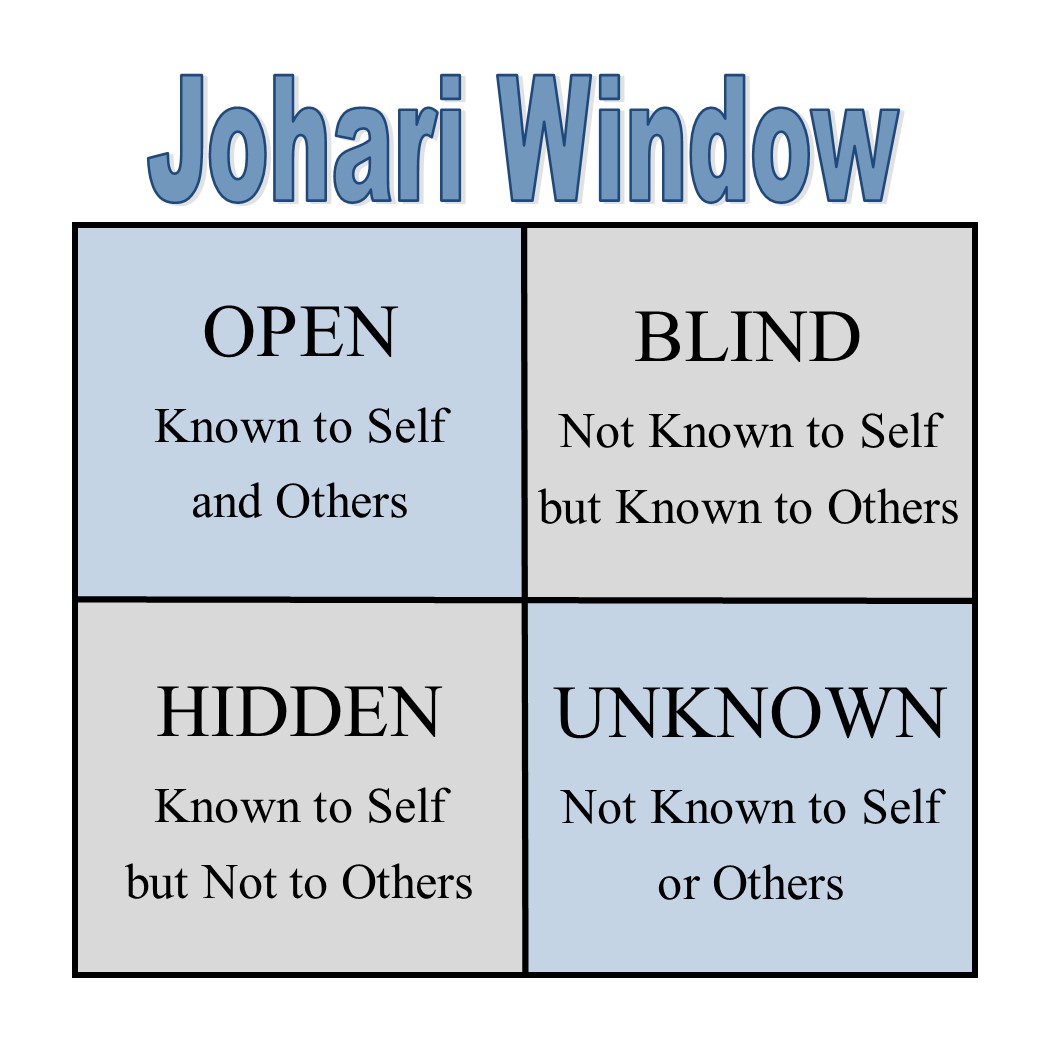
Any information that I share with someone else is in the Open area. Once I let you know that I wear a size 8 shoe, it’s in the Open region. Hidden items are things that I know, but no one else knows. We all have lots of those! We should have lots of them. We don’t share everything. Unknown items are things that I don’t know about myself and no one else knows either. For example, maybe I could be a great computer programmer and neither one of us knows it.

The one that’s interesting is the Blind region. Those are things that other people know about us that we don’t know about ourselves. Perhaps everyone else can see that I am inspirational, but I don’t realize it. Maybe I have a distracting habit of messing with my hair that drives everyone crazy, and I don’t even realize that I do it.

It’s important for all of us to know that we have items in the Blind region of a Johari Window. Some of them are good qualities, and some are not. Discovering those things about ourselves is revelatory! The new information can transform us. Like Shakespeare’s characters, we don’t remain static; we develop and grow. We are interesting!

Learning about ourselves is a challenge that can be exciting and gratifying. When I began my journey of self-discovery, I felt lost. I didn’t know what I liked, what my strengths were, what I liked to do, or what I wanted to accomplish.

This month, I am going to get reacquainted with myself. I hope that you will join me, and we can move a few things from the Blind region to the Open one on the Johari Window.  We want to continue to grow, change, and learn because it is a life-long process that keeps us interested and interesting.


For a little bit of fun leadership development, join 53 Leadership Challenges at KathyStoddardTorrey.com.

Want to go further with your professional development? Check out the courses offered at PositiveEffectLeadership.com.

If you are interested in taking your career to the next level quickly, contact me for a sample coaching session at KSTorrey@tapferconsulting.com.

You’re OK, too!

21 Tuesday Feb 2017

Posted by Kathy Stoddard Torrey in Feelings, Leadership, Uncategorized

≈ Leave a comment

Tags

#KathySays, #OtherCompassion, #peoplearepeople, #personalgrowth, #resiliency, Feelings, Positivity, relationships

other-compassion

February Series: Feelings

You’re OK, too!

Let’s end this series on feelings by talking about our feelings for others. I’m going to tell you that it’s worthwhile to cultivate positive feelings towards others, and I imagine your initial response will be that there are some people for whom you will never have positive feelings. I’ve had this conversation before!

I know that there are annoying and obnoxious people out there. Some don’t seem to have any morals or common sense. It feels like a lot of work NOT to dislike those people! I get it. I’ve been there. I am there! However, I want you to know that it is worth the effort – for you.

It’s difficult to hold the heavy lens of negativity and not have it affect your life. It’s next to impossible to hold it up some of the time and drop it other times. If we look through a negative lens at some people, we probably will use it to look at all people. We begin a cycle of negativity in which we expect to see negative behaviors, provoke them by our expectation, and then feel satisfied and right when others behave in the negative way that we predicted. It’s a messy quagmire, and it’s exhausting.

On the other hand, a spiral of positivity is an uplifting and energizing cycle to create. There are other benefits as well that include increased resiliency, increased satisfaction with life, less inflammation in your body, increased broad-mindedness (our brain actually processes information differently), increased immunity to viruses, better ability to connect with others, less depression, and better focus. Wow! That’s quite a list!

OK, so positivity is a great thing and feeling empathy and kindness towards other is going to help us achieve it. How do we go about creating it? There are some obnoxious, annoying, dishonest, selfish, callous, infuriating, tactless people out there! Ack! Take a breath and read on.

In my leadership series, I begin with a book called Leadership and Self-Deception. I highly recommend it. In a nutshell, the book promotes the idea that all personnel and personal issues are caused by one thing: we don’t see other people as people.

Here is an example from the book:  Imagine that you are sitting on an airplane next to the window, and it is open seating. No one has an assigned seat. The middle seat is open. Do you put your bag in the middle seat and try to discourage people from sitting there even though the flight attendant has announced that the flight is full. Do you judge each person by how much of an inconvenience that they will be? Does one look too chatty? Another have too many bags?

In that moment, are you seeing the other passengers walking down the aisle as people like you who have a need to sit down or as annoying objects that threaten to invade your personal space? How would you feel as a person walking down the aisle?

The book explains that theory in detail, but basically, we want to see everyone around us, even the obnoxious ones, as people. Of course, that doesn’t mean that we have to put up with unethical behavior or disrespect. It means that we set boundaries and give feedback in a compassionate and kind way.

We talked about self-compassion in last week’s blog (https://kathystoddardtorrey.wordpress.com/2017/02/14/im-ok-of-course/), and this week, we are talking about practicing “other-compassion.” It’s a new term that I just made up! The key is to see everyone as having needs and dreams equal to your own. We want to treat them the way that we want to be treated. Sound familiar?

I continue to work on seeing other people as people. When I begin to slip by magnifying someone’s faults and objectifying them, I repeat to myself, “This is a person with worries and dreams equal to my own.”

There is another way to develop empathy for others that has some impressive research behind it. Loving Kindness Meditation, increases positivity with all the benefits mentioned earlier. It also increases our empathy for others and our feelings of friendliness and compassion.

There are no right or wrong ways to do it; there are just guidelines. You can search online and find all types of Loving Kindness Meditations. You can listen to on or create statements to use in the meditation that have the most power and meaning for you.

Basically, during the Loving Kindness Meditation, we say three or four phrases several times. The first time we say the phrases, we say them to ourselves. The most important part of the meditation is to create and hold onto a feeling of friendliness, compassion, joy, and expansiveness as you say the phrases. Here is an example:

  • May I be filled with loving kindness.
  • May I be well in body and mind.
  • May I be at ease and happy.

Then we say the same phrases while thinking of someone with whom we feel close.  We would think, “May you be filled with loving kindness.” It’s important to hold onto the positive feeling while thinking the phrases each time. It’s not too hard to say the phrases with feeling when it’s toward someone that we you are fond of.

Next, we move on to someone who we feel neutral about, someone we don’t really care for, and finally everyone in the world. Use the same three to four phrases each time, and focus on maintaining the feeling of compassion and acceptance.

This practice can be a game changer in your life. You can see results by meditating for 10 minutes about 5 or 6 times a week. Who wants more resiliency when facing challenges and more satisfaction with life? I do, I do! For me, resiliency is one of the biggest benefits of Loving Kindness Meditation. The world is full of challenges, and I welcome the grit that will help me to overcome them.

The goal is to incorporate Loving Kindness Meditation into your life for eight weeks. By then, you should see results that will motivate you to use the meditation for the rest of your life.

In the end, we win when we develop feelings of friendliness and compassion for others. We get to put down the heavy lens of negativity. We begin to see the positive things around us and expect more of them. We create a self-supporting cycle of positivity that improves our “other-compassion,” our own health, and our emotional well-being.


For a little bit of fun leadership development, join 53 Leadership Challenges at KathyStoddardTorrey.com.

Want to go further with your professional development? Check out the courses offered at PositiveEffectLeadership.com.

If you are interested in taking your career to the next level quickly, contact me for a sample coaching session at KSTorrey@tapferconsulting.com.

Everything Has A Fact and A Feeling Part

07 Tuesday Feb 2017

Posted by Kathy Stoddard Torrey in Feelings, Leadership, Uncategorized

≈ 1 Comment

Tags

#Communication, #conflict, #factsandfeelings, #KathySays, Feelings

fact-and-feeling-2

February Feelings

Everything has a fact and a feeling part.

Feelings are an important part of being human, and they are present in every facet of life. It’s valuable to keep in mind that every message and situation has both a fact and a feeling part. One must identify both parts in order to deal with a conflict effectively or to communicate clearly. I learned this lesson late in life, and it would have saved me some time and trouble if I’d known about it sooner.

For 20 years, I led volunteers as an Army spouse. In one group that met monthly, there was one young woman who always sat at my right hand and objected to everything that the group proposed. She objected on a factual level – things like logistics, budget, and convenience. She slowed us down every single month.

If I’d been more savvy, I would have figured out that it wasn’t the facts that bothered her. She was having strong feelings that I was ignoring.  I had a vague notion that she was unhappy or resentful, but I had no idea why. If I’d asked and listened, I could have saved us a lot of time arguing over facts for no good reason.

It’s a good idea to make a practice of identifying the fact and feeling part of situations. Is your pre-teen refusing to wash dishes? If so, then ask how he or she feels about washing the dishes. Of course, no one gets out of washing the dishes just because they don’t like the job. However, finding out why your pre-teen doesn’t like it can open an interesting discussion.

If a coworker consistently objects to following a procedure, find out why. You may get factual responses at first, but ask some curious questions about feelings until you know how he or she feels about the procedure. The discussion will usually include why he or she has those feelings, and that’s where the valuable part of the discussion resides. Once we know the emotions that a person is feeling and why, we have what we need to start finding a solution to the challenge.

You can even ask yourself about the feeling part of a personal situation. It’s great to list the facts and to know the pros and cons of possible actions. It is also enlightening to know how you feel about those possible actions and why. You can gain insight into your values and priorities by getting in touch with your feelings.

The answers to the question of what someone is feeling and why are usually surprising – something that you wouldn’t have guessed. The only way to identify the feeling part of a situation is to ask! The answer is the information that you need to begin finding a solution.


For a little bit of fun leadership development, join 53 Leadership Challenges at KathyStoddardTorrey.com.

Want to go further with your professional development? Check out the courses offered at PositiveEffectLeadership.com.

If you are interested in taking your career to the next level quickly, contact me for a sample coaching session at KSTorrey@tapferconsulting.com.

I’ve Got A Bad Feeling About This!

31 Tuesday Jan 2017

Posted by Kathy Stoddard Torrey in Emotional Intelligence, Feelings, Leadership, Uncategorized

≈ 1 Comment

Tags

#EmotionalIntelligence, #emotions, #KathySays, #stuffing, Feelings, Heart

valentine-dog

Feelings

February is the month of Valentine’s Day and declaring our feelings. Therefore, it feels like a good time to discuss the good, the bad, and the ugly emotions that we all experience – and what to do with them.

I’ve got a bad feeling about this!

We all have feelings. In my mind, that isn’t always a good thing. I’ve had a love/hate relationship with emotions for years! I am not a natural touchy-feely type; however, I have learned that there is value in all types of emotions.

If we think about emotions as light and dark, then we know one type by comparing it  to the other. For example, we experience joy in the context of sadness. We can’t experience one without the other. If we only feel one type o emotion, it’s like looking at something white on a white background.

One quote that I heard in high school has stayed with me for almost 40 years: “The deeper that sorrow carves into your being, the more joy you can contain.” – Kahlil Gibran,  The Prophet (I will admit that I did not remember where the quote came from, and I had to look it up.)

There was a time when I was awful at dealing with my feelings. That is to say, I stuffed them most of the time. If a feeling made me the least little bit uncomfortable, it was banished. I was very good at not feeling my feelings.

I began my life coach training in 2005, and they wanted to talk about feelings a lot. I didn’t want to play in the beginning! The instructor would walk past some poor person trying to coach me around my feelings, and he would say, “Get her out of her head! She’s always in her head.” Hmmm. Let me think about that.

I do have a tendency to live in my head. I am very logical, but I saw the value in embracing feelings so I changed how I respond to emotions. I decided to view emotions as friends rather than enemies.

The first step to embracing your feelings is to know that dark feelings are not bad and light feelings are not good. Feelings just are, and all feelings are okay. We can react poorly to any emotion, but the emotion is just a natural part of being human.

The next step is to figure out exactly which emotion is visiting. When I feel an emotion, I accurately name it rather than stuffing it. For example, if I feel angry, I would say to myself, “Wow! I am feeling very angry, and disappointed, and frustrated!” Stepping outside ourselves to objectively define how we are feeling takes away some of the power of the emotions.

In the beginning, I wasn’t even good at labeling light emotions! I wasn’t sure about what I liked or what brought me joy. I’d spent many years as a stay-at-home mom who did what everyone else liked to do. I did enjoy those things, but I didn’t know what I enjoyed in a vacuum outside of other relationships. I spent a lot of time asking myself, “Do I like doing this? Does this bring me joy?” and “What emotion is this creating?” It was a little unsettling to realize that I didn’t know myself well at all.

It took me a while, but I did improve. It helped to go through a list of various emotions and then decide which one felt most accurate. I would think, “Is this happiness? No. Is this relief? No. Is this contentment? Yes, I think I am content.” A written list of emotions can help you explore your feelings. If you search online for “list of human emotions,” you will get a bunch of results.

Embracing emotions can be scary. I find comfort in the fact that they are just visiting, and not setting up a permanent residence. I guess that one could argue that depression is sadness staying too long. We definitely should get help if a dark emotion won’t go away. However, most of the time our emotions will come and go.

Lastly, it’s a useful exercise to take a few minutes and examine why we are feeling a particular emotion. A dark emotion can be the result of something challenging  a value that we hold or our ego reacting to something that makes us feel small. A light emotion can tell us what we like to do and who we like to be around.

Remember that you aren’t a turkey, and you shouldn’t be stuffing yourself with unwanted and unexamined emotions. It’s better to label the emotion, give it a hug, and then figure out the source of it. To feel is to be human and we are all human. There is no need to have a bad feeling about that!


For a little bit of fun leadership development, join 53 Leadership Challenges at KathyStoddardTorrey.com.

Want to go further with your professional development? Check out the courses offered at PositiveEffectLeadership.com.

If you are interested in taking your career to the next level quickly, contact me for a sample coaching session at KSTorrey@tapferconsulting.com.

Intentions

24 Tuesday Jan 2017

Posted by Kathy Stoddard Torrey in Fresh Start, Leadership, Uncategorized

≈ Leave a comment

Tags

#achievement, #goals, #intentions, #KathySays, #progress, #resolutions, success

engage-cropped

January Series: Fresh Start

Intentions

I’ve been reading a lot about the difference between resolutions and intentions lately. Usually the author advocates for one over the other, but I believe that they are both valuable. In addition, I’ve thought about it and determined that goals and resolutions aren’t necessarily the same things. Here’s how we can use resolutions, goals, and intentions to help us succeed.

Let’s start with resolutions. Many times, resolutions are things that we want to do. For example, I could make my New Year’s resolution “I will exercise three times a week.” It’s a resolution that goes on my To Do List.

My goal would be the reason why I want to exercise three times a week. It’s important that our goals resonate with our hearts. I talked about goals at the beginning of the month and you can read that blog here: https://kathystoddardtorrey.wordpress.com/2017/01/03/creating-goals/.

For this example, let’s say that my goals are to maintain my weight and be able to stand up from the floor while holding my granddaughter. She was four months old when she visited for Christmas, and she weighed about 15 pounds. I’m including a lot of squats in my exercise routine!

Both resolutions and goals are useful in getting us where we want to go. Now let’s add an intention. An intention is a guideline for making decisions. I like to think of it as the ruler that we hold up to any decision to see if it is in alignment with our goals and values.

For example, my intention this year is to lead a healthy life, both emotionally and physically. Any time an opportunity presents itself, I will ask, “Will doing this make me more healthy or less healthy?” There are lots of studies that show one glass of wine is healthy for you, but I’d have a hard time getting a second glass of wine past my test!

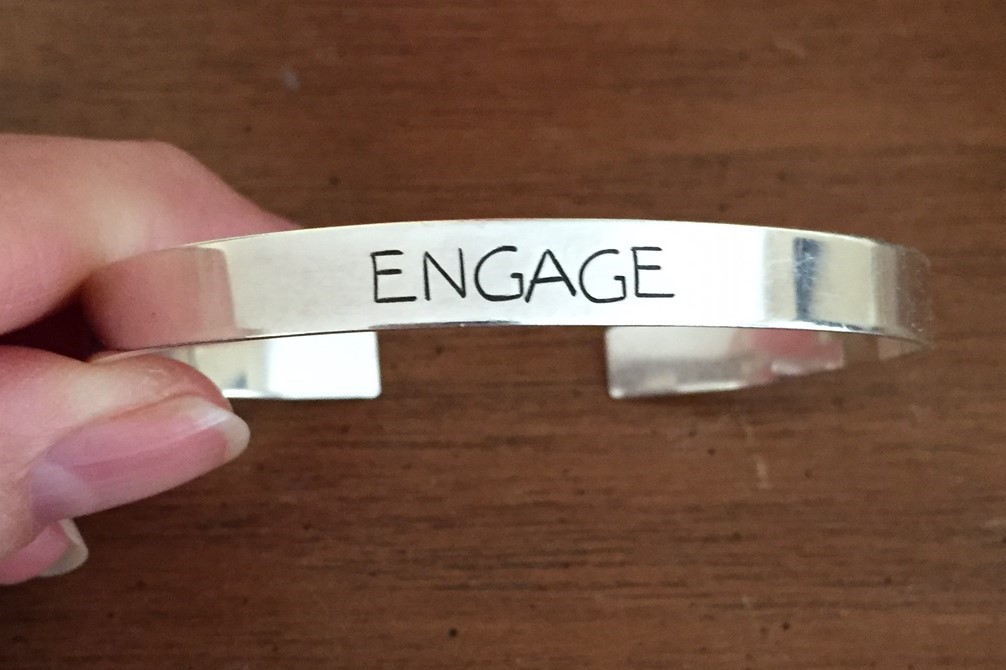
Our intentions are what help us stay on track as we go through the year and make choices. Last year, my intention was to engage. I ordered a small silver bracelet engraved with “ENGAGE.” I am a Star Trek Next Generation fan so it had an extra fun meaning; it’s what Captain Picard says when he wants the ship to get moving.

Last year, my resolution was to get out more; my goal was to create a business and personal community; and my intention was to engage. Together, the three together helped me stay on track and achieve my goal.

I have one friend whose intention was “Create More White Space.” She was feeling a little overwhelmed, and she wanted more time to relax and to be with her family. Another friend’s intention was “Create Financial Freedom.” Each time she had a choice or opportunity, her first consideration was, “Will this move me closer to financial freedom?”

One of the great things about an intention is that it’s a short-term structure to help you move ahead on a current priority. Next year, you can pick a new one! You can pick a new one each month or every six months. An intention is just a decision helper; something to remind you of what is important to you right now and what you want to achieve.

As we finish up January, it’s important to have a clear picture of where we want to go in 2017. Use resolutions, goals, and intentions to help us get there.


For a little bit of fun leadership development, join 53 Leadership Challenges at KathyStoddardTorrey.com.

Want to go further with your professional development? Check out the courses offered at PositiveEffectLeadership.com.

If you are interested in taking your career to the next level quickly, contact me for a sample coaching session at KSTorrey@tapferconsulting.com.

Dealing With Gremlins

17 Tuesday Jan 2017

Posted by Kathy Stoddard Torrey in Fresh Start, Leadership, Uncategorized

≈ Leave a comment

Tags

#FreshStart, #goals, #Gremlins, #KathySays, #perspective

gremlin-cropped

January Series: Fresh Start

Dealing With Gremlins

We all have a voice or two in our head that tell us not to do things. Those voices are our Gremlins. They say things like  “don’t try for that job! You will be so disappointed if you don’t get it” and “if you play charades, you might look foolish, and people will laugh at you.”

Our Gremlins’ job is to keep us safe, and they take it very seriously. They want us to live a life as free from pain and disappointment as possible. If we follow our Gremlins’ advice, we live a small life with few risks. We don’t take chances on life, career, or love. The less we expect or want, the less disappointment we experience.

Our Gremlins often pop up when we are setting goals. If we set an audacious, exciting goal, our Gremlins might say, “You can’t reach that goal. You will be disappointed. You should make a smaller goal.”  Remember, our Gremlins’ priority is safety, and they don’t care if their advice leads to a stagnant, boring life.

Besides, living a disappointment-free life is impossible. Things don’t always go according to plan. Even if we try our best to avoid embarrassment, we are going to goof up in public now and then. Embarrassment, disappointment, and failure are important parts of life! We learn and grow from adversity. Each unpleasant event that we overcome helps us to face the next challenge better. We need to explain this to our Gremlins.

When making goals, take your Gremlin by the hand, and lead it into another room. Say, “Thank you for trying to keep me safe. I appreciate that. However, I’ve got this.” Then leave the Gremlin alone in the room and go write some goals.

We want our goals to be attainable, but we also want them to be a bit of stretch. A great goal feels a little bit scary but exciting. A good goal will definitely make your Gremlin nervous, but you can do it!


For a little bit of fun leadership development, join 53 Leadership Challenges at KathyStoddardTorrey.com.

Want to go further with your professional development? Check out the courses offered at PositiveEffectLeadership.com.

If you are interested in taking your career to the next level quickly, contact me for a sample coaching session at KSTorrey@tapferconsulting.com.



 

Making It Real: Creative Visualization

10 Tuesday Jan 2017

Posted by Kathy Stoddard Torrey in Fresh Start, Leadership, Uncategorized

≈ Leave a comment

Tags

#goals #creattivevisualization #motivation, #KathySays

saxophone-visualization

January Series: Fresh Start

Making it Real: Creative Visualization

Creative visualization is a great way to define and check your goals. First, think of a warm light starting at your head and slowly moving down your body to your toes. As the light passes down your body, it relaxes all the muscles.

Next, take a few deep breaths. Feel a great calm and peace surrounding and supporting your body. Now picture one of your goals. Create a scene in which you’ve already achieved your goal.

For example, if you want to lose weight, picture yourself putting on an outfit that you love and that shows off how fit you are. Imagine all the activities that you enjoy now that you have attained your ideal weight. Have conversations with people you know and hear them commenting on your accomplishment.

If you want to graduate at the head of your class, see yourself taking a test and knowing all the answers. See the instructor handing back the , congratulating you on your outstanding performance. Visualize yourself standing behind the podium at graduation, giving a scintillating speech. See the reactions of the faces in the crowd.

If you want to learn to play the saxophone, see yourself wailing on one. Visualize yourself in front of a crowd at a concert. Feel the cool of the metal turn warm in your hands as your performance heats up.

You get the idea. Make your vision as detailed as possible. Include smells and sounds. Take as much time as you need. It’s important to see your goal as if it has already happened.

Everything starts out as a thought. You have to think of something before you can make it happen. You must think, “I’m going to build a birdhouse,” before you can create it. Thinking about something is the first step to creating it. Making your goals “real” in your mind is the way to begin achieving them.

A very clear vision of what we want to achieve can also help us stay motivated. When our energy level gets low and we begin to feel that we can’t go on, it’s time to pull out our visualization to remind ourselves what we are working for.


For a little bit of fun leadership development, join 53 Leadership Challenges at KathyStoddardTorrey.com.

Want to go further with your professional development? Check out the courses offered at PositiveEffectLeadership.com.

If you are interested in taking your career to the next level quickly, contact me for a sample coaching session at KSTorrey@tapferconsulting.com.
Creating Goals

03 Tuesday Jan 2017

Posted by Kathy Stoddard Torrey in Fresh Start, Uncategorized

≈ Leave a comment

Tags

#achievement, #goals, #gratitude, #HappyNewYear, #KathySays, #perspective, #progress, Heart

2017-start

January Series: Fresh Start

I love January! A new year always feels like a new beginning to me. We get to decide who we want to be and what we want to focus on this year. We also have the opportunity to leave behind traits, mindsets, behaviors, and people that don’t support our goals for the year. It’s the time to wipe the slate clean and put up nice, new, neat lettering that clearly shows who we want to be this year.

Creating Goals (a.k.a. New Year’s Resolutions)

Happy New Year! During this time, lots of us choose to make New Year’s resolutions. These resolutions are goals; things that we want to achieve. The problem with resolutions is that we tend to start strong, but our determination slowly fades. At some point, we end up asking ourselves why we didn’t stick to our resolutions.

The actual choosing part of the goal is the most important piece. The goal must resonate with our hearts. If it is not something that we truly want, then we aren’t going to put in the hard work to achieve it. We must find the Big Why for our goal and hold onto it. Here is a link to a blog I wrote on finding your Big Why: https://kathystoddardtorrey.wordpress.com/2015/01/19/goals-big-why-and-little-hows

Even if we really want to achieve a goal that resonates with our hearts, it sometimes still takes a little creativity to achieve it. Let’s say that becoming fit and lean is a goal that I really want to achieve. I know that I will feel healthier, have more energy, and keep up with my granddaughter better. However, I hate to run, and I detest crowded aerobics classes. In order to accomplish this goal, I need to get creative. Maybe I could learn a martial art or take a kickboxing class. Perhaps I could join a bike club. It could be that I just need to find a buddy to go walking with me. The key is to think creatively and find a way to accomplish the goal without forcing myself to do things I hate.

Sometimes heart goals need a dose of realism attached. For example, I am physically limited in the exercise that I can do. I had brain surgery in 2009 that resulted in a few tiny platinum coils of wire being inserted into my brain. Since the surgery, if I exercise enough to break a sweat, I become ill. I get nauseous and a little dizzy. For up to a week, I will have a rocking headache.

I must accept that I am never going to run a marathon or even a 5K, no matter how much I want to do so. Although those could be real, heart goals that resonate with me, I need to acknowledge who and where I am, and honor that.

Trust me, I went through a huge pity party when I first figured out that I’d recovered as much as I was going to recover. I wasn’t fond of my new normal at all. However, there wasn’t a way to change my limitations. I had to work with them ad adjust my goals accordingly. I can still reach my own highest level of fitness, but it requires creativity as well as some trial and error.

Since I usually work from home, I take short exercise breaks every hour or so. I use three pound weights and straps that attach to a door to do exercises throughout the day. The straps are in the bathroom so I do modified squats each time I go in there. I don’t break a sweat, so I can be dressed for the day. In addition to strength training, I try to walk 30 minutes each day. That gives my heart and lungs an extended workout at a pace that I can handle.

I do have fitness goals, but they are realistic goals that I can achieve without making myself ill. Setting goals that are challenging (and a little intimidating), but also within reach can be a difficult dance best done with a partner. A life coach or trusted friend can help you sort out dreams from pipe dreams. Spending time and energy on a goal that cannot happen is an exercise in frustration and a waste of time.

So here is our summary of how to achieve our goals:

1. Establish a goal that resonates with your heart.

2. Make sure it’s doable. It’s OK for the goal to feel scary and little out of your reach. However, do a firm reality check on it. One way to know if something is possible is to make sure you can do the actions needed to reach that goal. Make the goal achievable. I can’t run a 5K, but I could work up to walking one!

3. Get creative. We can overcome a lot of obstacles, both mental and physical, with a little creativity. If you feel stuck, a life coach is a great person to help you expand your awareness and create new possibilities.


For a little bit of fun leadership development, join 53 Leadership Challenges at KathyStoddardTorrey.com.

 Want to go further with your professional development? Check out the courses offered at PositiveEffectLeadership.com.

 If you are interested in taking your career to the next level quickly, contact me for a sample coaching session at KSTorrey@tapferconsulting.com.

Practice Excellent Self-Care

27 Tuesday Dec 2016

Posted by Kathy Stoddard Torrey in Emotional Intelligence, Leadership, Thriving Through the Holidays, Uncategorized

≈ Leave a comment

Tags

#acceptance, #Communication, #empowerment, #KathySays, #perspective, #selfcare, #ThrivingThroughTheHolidays

inner-child

Series: Thriving Through the Holidays

Skill 5: Practice excellent self-care.

Self-care is not selfishness. We need put the oxygen mask on ourselves before we can help others. We also need to recharge to avoid burn out. Self-care is a necessary piece of dealing with the stresses of life.

Self-care looks different for different people. For some it’s a massage or a pedicure. For other people, it is curling up for an hour with a good book. Self-care also can be meditation or exercise. Maybe a long, hot bath is what self-care looks like for you. Self-care is time spent with yourself that feels rejuvenating.

Of course, the other skills that we’ve discussed are also part of self-care. The goal is to reduce the number of things that are stressful and minimize our stressful reactions to everything. Being mindful, listening without judgment, visualizing our bubbles, and saying no are all things that can help us reduce stress and increase joy.

Many of us put the needs of everyone else ahead of our own. Let’s give ourselves permission to take care of us, too! I ask coaching clients to find a picture of themselves as a child, and to remember that the child is still there inside of them. I tell them to look at the picture of their young selves and ask questions like:

  • Would I let her stay up late all the time and eat bad food?
  • Would I say harsh things to him?
  • Would I not allow some time for this child to run and play?

We would all protect a child and do what is best for him or her. We need to feel comfortable doing the same for ourselves. Each of us has our childhood self inside who is depending on us!


For a little bit of fun leadership development, join 53 Leadership Challenges at KathyStoddardTorrey.com.

Want to go further with your professional development? Check out the courses offered at PositiveEffectLeadership.com.

If you are interested in taking your career to the next level quickly, contact me for a sample coaching session at KSTorrey@tapferconsulting.com.

20 Tuesday Dec 2016

Posted by Kathy Stoddard Torrey in Leadership, Thriving Through the Holidays, Uncategorized

≈ Leave a comment

Tags

#Boundaries, #Communication, #KathySays, #LeadershipRules, PositiveEffectLeadership, relationships

say-no

Thriving Through the Holidays

Skill 4: Say no.

It’s one thing to put up with feisty family members every now and again. It’s another thing to allow truly negative people who do not share your values to be in your life. It’s about setting boundaries which can take some courage.

Generally, the people that create a need for boundaries are not people who are easy to get along with in the first place. These people tend to over-react to things, and setting boundaries is sure to elicit a loud protest in response. Be strong, firm, and calm inside your bubble. If Cousin Gilbert insists on making racist comments, ask him to stop. If he doesn’t, you have every right to leave. You can’t make him behave himself, but you can remove yourself from situations that are in direct violation of your values. Often, the rest of the group will step in and help if they see your resolve.

The same situation at work is a little different. You can’t leave work. Well, you can, but you need to plan for it. Don’t just storm out. In the meantime, there are protections in the workplace to ensure that we act respectfully toward one another. It’s your call whether you tolerate negative behaviors or not. The first step is to tell the offending person that his or her comments are inappropriate. If nothing changes, the next step is a discussion with your supervisor if you are comfortable talking to him or her. The final step is talking with someone in your Human Resources department. They know the seriousness of harassment in the workplace.

We can also say no to some of the holiday hoopla that makes us feel frantic. Are there holiday activities that you can eliminate? Are there decorations that can stay in the box this year? Are there holiday parties and cookie exchanges that you can skip? If the activity brings you joy, keep it! If the activity brings on a feeling of dread, then it’s probably one that you can get rid of this year. Don’t get caught up in the “shoulds” of the holiday season. Do it if you want. Don’t do it if it doesn’t appeal to you.

It’s important to know that you can say no to people, activities, and behaviors. We all have a right to live a life free of harassment and insult. The world is a brighter place when we remove people who aggressively disrespect our values. We also have the right to do only the things that bring us joy. Simplifying the holidays by saying no can be very freeing!


For a little bit of fun leadership development, join 53 Leadership Challenges at KathyStoddardTorrey.com.

Want to go further with your professional development? Check out the courses offered at PositiveEffectLeadership.com.

If you are interested in taking your career to the next level quickly, contact me for a sample coaching session at KSTorrey@tapferconsulting.com.

← Older posts
Newer posts →

Follow Blog via Email

Enter your email address to follow this blog and receive notifications of new posts by email.

Join 214 other subscribers
  • RSS - Posts

Categories

Archives

  • December 2020
  • November 2020
  • October 2020
  • September 2020
  • August 2020
  • July 2020
  • June 2020
  • May 2020
  • April 2020
  • March 2020
  • February 2020
  • January 2020
  • December 2019
  • November 2019
  • October 2019
  • September 2019
  • August 2019
  • July 2019
  • June 2019
  • May 2019
  • April 2019
  • March 2019
  • February 2019
  • January 2019
  • December 2018
  • November 2018
  • October 2018
  • September 2018
  • August 2018
  • July 2018
  • June 2018
  • May 2018
  • April 2018
  • March 2018
  • February 2018
  • January 2018
  • December 2017
  • November 2017
  • October 2017
  • September 2017
  • August 2017
  • July 2017
  • June 2017
  • May 2017
  • April 2017
  • March 2017
  • February 2017
  • January 2017
  • December 2016
  • November 2016
  • October 2016
  • May 2015
  • April 2015
  • March 2015
  • February 2015
  • January 2015
  • February 2014
  • January 2014

Powered by WordPress.com.