• About

Kathy Stoddard Torrey

~ Leadership Coach and Trainer

Kathy Stoddard Torrey

Tag Archives: relationships

Psychological Safety: Foundation of Trust

16 Tuesday Jan 2018

Posted by Kathy Stoddard Torrey in Psychological Safety, Uncategorized

≈ 2 Comments

Tags

#FiveDysfunctionsofaTeam, #LeadershipRules, #psychologicalsafety, #trust, relationships

psych safety trust 550 px

Psychological safety is the topic that I am dissecting in 2018, and I’m taking it in very small steps because it is a very complex concept. If it doesn’t make sense to you yet, hang in there! All will be revealed.

So far I’ve defined psychological safety here and talked about noticing it in my personal life here. When I’m playing around with a new topic, I like to look at the personal applications first. For me, those are easiest to see and grasp because I’m analyzing familiar situations and people.

However, the concept of psychological safety comes from a study of work teams done by Google called Project Aristotle. Some of Google’s teams were doing better than others, and after years of research they discovered that psychological safety was the main component of the high-performing teams.

Of course, I’ve come across many places that lack psychological safety in my years as a leadership trainer. Unfortunately, I haven’t seen many organizations or teams with psychological safety, which is why this concept intrigues me. It’s obviously not easy to create, or everyone would be doing it.

The best example I’ve seen is in a fictional workplace described in The Five Dysfunctions of a Team. The book is in story format and worth looking at as a positive model for creating psychological safety. I highly suggest reading it. It’s been one of the books in my leadership series for a decade.

In the story, Kathryn comes in as CEO of a floundering business. We meet her team at a series of meetings that Kathryn leads. The book never uses the term “psychological safety,” but it is exactly what Kathryn is creating. She encourages disagreement with respect. She calls out one sarcastic team member on her eye rolls at other people’s comments. She creates a safe environment for people to speak their minds and teaches them how to do it in a professional way.

Here is a diagram of the five dysfunctions of a team.

five_dysfunctions pyramid

We will talk about the entire pyramid as we go along, but let’s just look at the foundation first. The success of a highly functioning team is dependent on trust. That makes sense. I don’t feel free to share my ideas with you unless I trust you to listen with an open mind. I must also trust that you won’t belittle me or plot behind my back. A team cannot function well if team members aren’t sharing information and working to achieve team and organizational goals.

There are entire books about trust. It’s also a complex concept. Let’s start simply. First, I don’t trust you if you don’t trust me. Ok, that sounds simple, but it isn’t really. Can you see the chicken and the egg problem that we face? I must trust you before you will trust me. However, I don’t want to trust you until you trust me. Ack!

Fortunately for us all, we humans generally extend a small level of trust to someone when we first meet them. We then have an opportunity to build that trust or destroy it. Creating and maintaining a high level of trust is a difficult thing to do. I trust people who are dependable, who do what they say, who respond reasonably, and who don’t make me feel small or stupid. The people I trust most are consistently reasonable and kind – which doesn’t mean that they must be pushovers. A person can give me developmental feedback that strengthens our relationship if it is done with respect and kindness.

So, if we are all consistently respectful and kind, we can create psychological safety – and maybe world peace. Sounds easy. It would be easy if we weren’t dealing with other humans who have their own fears, beliefs, and bad days. Easier still if we didn’t have our own fears, beliefs, and bad days.

Humans! Our humanity and flaws can really get in the way of creating trust and psychological safety. In my experience, our egos and the need to be right are two of our biggest stumbling blocks to consistent respect and kindness.

So, that’s enough for this week. We know that psychological safety is dependent on trust. The Five Dysfunctions of a Team is an excellent model for creating trust and psychological safety. If those topics interest you, I’d recommend reading the book. It’s a quick read, and we will be discussing it further.

As you go out in the world, analyzing your level of trust is a good exercise. When you interact with people at home, work, or during your volunteer activities, ask yourself if you trust them. Then ask why or why not. What specific behaviors have they done that build or destroy trust? It’s also a good idea to assess whether you believe people trust you. Do they feel free to share ideas and failures with you? What actions have you done that would make those people trust you more or less?

We are defining the first foundational pieces of creating psychological safety. I can hear you thinking, “Some people are not trustworthy, and I could never have psychological safety around them.” I hear it all the time in workshops. One step at a time! First we raise awareness, and then we decide what to do about it. Patience, Padawan! We will get there. And patience is also a trait we are going to need to create psychological safety.

If you are interested in taking your career to the next level quickly, contact me for a sample coaching session at KSTorrey@tapferconsulting.com.


For a little bit of fun leadership development, join 53 Leadership Challenges at KathyStoddardTorrey.com.

Want to go further with your professional development? Check out the courses offered at PositiveEffectLeadership.com.

If you are interested in taking your career to the next level quickly, contact me for a sample coaching session at KSTorrey@tapferconsulting.com.

Psychological Safety: My Focus for 2018

02 Tuesday Jan 2018

Posted by Kathy Stoddard Torrey in Psychological Safety, Uncategorized

≈ 8 Comments

Tags

#2018focus, #Google, #LeadershipRules, #powerofgroupnorms, #ProjectAristotle, #psychologicalsafety, relationships

psych safety intro 600 px

At the beginning of each year, I pick one concept or behavior on which to focus. One year I explored and practiced the various pieces and parts of emotional intelligence. Another year I examined compassion and encouragement. This year it is psychological safety. Frankly, as I look back over my life, I have failed at this one in many ways.

I talk about behavior that creates psychological safety in my leadership workshops and writing but have never named it as the reason for the behavior. However, the concept is one that it took Google three years to pin down, so I don’t feel too bad about not seeing it clearly. I am proud that if you take my online class called Boot Camp for New (and Lightly-Trained) Supervisors and do what it says, you create psychological safety for you and your employees without knowing its name.

So, what is psychological safety? Psychological safety exists in a relationship when the people in the relationship feel free to say what’s on their minds or make a mistake. No one fears angry yelling, being made fun of, or people saying mean things behind their backs. There may be consequences for a mistake or an action, but there is no punishment for speaking your mind or taking a risk. The essence of psychological safety for me is the phrase “feels free.”

I first got the name, the handle for this thing, from a friend of mine named George. George is an old PR guy who does an amazing job of keeping up with the current world. He read an article about  Project Aristotle, which is a massive research project done by Google, and insisted that I read it.

Google had studied management and managers and had a list of successful characteristics of leaders, but still there were some teams that outperformed others. Now, everyone at Google is smart and motivated, so you would think that all the teams would do equally well. However, some teams definitely did much better than others, so they decided to figure out why.

It took three years for the research team to figure it out. Their first discovery was that the best teams’ success had something to do with group norms. Then, they worked to determine the exact group norms. In the end, they found that the groups with the highest performance were the ones that had psychological safety.

The leaders of the exceptional groups created an atmosphere of openness and acceptance. The members of the team felt that they could disagree and not be punished for it. An honest disagreement and discussion were acceptable – even encouraged. Taking intelligent risks was also encouraged. The team could try innovative ideas without fear of being belittled or punished.

I see a lack of psychological safety in lots of relationships outside work. I hear people talking all the time about not telling a spouse about a purchase or mistake because they don’t want the hassle of their partner questioning them and making them feel bad. When anyone feels they must hide things or keep secrets for fear of reprisal, there is no psychological safety. I believe most of us feel that way in at least one or two relationships in our lives. The more important the relationship, the more psychological safety is needed.

I, for one, am tired of hiding who I am, what I think, and what I do. This year, I plan to master the communication and leadership skills needed to ensure that I and everyone who I am in a relationship with don’t feel those needs. I think exploring and mastering the creation of psychological safety could be a turning point for me in my life.

I am so grateful to my friend George for insisting that I read the Project Aristotle research. It’s a new lens through which I am choosing to view life. You are welcome to join me – or not. No repercussions here, only psychological safety.


For a little bit of fun leadership development, join 53 Leadership Challenges at KathyStoddardTorrey.com.

Want to go further with your professional development? Check out the courses offered at PositiveEffectLeadership.com.

If you are interested in taking your career to the next level quickly, contact me for a sample coaching session at KSTorrey@tapferconsulting.com.

Effective Conflict: Listening Creates Solutions

19 Tuesday Sep 2017

Posted by Kathy Stoddard Torrey in Effective Conflict, Uncategorized

≈ Leave a comment

Tags

#effectiveconflict #conflictresolution #positive disagreements, #listenfully, relationships

listening fully 550 px

Sometimes I help groups that are stuck in disagreement find solutions. When we meet, every person who walks in the door has the problem in one pocket and the solution in the other pocket. They are all completely certain that their view of the situation are clear and correct. They also believe that they have determined the correct solution using the best criteria.

What’s fascinating is that each person has his or her own definition of the problem that is rarely the same as anyone else’s. The solutions they bring are different, and the standards used to judge those solutions’ correctness often vary wildly.

Of course, they don’t know all that when they walk in. They’ve been arguing but not listening. They may know each other’s solutions, but they rarely have figured out why each person believes that their solution is best. They have been arguing positions without asking questions or truly listening.

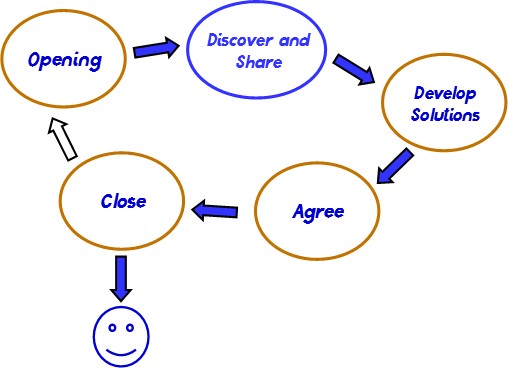
The best illustration of what is missing from the discussion is the Conversation Outline that I’ve talked about before (https://kathystoddardtorrey.wordpress.com/2017/08/15/lets-talk-conversation-outline).

Conversation outline 4

When in conflict, we usually jump from Opening to Develop Solutions. It amounts to saying, “Let’s talk about the new procedure” and then each person insisting that his or her way is the right way. This chain of events damages relationships and doesn’t increase the chances of the group agreeing to anything other than the fact that they don’t like each other.

The Listen and Share stage is often skipped, and it is where the biggest picture of the problem is discovered. Let’s say that a team must decide on a vendor to use for a new project. One person believes that the most reliable vendor is the one to choose. Another thinks that the lowest-cost vendor is the best choice. Another person might say that they should stick with the one that they have now with whom they’ve built a relationship. One team member thinks they should give a brand new and promising vendor an opportunity.

Each person is using reasonable criteria for his or her decision. In the Listen and Share stage, the group stops to figure out what those criteria are – they listen for understanding. In the process, they acquire a complete view of the situation. In essence, they pull the problems and solutions out of their pockets and lay them all out on the table. Then they examine them one by one without trying to convince each other of anything. The discussion is truly sharing and listening – not arguing or convincing.

During the Listen and Share stage, it’s important that everyone stays curious. They would ask questions like, “Why do you think reliability is more important that cost?” and “What advantages do you think the new vendor would bring?”

Here is an important side note: authentic curiosity is imperative! You can ask the questions above with a sarcastic or snide tone and ruin the relationship and the discussion. It can be difficult to put our egos aside and listen to other people’s ideas, but listening and curiosity are the keys to great solutions. If you are having a hard time, remember that maintaining a positive relationship with others is key in getting to your desired outcome. No one likes to “give in” to someone who is mean to them.

After I have guided a group through the discussion process, they come up with a better solution than any one person brought through the door. It’s a better solution because it’s been created by many different brains and perspectives. We take the collective knowledge of the group and then use their collective brain power to decide on the best course of action for the group or organization. It is a fabulous process to watch.

There may be a person or two who won’t let go of a solution because it helps them the most or just because they’ve let their egos get the best of them. Those people who put their own needs above the needs of others and the organization benefit from coaching conversations with their leaders.

Once a person has taken a strong position, it can be difficult to change because it feels like defeat. It’s important for the group to accept a person’s change in position gracefully and never do the “I told you so” dance or say, “I knew you’d come around to the right way of thinking.” Not cool.

For the most part, after a facilitated discussion, there is more understanding and less animosity – and the decision is a good one that the group feels confident about. You can achieve those same results by focusing on the Listen and Share stage of the conversation outline. Ensuring that every person’s perspective is heard and understood makes finding a solution much, much easier.


For a little bit of fun leadership development, join 53 Leadership Challenges at KathyStoddardTorrey.com.

Want to go further with your professional development? Check out the courses offered at PositiveEffectLeadership.com.

If you are interested in taking your career to the next level quickly, contact me for a sample coaching session at KSTorrey@tapferconsulting.com.

Kathy’s Bloom and Flourish Model: Positivity Spiral

23 Tuesday May 2017

Posted by Kathy Stoddard Torrey in Bloom and Flourish, Positivity, Uncategorized

≈ Leave a comment

Tags

#BloomandFlourish, #gratitudejournal, #LovingKindness, #morningritual, #positivityspiral, Mindfulness, relationships

positivity spiral 550 px

Kathy’s Bloom and Flourish Model

  1. Peaceful Base
  2. Physical Health
  3. Positivity Spiral
  4. Flow/Accomplishment/Meaning
  5. Positive Relationships
  6. Spiritual Connectedness
  7. Financial Stability

Creating and increasing positivity is something I talk about all the time because I believe it holds the key to a life worth living. Studies show that great leaders have positive attitudes and that we are more attractive when we are positive; people like being around positive individuals.

However, like most things that are worth having, you have to work for it. Happiness, joy, and positivity don’t just land in your lap. At least they don’t land in mine! Those positive feelings are things I create and keep alive with daily, intentional thoughts and actions.

Our human brains are hardwired to notice problems and potential danger. We are more likely to pay attention to negative events than positive ones. We also hold on to negative events longer and with more intensity. When we are creating positivity, we are retraining our brains. We are intentionally choosing what we notice, think, and remember.

Mindfulness is being fully present in the moment. It helps us focus on what we want. Mindfulness is great training for our brains. You can eat, walk, breathe, and meditate mindfully. If you are completely focused on what you are doing and experiencing, your mind doesn’t have a chance to chatter and spin.

Mindfulness gives your brain a mini-vacation and can leave you feeling refreshed. Instead of walking or running with headphones, listen to the sounds around you. Intentionally focus on the feel of your foot as it touches the ground. Feel the air coming in your nose and filling your lungs. Which muscles are you using? Embrace the feeling of moving strong muscles. You don’t have to exercise mindfully every time, but it’s a nice change of pace and good exercise for your brain. You learn to focus intentionally instead of being at the mercy of a gerbil brain running on its wheel.

Another good brain-training activity that has lots of great research behind it is meditation. A good start is a mindful meditation; focus on your breath and the feelings in your body as you meditate. There are mindful meditations online that you can download and use.

The type of meditation that gives the most positive results is a Loving Kindness Meditation. In a Loving Kindness Meditation, you are asking for love, health, abundance, and happiness for yourself and others. After a few weeks of doing a Loving Kindness Meditation daily for only 10 minutes, you can:

  • Increase your empathy and compassion for others.
  • Decrease inflammation in your body.
  • Become more resilient.
  • Increase your resistance to viruses.
  • Generate positive emotions.
  • Be more creative.
  • Broaden your awareness to see the big picture.

Wow! That’s a lot of great stuff from an investment of 10 minutes a day! You can find guidelines online for Loving Kindness Meditations. Sometimes people have a negative feeling about the word “meditation,” because they feel that it has connotations of Eastern Religions. For me, “meditation” is a time of spiritual connection to your higher power. There are Christian Loving Kindness Meditations if that resonates with you. In my mind, I am asking for grace and blessings for myself and others when I do a Loving Kindness Meditation.

The most important part of the Loving Kindness Meditation is the creation of feelings of love, empathy, and expansiveness. As you begin, think of people and situations that make you feel warm and fuzzy. Find your happy place! I think of the feeling that I get when my granddaughter gives me a sloppy baby kiss, and how I felt when my boys would put their arms up to me when they were very young. I think of how it feels to hug the people I love and hold them close.

Figure out what evokes warm feelings of love for you. Maybe it’s holding a pet or sitting at a beach with your toes in the water. It could be the feeling of sunshine on your body or the strong healthy feeling you get when running or walking. Nature brings many people the feeling of expansiveness and joy. Experiment until you find the mental picture that creates a feeling of joy for you.

Once you can do this prep for the Loving Kindness Meditation, you can create joy on demand! Woot! Whenever you are feeling low or upset, you can take a deep breath and go to your happy place and create positive emotions. That. Is. Huge!

Once you have strong positive feelings, say three or four phrases about yourself. The specific words are not important. Use ones that resonate with you, but they will be something like this:

  • May I be filled with loving kindness.
  • May I be well in body and mind.
  • May I be at ease and happy.

The most important part of the meditation is to create and hold onto a feeling of friendliness, compassion, joy, and expansiveness as you say the phrases.

Then say the same phrases while thinking of someone with whom you feel close.  Think, “May you be filled with loving kindness.” It’s important to hold onto the positive feeling while thinking the phrases each time. It’s not too hard to say the phrases with feeling when it’s toward someone that you are fond of.

Next, move on to someone who you feel neutral about, someone you don’t really care for, and finally everyone in the world. Use the same three to four phrases each time, and focus on maintaining the feeling of compassion and acceptance.

It’s hard in the beginning to hold on to feelings of warmth and joy when you think of someone with whom you are angry or upset, but you can do it! It gets easier over time. You are training your brain and taking control of your emotions. In essence, you are gaining the ability to be positive whenever you choose.

If you have a hard time getting into a place of loving kindness, it might help to create a Positivity Portfolio, which is a collection of physical or digital pictures that make you smile. For example, I can look at a picture of my granddaughter and immediately feel love, compassion, and kindness toward her. After a while, I don’t need to see the picture; I can see it in my head and create the feeling.

A collection of pictures that you can flip through when you are feeling low or angry can be a huge help in bringing up positive emotions that seem elusive. I have an album on my phone of pictures that make me smile. I look at them when I need a dose of positivity.

The next tool to create more positivity in your life is a gratitude journal. Each evening, write down three things for which you are grateful. As you write down the thing or event, recreate the feeling that it brought to you. Name the emotion if you can.

My mom kept a gratitude journal for years, and it’s a great legacy. She lived with me and my family for 10 years. My youngest son Andrew would go straight down to her room every morning when he woke up. I could hear the swish-swish of his diaper as he passed my bedroom door.

Mom read each morning, and when Andrew arrived she would read aloud to him. It took at least a year, but they read Moby Dick together! I find that amazing. I have tried to read Moby Dick several times and haven’t managed to get through it. They also read Adventures of Huckleberry Finn together. After they read a scene about Huck sneaking into a smokehouse to steal some ham, they decided to sneak upstairs and steal some ham out of the refrigerator.

Of course, it sounded like a herd of elephants shushing each other as they came up the stairs. I stayed out of their way while they “stole” some ham and giggled their way downstairs. That evening, one of Mom’s gratitude journal entries was “Stealing ham with Andrew.” I read it when I went through her gratitude journal after she died. Her journal was full of wonderful memories that helped her stay positive when she was alive and brought me joy when she was gone.

After you write three things in your gratitude journal, take a moment to remember a few of the positive interactions that you had with others during the day. It doesn’t have to be an interaction with people that you know; it could be a pleasant conversation with a cashier as you checked out at the grocery store. We want to remember any micro-moment of positive interaction. Think of a few interactions and the emotions that you experienced. It will just take a minute or two, but it will increase your positivity and capacity to connect with others in a positive way, according to research by Dr. Barbara Fredrickson.

My mom was one of the most positive people that I have ever met. She was ahead of her time with writing in her gratitude journal each evening. She also began her mornings in a positive way. She read classics with Andrew when he was little, but she also read uplifting books in the morning. She would get up early and fix some tea. Then she would read something that put her in a positive frame of mind. It could be scripture or a devotional. One of her favorite books that she read over and over was Simple Abundance by Sarah Ban Breathnach. She was always telling me what “Sarah Ban” said. Mom even wrote Ms. Breathnach a letter telling her how much joy the book had given her, and Ms. Breathnach replied with a letter. I have copies of both.

All of the things that we’ve talked about help us overcome our natural negativity bias and create a Positivity Spiral. We do a Loving Kindness Meditation that increases our feelings of empathy and compassion for others – which increases our positive interactions with others – which increases the number of positive things we notice and are grateful for – which makes it easier to do the Loving Kindness Meditation. Each action supports the next until we have created an upward spiral of self-generating positive emotions. Woot!

Here is a summary of things to do to create your own self-sustaining Positivity Spiral:

  1. Practice mindfulness. Start with paying attention to one deep breath when stopped at traffic lights.
  2. Do the Loving Kindness Meditation for 10 minutes at least five times a week, and you will begin to feel lighter and more resilient. Big results come after eight weeks of consistent practice.
  3. Keep a gratitude journal. Write down three things each evening for which you are grateful.
  4. Take a minute each evening to reflect on the micro-moments of positive interaction that you had with other people that day.
  5. Feed your brain and heart uplifting messages. Create a morning ritual of reading something that makes you feel positive.

My last suggestion is to do one thing you enjoy each day! Even if you only spend five to ten minutes doing it, it will be worthwhile. Read a trashy novel, knit, draw, flip through a magazine, or write – whatever makes you happy! We all deserve an intentional moment of enjoyment. It’s one more thing that makes life worth living.


For a little bit of fun leadership development, join 53 Leadership Challenges at KathyStoddardTorrey.com.

Want to go further with your professional development? Check out the courses offered at PositiveEffectLeadership.com.

If you are interested in taking your career to the next level quickly, contact me for a sample coaching session at KSTorrey@tapferconsulting.com.

Becoming the Wise and Powerful You

28 Tuesday Mar 2017

Posted by Kathy Stoddard Torrey in Leadership, Uncategorized, Uncovering Your Authentic Self

≈ Leave a comment

Tags

#AuthenticSelf, #beliefs, #experiences, #FrameofReference, #FutureSelfVisualization, #goals, #IdealSelf, #NowSelf, #priorities, #superpowers, #WheelofLife, relationships, values

wise powerful self

March Series: Uncovering Your Authentic Self

Becoming the Wise and Powerful You

Last week, we created the lists below. If you didn’t do the exercises, then take some time now to get to know yourself better.

  1. Things I enjoy doing
  2. Things I do not like to do
  3. My superpowers
  4. Characteristics I want to minimize
  5. Values my ideal self holds dear
  6. My ideal self’s priorities right now
  7. Beliefs that support my ideal self
  8. Beliefs that I hold now for which my ideal self has no use
  9. One category on the Wheel of Life that I want to improve in order to help me become my ideal self
  10. Possible careers/jobs that my ideal self would love

Let’s start with a visualization. Keeping everything in mind that you have learned about yourself, picture your Ideal Self going through a day. What time do you get up? What’s the first thing that you do? What sort of clothes are you wearing? What does your house look like? Who are the people that you talk with on a normal day? Include all five senses in your visualization. What smells surround you?

If you would like to listen to a guided visualization, I have one under the “Free Stuff” tab on my website. (http://www.tapferconsulting.com/free-stuff/) It’s called “Future Self Visualization.”

Now, we are searching for gaps between your Now Self and your Ideal Self. The Wheel of Life gives us a good structure for analysis. (If you haven’t already, you can download the Wheel of Life here: http://www.tapferconsulting.com/free-stuff/) There are eight categories to consider: Family, Physical Environment, Fun and Friends, Personal Growth, Money, Health, Significant Other/Romance, and Career. In which category is the biggest gap between your Now Self and your Ideal Self? Where could you get the biggest bang for your buck if you invested some time and energy in improving an area?

It could be that you are really bothered by your physical environment at home. The solution to your annoyance could be simplifying and organizing. However, if you live in a tiny apartment and want to up-size, then that requires more money. Would it be best to focus on the Money category or the Career category?

Your analysis is going to be highly individualized, but let’s follow through with this example. Let’s say that my family and I are very crowded in our current house, and we want to move into a bigger place. Bigger places are more expensive, and we can’t afford it right now.

Would it be best for me to focus on money or career? If I focus on money, then I could learn how to invest or get a second job. Maybe we could all reduce spending so that we could put more towards a bigger place. That’s one option.

Perhaps a better option is to focus on my career. What could I do to get a promotion? Is a career change in order? If I learn how to write computer code, would I earn more money and get to work from home some of the time?

Now, it’s time to check those options against my vision of my Ideal Self. What would my Ideal Self do? How would she handle the situation? What actions will help me move toward my ultimate life goals at retirement or end-of-work?

Now, I want to look at the options in terms of values and priorities. Which options are in alignment with my stated goals and priorities? If family was my top priority, then it might not make sense to get a second job and spend less time with them.

I also want to look at how I can best use my superpowers. Where do I have an advantage because of a superpower? How can use what I am naturally good at to my advantage. I learn things quickly and am very logical in my thinking. I’m also good at staying on track and finishing things. Learning to code computer software is looking like a good option.

Now, I want to look at my beliefs about the world and myself. Which ones will support me and which ones will hinder me? What new ones can I create to help me? We can change our habitual thinking by replacing one thought with another. We can also create new beliefs. One way is to put sticky notes with the new belief in prominent places. Another way is to practice my game of “Cancel That Order.” I wrote about it for Day 9 of my 53 Leadership Challenges, and I’ve put a pdf that you can download here: http://www.tapferconsulting.com/free-stuff/

Use the same steps to analyze your Wheel of Life and create goals. Maybe you feel lonely and want to focus on the category of Fun and Friends – or maybe Significant Other/Romance! Perhaps you feel a spiritual emptiness and want grow your faith. Your path could be through the Personal Growth category or finding a spiritual community in Fun and Friends. Find the gap between your Now Self and Ideal Self and then dig down to the root.

Here is a step-by-step guide:

  1. Look at your Wheel of Life. Dig down to the root cause of the gap. For example, I am not happy with my Physical Environment, but I need to focus on Career to change it.
  2. Ask yourself which options and actions are most aligned with your values and priorities.
  3. Which options allow you to leverage your superpowers? We don’t call them superpowers for nothing! Your superpowers are things that you naturally do well. They are things you do better than most other people. Use them to your advantage!
  4. Determine what beliefs will support you and which ones are holding you back. If you hear yourself saying something like, “Oh, I will never be able to do that,” then you’ve got a limiting belief lurking somewhere. Pick a belief that will help you and post it everywhere. It could be a simple as “God has a plan for me” or “Everything will turn out for the highest good of all.” In my example, I would use “I am a fabulous coder!”

Analyzing yourself and your life is a difficult thing. Creating goals is another challenge. The behavior change required to reach your goals is one of the hardest things to do. Get help! Hire a coach, create a group with supportive friends, or enlist your family’s help.

You are solving the unique puzzle of you. There aren’t any right or wrong answers. Give something a try! If it doesn’t work out, then try something else! Unfortunately, none of us come with an owner’s manual that tells us exactly what to do. In truth, that’s a good thing. Life is about discovery, change, and growth. Some of the best moments come from the revelation of ourselves to ourselves.


For a little bit of fun leadership development, join 53 Leadership Challenges at KathyStoddardTorrey.com.

Want to go further with your professional development? Check out the courses offered at PositiveEffectLeadership.com.

If you are interested in taking your career to the next level quickly, contact me for a sample coaching session at KSTorrey@tapferconsulting.com.

You’re OK, too!

21 Tuesday Feb 2017

Posted by Kathy Stoddard Torrey in Feelings, Leadership, Uncategorized

≈ Leave a comment

Tags

#KathySays, #OtherCompassion, #peoplearepeople, #personalgrowth, #resiliency, Feelings, Positivity, relationships

other-compassion

February Series: Feelings

You’re OK, too!

Let’s end this series on feelings by talking about our feelings for others. I’m going to tell you that it’s worthwhile to cultivate positive feelings towards others, and I imagine your initial response will be that there are some people for whom you will never have positive feelings. I’ve had this conversation before!

I know that there are annoying and obnoxious people out there. Some don’t seem to have any morals or common sense. It feels like a lot of work NOT to dislike those people! I get it. I’ve been there. I am there! However, I want you to know that it is worth the effort – for you.

It’s difficult to hold the heavy lens of negativity and not have it affect your life. It’s next to impossible to hold it up some of the time and drop it other times. If we look through a negative lens at some people, we probably will use it to look at all people. We begin a cycle of negativity in which we expect to see negative behaviors, provoke them by our expectation, and then feel satisfied and right when others behave in the negative way that we predicted. It’s a messy quagmire, and it’s exhausting.

On the other hand, a spiral of positivity is an uplifting and energizing cycle to create. There are other benefits as well that include increased resiliency, increased satisfaction with life, less inflammation in your body, increased broad-mindedness (our brain actually processes information differently), increased immunity to viruses, better ability to connect with others, less depression, and better focus. Wow! That’s quite a list!

OK, so positivity is a great thing and feeling empathy and kindness towards other is going to help us achieve it. How do we go about creating it? There are some obnoxious, annoying, dishonest, selfish, callous, infuriating, tactless people out there! Ack! Take a breath and read on.

In my leadership series, I begin with a book called Leadership and Self-Deception. I highly recommend it. In a nutshell, the book promotes the idea that all personnel and personal issues are caused by one thing: we don’t see other people as people.

Here is an example from the book:  Imagine that you are sitting on an airplane next to the window, and it is open seating. No one has an assigned seat. The middle seat is open. Do you put your bag in the middle seat and try to discourage people from sitting there even though the flight attendant has announced that the flight is full. Do you judge each person by how much of an inconvenience that they will be? Does one look too chatty? Another have too many bags?

In that moment, are you seeing the other passengers walking down the aisle as people like you who have a need to sit down or as annoying objects that threaten to invade your personal space? How would you feel as a person walking down the aisle?

The book explains that theory in detail, but basically, we want to see everyone around us, even the obnoxious ones, as people. Of course, that doesn’t mean that we have to put up with unethical behavior or disrespect. It means that we set boundaries and give feedback in a compassionate and kind way.

We talked about self-compassion in last week’s blog (https://kathystoddardtorrey.wordpress.com/2017/02/14/im-ok-of-course/), and this week, we are talking about practicing “other-compassion.” It’s a new term that I just made up! The key is to see everyone as having needs and dreams equal to your own. We want to treat them the way that we want to be treated. Sound familiar?

I continue to work on seeing other people as people. When I begin to slip by magnifying someone’s faults and objectifying them, I repeat to myself, “This is a person with worries and dreams equal to my own.”

There is another way to develop empathy for others that has some impressive research behind it. Loving Kindness Meditation, increases positivity with all the benefits mentioned earlier. It also increases our empathy for others and our feelings of friendliness and compassion.

There are no right or wrong ways to do it; there are just guidelines. You can search online and find all types of Loving Kindness Meditations. You can listen to on or create statements to use in the meditation that have the most power and meaning for you.

Basically, during the Loving Kindness Meditation, we say three or four phrases several times. The first time we say the phrases, we say them to ourselves. The most important part of the meditation is to create and hold onto a feeling of friendliness, compassion, joy, and expansiveness as you say the phrases. Here is an example:

  • May I be filled with loving kindness.
  • May I be well in body and mind.
  • May I be at ease and happy.

Then we say the same phrases while thinking of someone with whom we feel close.  We would think, “May you be filled with loving kindness.” It’s important to hold onto the positive feeling while thinking the phrases each time. It’s not too hard to say the phrases with feeling when it’s toward someone that we you are fond of.

Next, we move on to someone who we feel neutral about, someone we don’t really care for, and finally everyone in the world. Use the same three to four phrases each time, and focus on maintaining the feeling of compassion and acceptance.

This practice can be a game changer in your life. You can see results by meditating for 10 minutes about 5 or 6 times a week. Who wants more resiliency when facing challenges and more satisfaction with life? I do, I do! For me, resiliency is one of the biggest benefits of Loving Kindness Meditation. The world is full of challenges, and I welcome the grit that will help me to overcome them.

The goal is to incorporate Loving Kindness Meditation into your life for eight weeks. By then, you should see results that will motivate you to use the meditation for the rest of your life.

In the end, we win when we develop feelings of friendliness and compassion for others. We get to put down the heavy lens of negativity. We begin to see the positive things around us and expect more of them. We create a self-supporting cycle of positivity that improves our “other-compassion,” our own health, and our emotional well-being.


For a little bit of fun leadership development, join 53 Leadership Challenges at KathyStoddardTorrey.com.

Want to go further with your professional development? Check out the courses offered at PositiveEffectLeadership.com.

If you are interested in taking your career to the next level quickly, contact me for a sample coaching session at KSTorrey@tapferconsulting.com.

20 Tuesday Dec 2016

Posted by Kathy Stoddard Torrey in Leadership, Thriving Through the Holidays, Uncategorized

≈ Leave a comment

Tags

#Boundaries, #Communication, #KathySays, #LeadershipRules, PositiveEffectLeadership, relationships

say-no

Thriving Through the Holidays

Skill 4: Say no.

It’s one thing to put up with feisty family members every now and again. It’s another thing to allow truly negative people who do not share your values to be in your life. It’s about setting boundaries which can take some courage.

Generally, the people that create a need for boundaries are not people who are easy to get along with in the first place. These people tend to over-react to things, and setting boundaries is sure to elicit a loud protest in response. Be strong, firm, and calm inside your bubble. If Cousin Gilbert insists on making racist comments, ask him to stop. If he doesn’t, you have every right to leave. You can’t make him behave himself, but you can remove yourself from situations that are in direct violation of your values. Often, the rest of the group will step in and help if they see your resolve.

The same situation at work is a little different. You can’t leave work. Well, you can, but you need to plan for it. Don’t just storm out. In the meantime, there are protections in the workplace to ensure that we act respectfully toward one another. It’s your call whether you tolerate negative behaviors or not. The first step is to tell the offending person that his or her comments are inappropriate. If nothing changes, the next step is a discussion with your supervisor if you are comfortable talking to him or her. The final step is talking with someone in your Human Resources department. They know the seriousness of harassment in the workplace.

We can also say no to some of the holiday hoopla that makes us feel frantic. Are there holiday activities that you can eliminate? Are there decorations that can stay in the box this year? Are there holiday parties and cookie exchanges that you can skip? If the activity brings you joy, keep it! If the activity brings on a feeling of dread, then it’s probably one that you can get rid of this year. Don’t get caught up in the “shoulds” of the holiday season. Do it if you want. Don’t do it if it doesn’t appeal to you.

It’s important to know that you can say no to people, activities, and behaviors. We all have a right to live a life free of harassment and insult. The world is a brighter place when we remove people who aggressively disrespect our values. We also have the right to do only the things that bring us joy. Simplifying the holidays by saying no can be very freeing!


For a little bit of fun leadership development, join 53 Leadership Challenges at KathyStoddardTorrey.com.

Want to go further with your professional development? Check out the courses offered at PositiveEffectLeadership.com.

If you are interested in taking your career to the next level quickly, contact me for a sample coaching session at KSTorrey@tapferconsulting.com.

Create Your Bubble

13 Tuesday Dec 2016

Posted by Kathy Stoddard Torrey in Leadership, Thriving Through the Holidays, Uncategorized

≈ Leave a comment

Tags

#Bubbles, #Communication, #KathySays, #leadership, #LeadershipRules, #Listening, #perspective, happiness, Intention, PositiveEffectLeadership, Positivity, relationships

create-your-bubble-2

Thriving Through the Holidays

Yay! We made it through Thanksgiving! We don’t have to just survive the holidays. There are skills and perspectives that can help us sail through the holidays with ease and enjoyment. Survival is not our goal. Thriving by creating and maintaining positive relationships and perspectives is what we want to strive for during the holiday season. It is so much more fun and motivating that just slogging through! Let’s make the holidays joyous!

 Skill 3: Create your bubble.

It’s easy to be influenced by the negativity of others. In fact, studies have proven that we tend to mimic the emotions of those around us. We have mirror neurons in our brain that fire automatically when we interact with others. If the other person is happy, then we feel happy. If he or she is angry, we feel angry. Our mirror neurons may fire, but it doesn’t mean that we are a slave to them. Despite the initial reaction triggered by our mirror neurons, we can choose our own emotions.

Sometimes it helps to visualize a shiny bubble around you that protects you from negative energy. Visualize yourself zipping up the front of the bubble if that helps you – like you are zipping yourself into a sleeping bag. Your bubble is a complete barrier that allows only the good and positive inside. The negative cannot get through. There are no holes, no leaks, and no soft spots. Instead of a bubble, it can be God’s love or Universal energy that surrounds you. Visualize and describe it in your mind in a way that has meaning for you.

When Uncle Seibert starts on one of his tirades, mentally zip up your bubble around yourself. Imagine all his negative words sliding past you. None of them make it past your shiny bubble because it is impervious to negativity. It’s amazing how well this works! You get to choose whether or not you let the negativity of others affect you.

If someone is on a huge rant, I imagine a mirror between us – facing him or her. I see them complaining to themselves in the mirror. It isn’t even directed at me. I hope that they can see and hear themselves spewing toxic emotions. Sometimes they slow down when they aren’t getting a reaction. It isn’t fun to rant if you can’t get the other person riled up with you.

When my children were young, I would send them off to school with a shield. Here are the words that I would say, “I am surrounding you with God’s shield of white light, love, and truth. Nothing harmful or negative can get in, only good and positive.” You can phrase it in your own way, but it’s a nice gift to give others; even Uncle Seibert could do with a bubble of his own.


For a little bit of fun leadership development, join 53 Leadership Challenges at KathyStoddardTorrey.com.

Want to go further with your professional development? Check out the courses offered at PositiveEffectLeadership.com.

If you are interested in taking your career to the next level quickly, contact me for a sample coaching session at KSTorrey@tapferconsulting.com.

Presence

08 Friday May 2015

Posted by Kathy Stoddard Torrey in Emotional Intelligence, Leadership, Mindfulness, Positivity

≈ 1 Comment

Tags

#presence, ActiveListening, leadership, Positivity, relationships

Presence

Think back to the conversations that you’ve had with other people in the last few days. In how many of those conversation did you feel that you had the complete attention of the other person? In how many did you feel fully listened to and understood? I’m betting not many. In how many of those conversations did you give your full and complete attention to the other person? Once again, I’m betting the answer is “Not many.”

The ability to be completely present with another person during a conversation is a powerful skill and a hallmark of great leaders. The goal of an outstanding leader is to create positive relationships with the people around him or her. One of the ways to build positivity is to meet people’s need to be listened to, understood, and respected.  Many times, leaders are pushed for time and listen with only one ear. I often hear participants in my leadership series complain of bosses who talk to them while facing and typing on the computer. Not being fully present during conversations is the downfall of many leaders.

It’s not surprising that we find being present in the moment so difficult. It is a skill and like any other skill it requires intentional practice. Of course, one way to practice is to practice listening well to others. In coaching, we talk about Listening Levels I, II, and III. At Listening Level I, I’m not really listening to you much at all. I’m thinking about what I want to say as soon as you stop talking and what I need to do after we finish talking. At Listening Level II, I am listening intently, but not catching all of the meaning. At Listening Level III, I am fully present and listening for understanding. I am paying attention to your words, your tone of voice, your facial expressions and your body language. I am curious about it all and ask a lot of questions. Listening Level III is required for one to be fully present.

Listening Level III requires a lot of mental discipline and the ability to focus your attention on one thing. Another way to practice those skills is with mindfulness exercises. Mindfulness is focusing on one thing or moment at a time. An easy way to begin honing your mental focus is to sit quietly and pay attention to your breath. Then pay attention to the small spaces when an inhale becomes an exhale and when an exhale becomes an inhale. Any time your mind wanders, bring it back to your breath. As with any skill, the more you practice, the better you get. Simply paying attention fully to anything that you are doing can turn it into a mindfulness exercise.

Being fully present with someone and listening to him or her at Listening Level III is a wonderful gift to both the giver and receiver. It builds positivity in the relationship and strengthens the connection between them. Being present is a powerful way to improve personal and work relationships. It’s even a great gift to give yourself.


Here’s a link to my video on Presence: https://www.youtube.com/watch?v=8auxZvRiRM4

Newer posts →

Follow Blog via Email

Enter your email address to follow this blog and receive notifications of new posts by email.

Join 214 other subscribers
  • RSS - Posts

Categories

Archives

  • December 2020
  • November 2020
  • October 2020
  • September 2020
  • August 2020
  • July 2020
  • June 2020
  • May 2020
  • April 2020
  • March 2020
  • February 2020
  • January 2020
  • December 2019
  • November 2019
  • October 2019
  • September 2019
  • August 2019
  • July 2019
  • June 2019
  • May 2019
  • April 2019
  • March 2019
  • February 2019
  • January 2019
  • December 2018
  • November 2018
  • October 2018
  • September 2018
  • August 2018
  • July 2018
  • June 2018
  • May 2018
  • April 2018
  • March 2018
  • February 2018
  • January 2018
  • December 2017
  • November 2017
  • October 2017
  • September 2017
  • August 2017
  • July 2017
  • June 2017
  • May 2017
  • April 2017
  • March 2017
  • February 2017
  • January 2017
  • December 2016
  • November 2016
  • October 2016
  • May 2015
  • April 2015
  • March 2015
  • February 2015
  • January 2015
  • February 2014
  • January 2014

Powered by WordPress.com.